At a time when India is navigating one of the most complex geopolitical environments in recent history, from counter-terror operations at home to escalating tensions in West Asia the opposition Indian National Congress finds itself grappling with an internal dilemma: how to balance political opposition with national consensus.
Recent developments surrounding the Iran-Israel-US conflict and alleged domestic concerns over fuel supply have once again brought these contradictions to the forefront. What makes this moment particularly significant is not just the criticism of the government by the Congress leadership, but the visible and vocal divergence from within its own ranks.
At the centre of this divide stands Rahul Gandhi, the Leader of Opposition in the Lok Sabha, whose sharp criticism of the Narendra Modi government’s foreign policy has been countered, not by the ruling party alone but by several senior leaders within his own organisation.
‘Compromised Policy’ vs ‘Responsible Statecraft’
Rahul Gandhi has consistently described India’s foreign policy under Prime Minister Narendra Modi as “compromised,” particularly in the context of the West Asia conflict involving Iran, Israel, and the United States.
He has also called for stronger positions, including urging the government to explicitly condemn developments such as the killing of Iran’s Supreme Leader Ali Khamenei.
However, this line of attack has not gone uncontested within the Congress.
Senior leader Shashi Tharoor offered a sharply contrasting assessment, describing India’s approach as “responsible statecraft.” His remarks reflect a more nuanced understanding of diplomacy, one that acknowledges the tightrope India must walk between competing global interests.
This divergence is not merely rhetorical; it shows two competing visions within the Congress, one rooted in political opposition, and the other in strategic pragmatism.
A Pattern of Dissent: Voices from Within
Tharoor is not alone in breaking ranks.
Veteran leader Anand Sharma has praised the government’s diplomatic handling as “mature and skillful,” emphasising the need for national unity in times of international crisis. His remarks suggest a belief that foreign policy should transcend partisan politics.
Similarly, Manish Tewari has publicly stated that the government is “likely doing the right thing” in managing the West Asia situation, a rare admission from a senior opposition figure.
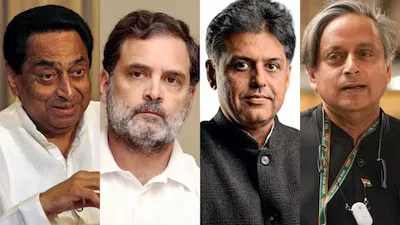
Even on domestic issues, such as concerns over LPG supply, differences have surfaced. Kamal Nath dismissed claims of a shortage, contradicting the party’s broader narrative. His assertion that an “impression of crisis” was being artificially created weakened the opposition’s attack line and provided ammunition to the ruling Bharatiya Janata Party.
Op Sindoor: The precedent for internal divergence
The current discord is not an isolated episode. A similar pattern emerged in the aftermath of Operation Sindoor, launched following the Pahalgam terror attack that claimed 26 lives.
While Rahul Gandhi questioned the government’s “political will,” leaders like Tharoor and Tewari openly supported the operation and praised the armed forces. Their stance was widely interpreted as prioritising national security over party lines.
The situation became more contentious when the government formed an all-party delegation to present India’s position globally. The inclusion of Tharoor and Tewari reportedly irked the Congress leadership, which claimed it had not been consulted.
Tharoor’s appointment as the head of one such delegation to the United States and Latin America further highlighted the leadership’s discomfort with independent voices within the party.
Notably, during parliamentary debates on Operation Sindoor, both Tharoor and Tewari were not given an opportunity to speak, an omission that raised eyebrows and added to perceptions of internal friction.
Iran War and the renewed fault lines
The ongoing conflict in West Asia has once again exposed these underlying tensions.
India’s response, marked by calibrated diplomacy, humanitarian concerns, and strategic caution has been broadly appreciated by sections of the international community. Leaders like Anand Sharma have argued that this approach has helped India avoid “potential minefields.”
He also pointed to India’s historical ties with Persia (modern-day Iran) and the complexities of energy security, emphasising that foreign policy decisions must be guided by long-term national interests rather than short-term political gains.
Kamal Nath’s remarks on LPG availability further reinforced the perception that not all Congress leaders are aligned with the central narrative being pushed by the party leadership.
A Leadership challenge
The repeated instances of senior leaders publicly contradicting Rahul Gandhi raise deeper and more uncomfortable questions about his acceptability as a unifying leader within the Congress. What is emerging is not merely episodic dissent, but a pattern where experienced party veterans appear unwilling to align unquestioningly with his positions, especially on matters of national security and foreign policy.
This divergence goes beyond ideological nuance. When leaders like Shashi Tharoor, Anand Sharma, Kamal Nath, and Manish Tewari publicly articulate views that contradict Rahul Gandhi’s criticism of the Centre, it signals a visible lack of internal consensus. More significantly, these are not fringe voices but senior figures with administrative experience, diplomatic exposure, and institutional memory making their divergence far more consequential.
This creates an unusual dynamic where the Congress is seen internally fact-checking its own leadership. Such contradictions weaken the credibility of the critique being advanced and raise doubts about whether the party’s official stance reflects a collective position or a leadership-centric narrative.
From a political communication perspective, this inconsistency poses a structural challenge. An opposition derives its strength from coherence and clarity in messaging. However, when senior leaders project alternative viewpoints often more measured or even supportive of the government, it fragments the narrative and blurs the party’s line of attack. The result is not just a diluted political message, but also the perception of a leadership that has yet to command full confidence within its own ranks.
Opposition vs National Interest
At the heart of this issue lies a fundamental dilemma faced by opposition parties in any democracy: how to critique the government without appearing to undermine national interests, especially on matters of foreign policy and security.
Leaders like Tharoor and Sharma appear to advocate a bipartisan approach in such domains, recognising that India’s global standing depends on consistency and credibility.
Rahul Gandhi’s approach, on the other hand, reflects a more confrontational political strategy, one that seeks to hold the government accountable but risks being perceived as out of sync with ground realities.
This internal divide is particularly significant given the Congress party’s historical legacy in shaping India’s foreign policy from the Non-Aligned Movement under Jawaharlal Nehru to economic liberalisation under P. V. Narasimha Rao.
The current situation raises questions about whether the party can reconcile its legacy of strategic autonomy with the demands of contemporary geopolitics.
A Party at Crossroads
The unfolding developments, from Operation Sindoor to the Iran war highlight a Congress party at a crossroads.
On one side is a leadership seeking to aggressively challenge the government. On the other are seasoned leaders advocating restraint, pragmatism, and national consensus.
Whether this divergence evolves into a constructive internal debate or deepens into a structural fault line will have significant implications not just for the Congress, but for the broader contours of India’s opposition politics.
In an era where geopolitics and domestic politics are increasingly intertwined, the ability to present a coherent and credible position may well determine the party’s relevance in the years to come.