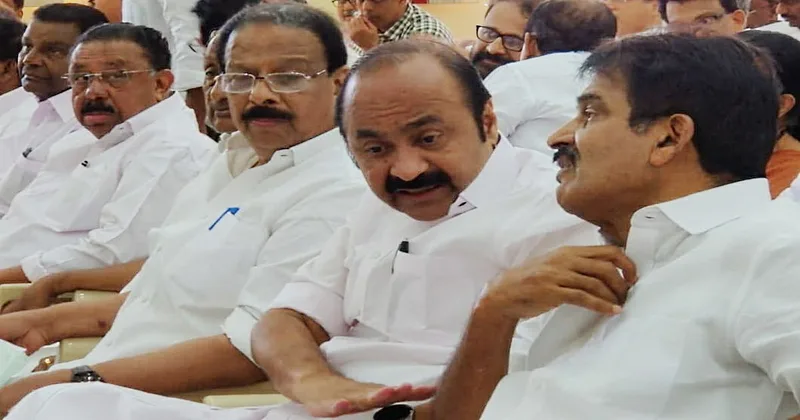
Kannur: The internal conflict within the Indian National Congress over the Kannur Assembly seat is intensifying, pushing the party into a deepening crisis just weeks before the election campaign. Senior leader and former KPCC president K. Sudhakaran has made it clear that he will not allow himself to be sidelined from his political stronghold of Kannur, as the party leadership struggles to finalise a candidate. With barely 21 days left for campaigning, the high command has failed to build consensus, exposing sharp factional divides within the state unit. District leaders, speaking privately, acknowledge that the deadlock stems from a power struggle between factions led by opposition leader V. D. Satheesan and and former opposition leader Ramesh Chennithala, each seeking to consolidate influence by securing more Assembly seats for their loyalists.
Factional tug-of-war deepens crisis
Despite the high command’s broader directive discouraging Members of Parliament from contesting Assembly elections, Sudhakaran remains firm that he himself should contest from Kannur. His defiance has escalated tensions, especially after he briefly withdrew from discussions with the leadership before returning to Delhi with renewed determination. What has further aggravated the situation is the collapse of a prior understanding that if Sudhakaran stepped aside, his faction would be allowed to propose an alternative candidate. That agreement now appears to have been overturned. The situation worsened when AICC general secretary K. C. Venugopal showed interest in a different name backed by the Satheesan faction, prompting Sudhakaran’s camp to harden its stance and reject any compromise in Kannur.
Sudhakaran is said to be deeply angered by attempts to impose a candidate he does not approve of. At the same time, Ramesh Chennithala’s open support for Sudhakaran has strengthened what is informally known as ‘Group I’ within the party. Chennithala has already met Sudhakaran in Delhi and expressed solidarity, signalling a consolidation of forces against the emerging KC–VD axis.
Social representation and political stakes
Adding another layer of complexity is the demand for Thiyya community representation in Kannur. The candidate reportedly favoured by the Satheesan faction does not belong to this community, intensifying resentment among local leaders and workers. This has transformed the dispute from a purely factional issue into one with significant social and electoral implications. While the Congress has already announced candidates in constituencies such as Irikkur, Peravoor, Thalassery, and Dharmadam constituencies, uncertainty persists in key seats including Kannur. The inability to resolve these disputes at a critical juncture is increasingly being viewed as a sign of organisational weakness. There are growing indications that the factional rivalry could spill out into the open during the final phase of candidate selection. Observers suggest that the alliance between Venugopal and Satheesan has effectively sidelined both KPCC President Sunny Joseph and Ramesh Chennithala, leaving them struggling to assert control over the process.
Leadership paralysis and high command dilemma
The crisis has also exposed a leadership vacuum within the Keralam Congress unit. Sunny Joseph appears caught between directives from the central leadership and pressure from competing factional managers, with little room to manoeuvre. The delay in announcing a candidate for Kannur, even days after the election schedule was declared, has made the party appear disorganised and indecisive.
Sudhakaran’s anger has been particularly directed at Satheesan’s efforts to override his recommendations and field a candidate of his own choosing. Having travelled to Delhi for consultations, Sudhakaran has signalled that he is prepared to take a firm and possibly confrontational stand if a decision is not made in his favour. His supporters warn that denying him the Kannur seat could have wider repercussions across the district, potentially affecting the party’s performance in neighbouring constituencies. On the other hand, Venugopal and Satheesan remain committed to their position that MPs should not be allowed to contest Assembly elections.
However, Sudhakaran argues that he was assured an opportunity to contest when he stepped down as KPCC president, and insists that the leadership must honour that commitment. This has turned the issue into not just a matter of candidacy, but one of political credibility and internal trust. With tensions reaching a breaking point, all eyes are now on Rahul Gandhi, who is expected to take the final call. His decision will not only determine the candidate for Kannur but could also reshape factional equations within the Keralam Congress ahead of a crucial electoral battle.