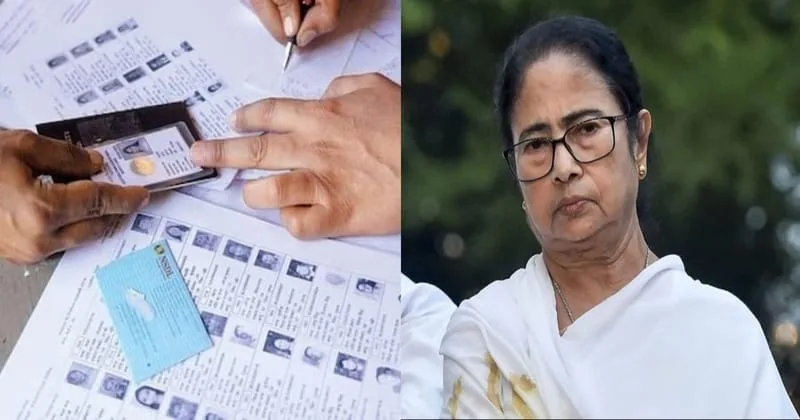
Elections in Bengal are among the most crucial times for the state. Many of the scenes we witness here are completely different from those in other states. This is a state where opposition-elected members have been killed by goons. Yet, the irony is that the same ruling party often speaks about democracy, even though democratic principles have largely vanished under its rule.
Now, another debate has emerged regarding the food habits of Bengal. The TMC argues that if the BJP comes to power, it will stop all non-vegetarian foods, such as fish. To counter this, BJP leaders have begun campaigning, and in one instance, a candidate was seen holding a fish. Another significant remark was made by former BJP state president and Union Minister Sukanta Majumdar, who stated that the Chief Minister from a BJP government would be a non-vegetarian. But my point is, a state like Bengal, which once contributed the highest share to the country’s GDP, is now debating food habits. Where elections should focus on issues like development and education, the election agenda here is becoming increasingly cheap. This is a strategy of the ruling party—to create such agendas, then stir emotional debates around them, and ultimately distract people from the real issues.
But at the same time, many government employees are not receiving their DA, which they rightfully deserve. Many educated youths are facing unemployment. Instead of taking concrete steps to generate employment, this government has introduced an allowance scheme called “Yuva Sathi.” Under this scheme, even an unemployed MA or PhD holder receives a fixed allowance of only Rs 1,500 per month. An educated youth who deserves an annual income of Rs 10 lakh is being given just Rs 18,000 per year, which comes down to barely Rs 50 per day. In reality, even travelling to Kolkata from a district costs more than Rs 50. Yet, this shameless government continues to advertise and promote this scheme. Because everything they are doing is only for vote bank politics. But due to their cheap politics, the people of Bengal are suffering. The consequences of this approach are far-reaching.
While the government promotes schemes like “Yuva Sathi” as a form of support for unemployed youth, a deeper contradiction lies beneath the surface. On one hand, educated young individuals are being offered a nominal allowance of Rs 1,500 per month, effectively normalising unemployment rather than solving it. On the other hand, the very systems that could provide stable employment—such as recruitment through the School Service Commission (SSC)—have been plagued by delays, irregularities, and allegations of corruption. Examinations are either not conducted on time or, when they are, their credibility is often questioned. The West Bengal School Service Commission recruitment process has faced serious scrutiny, with reports of paper leaks, bribery, and manipulation undermining meritocracy. As a result, deserving candidates are left in uncertainty for years, despite being qualified and prepared. This creates a troubling paradox: instead of ensuring transparent and timely job opportunities, the system appears to compensate for failure with token allowances. A government that cannot guarantee fair recruitment cannot claim to empower its youth through small stipends.
When political discourse is consistently diverted away from real issues, public accountability weakens. Citizens begin to engage with politics at a superficial level, focusing on symbolic debates rather than demanding concrete policy outcomes. Over time, this erodes the very foundation of democracy, which depends on informed and active participation from the electorate.
Bengal, with its rich history of political awareness and intellectual debate, deserves far better. It deserves elections where parties compete on visions for development, where leaders are held accountable for their performance, and where the aspirations of the youth are taken seriously. It deserves a political culture that respects the intelligence of its people rather than attempting to manipulate their emotions. The question, therefore, is not whether one party or another is right or wrong on the issue of food habits. The real question is why such issues are being prioritised at all when the state faces far more pressing challenges. Why are unemployment, industrial stagnation, and governance failures not at the centre of electoral debates? Why are citizens being encouraged to argue over identity markers instead of demanding economic progress?
Ultimately, the responsibility does not lie solely with political parties. It also rests with the people of Bengal. Voters must recognise these patterns of distraction and consciously shift their focus back to the issues that truly matter. They must ask difficult questions, demand clear answers, and hold their leaders accountable. Because if elections continue to revolve around trivialities, the cost will not just be political, it will be societal and generational. Bengal cannot afford to let its future be dictated by debates over fish while its youth struggle for survival.