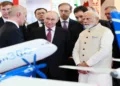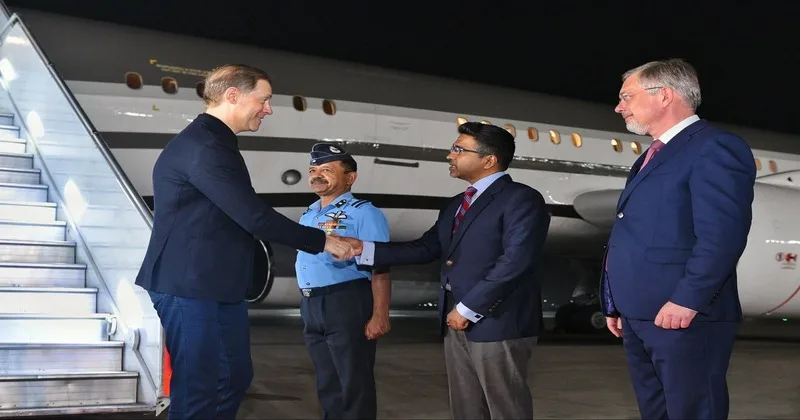
NEW DELHI/ Moscow: Russia’s First Deputy Chairman Denis Manturov arrived in India on April 2 for a two-day official visit aimed at strengthening bilateral ties across key sectors. He will co-chair the India–Russia Intergovernmental Commission on Trade, Economic, Scientific, Technological, and Cultural Cooperation, a key institutional mechanism guiding cooperation between the two countries.
“A warm welcome to Mr. Denis Manturov, First Deputy Chairman of the Russian Federation and Co-Chair of the India-Russia Intergovernmental Commission on Trade, Economic, Scientific, Technological & Cultural Cooperation, to New Delhi. During the visit, he will hold consultations with External Affairs Minister Dr. S. Jaishankar and engage in other bilateral meetings,” the Ministry of External Affairs said in a post on X.
The Embassy of Russia in India also confirmed his arrival, noting that a series of negotiations covering a broad spectrum of bilateral cooperation issues will take place during the visit. In a statement issued ahead of his arrival, Manturov underlined that the primary focus of the Intergovernmental Commission remains the comprehensive expansion of trade and economic ties between the two nations.
A warm welcome to Mr. Denis Manturov, First Deputy Chairman of the Russian Federation and co- Chair of India Russia Intergovernmental Commission on Trade , Economic, Scientific, Technological & Cultural Cooperation, to New Delhi.
During the visit, he will hold consultations… pic.twitter.com/hSZe4UGIP6
— Randhir Jaiswal (@MEAIndia) April 2, 2026
Focus on trade expansion and economic cooperation
Manturov emphasised key priorities, including ensuring stability in mutual settlements and logistics chains, improving market access conditions, and promoting new investment initiatives and joint projects. He further noted that discussions would include concrete steps to implement plans outlined in the Economic Cooperation Programme through 2030, adopted in December 2025, particularly in the context of the evolving global situation.
“The key focus of the Intergovernmental Commission’s work today is the comprehensive expansion of trade and economic ties, ensuring the stability of mutual settlements and logistics chains, improving conditions for mutual market access, and identifying and supporting new investment initiatives and cooperative projects. Specific steps to implement these plans, including those outlined in the Economic Cooperation Program through 2030, adopted in December 2025, and in the context of the current global situation, will be discussed during the meetings with our Indian partners scheduled as part of the visit,” Manturov noted.
During his stay in the national capital, Manturov is also scheduled to meet National Security Advisor Ajit Doval and Union Finance Minister Nirmala Sitharaman, underlining the multi-sectoral nature of the engagement.
Trade imbalance and energy dependence
Manturov’s visit signals a determined effort to expand bilateral economic ties, with both countries targeting $100 billion in trade by 2030 under the Economic Cooperation Programme. However, current trade figures reveal a significant imbalance. In FY 2024–25, bilateral trade reached approximately $68.7 billion, with Russian exports dominating at over $63.8 billion, while Indian exports remained below $5 billion. This imbalance is largely driven by India’s increased imports of discounted Russian crude oil, which has become a major component of its energy basket. Before the Ukraine conflict, Russian oil accounted for only about 2.5% of India’s imports. By FY 2024–25, this share had surged to roughly 35.8%. The shift reflects India’s response to disruptions in West Asia as well as its broader strategy to manage domestic inflation and ensure energy security. It also underscores the central role energy trade plays in shaping the economic relationship between the two countries.
Diversification beyond energy and defence
Both India and Russia are now seeking to diversify their cooperation beyond traditional sectors such as energy and defence. Emerging areas of collaboration include industrial technology, digital finance, artificial intelligence, cybersecurity, and advanced manufacturing. Efforts are also underway to address structural trade barriers, including eliminating non-tariff restrictions and exploring a potential Free Trade Area between India and the Eurasian Economic Union (EAEU). At the same time, India is actively diversifying its energy import sources, expanding from 27 to 41 countries, thereby reducing dependence on any single region. New connectivity initiatives, such as the International North-South Transport Corridor, are also being explored to improve logistics efficiency and facilitate trade. Additionally, India continues to diversify its defence procurement and maintain a balance in its strategic engagements with both Western and Eastern partners, reinforcing its policy of strategic autonomy.
Diplomatic engagements and future outlook
Meanwhile, Vladimir Putin is expected to participate in the BRICS summit scheduled for September in India, according to Russian Deputy Foreign Minister Andrey Rudenko, who announced the news in Colombo on April 1, 2026. He added that Moscow would support New Delhi’s efforts to build consensus among member nations.
Rudenko also confirmed that Russia will honour all existing oil contracts despite its decision to ban gasoline exports from April 1, 2026, due to price fluctuations. “My President has an invitation from the Prime Minister Modi to come to New Delhi, and for the time being, we don’t see any problems which would prevent him from doing so,” he said, while commending India’s role as BRICS chair for working to streamline differences among member states.
“We need to see what will happen by the time of the summit itself. But so far, we consider this invitation with seriousness,” Rudenko added, citing the volatile situation in West Asia. He was speaking at an interaction organised by the Pathfinder Foundation in Colombo.
His visit comes shortly after Russian Deputy Energy Minister Roman Marshavin travelled to Sri Lanka, where he pledged Moscow’s support to help Colombo manage the energy crisis stemming from disruptions in West Asia.
Rudenko reiterated the importance of sustained engagement between the two countries, stating that “it is very important for Russia and India to maintain regular, systematic contacts at various levels.”
He also expressed hope that the Indian Prime Minister would reciprocate President Putin’s invitation for an official visit to Russia at a mutually convenient time. Earlier, President Putin had visited India in December 2025 for the annual summit held in New Delhi. Rudenko also noted that it is now Moscow’s turn to host the next India-Russia summit later this year, signalling continued high-level diplomatic engagement between the two longstanding strategic partners.