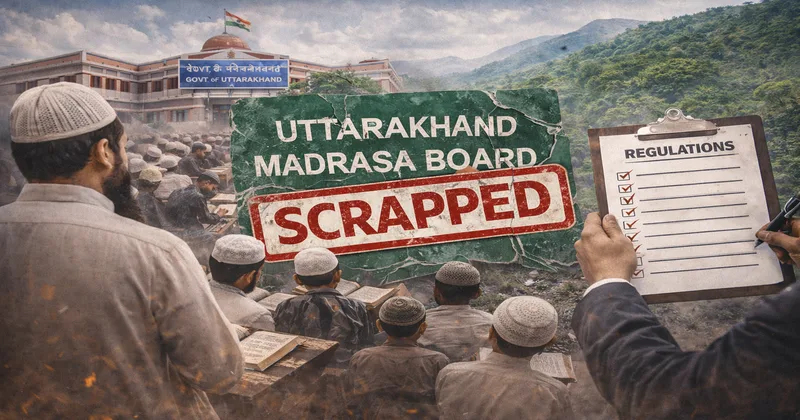
DEHRADUN: In a major policy shift, the Uttarakhand government has decided to dissolve the Madrasa Board and bring all madrasas under a new regulatory structure effective July 1. The decision is being seen as a significant step toward aligning religious educational institutions with the broader framework of formal education in the state.
Under the revised system, madrasas will now be required to comply with 11 mandatory conditions set out in Section 14 of the Minority Authority. These include the appointment of qualified teachers with recognised degrees, mandatory affiliation with the State Education Council, registration with the society registrar, and maintaining financial transparency through institutional bank accounts.
The new rules also specify that neither students nor teachers may be compelled to participate in religious activities, and that institutions must ensure communal harmony. Additionally, madrasas must provide audit reports for the past three years, have access to a playground, and employ trained teaching staff.
According to officials, the reforms are aimed at improving educational standards and bringing madrasa students into the mainstream. Madrasa Board Chairman Mufti Shamoon Kashmi stated that academic instruction will now follow the state board syllabus, with six to seven periods dedicated to general subjects during the day, while religious education will be conducted separately after school hours.
The state currently has 482 recognised madrasas with over 50,000 students, including 36 in Dehradun. Minority Welfare Officer JS Rawat clarified that institutions that fail to meet the new criteria will not be granted recognition to impart religious education.
Officials also addressed concerns about students’ future, stating that certificates issued under the new system will now be equivalent to high school and intermediate qualifications set by the state education board. This marks a shift from earlier certifications like ‘Munshi’ or ‘Maulvi’, which had limited academic recognition.
The government has indicated that smaller madrasas (maktabs) may function as primary-level or coaching institutions, while junior and senior madrasas will be regulated according to their level. Authorities may also provide a transition period and temporary recognition to help institutions adapt to the new rules.
The reform is being viewed as a major step toward enhancing transparency, standardisation, and inclusivity in the state’s education system. By bridging the gap between religious and formal education, the government aims to provide madrasa students with equal opportunities for higher education and career advancement.