
Politically polarised media persons and ignorant souls keep on harping about intolerance and freedom of speech, and try to narrate the reason for Kerala losing its peaceful atmosphere due to CPM-RSS clashes. The display of the real picture is either incomplete or distorted. Then, what is the fact? Are there really CPM-RSS clashes, or are they the naked exhibition of CPM terror and violence against their political enemies?
Politically polarised media persons and ignorant souls keep on harping about intolerance and freedom of speech, and try to narrate the reason for Kerala losing its peaceful atmosphere due to CPM-RSS clashes. The display of the real picture is either incomplete or distorted. Then, what is the fact? Are there really CPM-RSS clashes, or are they the naked exhibition of CPM terror and violence against their ‘political enemies’?
Communists, that is, Marxists as per modern terminology, are always dead against other ideologies, which is a well-known fact. Worldwide, it has been the same experience since the October Revolution, which took place in Russia in the second decade of the last century. The very basic tenet of Marxism, Dictatorship of the Proletariat, espouses the authoritarian rule of the Communist Party. This dictatorial euphoria leads to intolerance and hatred in the mindset of communists wherever they are. It is worse and graver wherever they get power.
In Kerala, whichever political clash we witness, the CPM is a common factor on one side. It could be CPM vs Congress, CPM vs RSS, CPM vs BJP, CPM vs Kerala Congress, CPM vs (even) CPI and sometimes (one group of) CPM vs (another group of) CPM. It proves the CPM’s intolerance towards other ideological groups and their ideologies. RSS and affiliated organisations are the worst-affected ideological groups in this violent mess, lashed out by the CPM.
The history of this ‘murder politics’ started during the 1940s itself, well before the undivided Communist party could taste the power in the Kerala political scenario.
Undivided CPI’s first significant physical attack against the RSS was in 1948 at Thiruvananthapuram. It was significant because the attack was against an RSS Samghikh (RSS programme focused on physical exercises) addressed by the then RSS Sarsanghachalak M S Golwalkar, popularly known as Guruji. They attacked the gathering while Shri Guruji was on the dais. Veteran RSS swayamsevak P Parameswaran was the Mukhya Shikshak (main instructor). The swayamsevaks retaliated in a befitting manner. And, the young Marxists led by a student leader fled the spot. The programme went on. Guruji spoke as if nothing had happened. He did not even refer to the incident he witnessed.
Another major attack by CPI took place in 1952 at a similar gathering that Guruji was to address in Alappuzha. The sequence of events is replicated here as well, and the programme went on without much discussion on the violent attack.
CPM and the Culture of Violence
After a lull for almost a decade, CPI underwent a vertical split in 1964. Though CPI refrained from physically attacking the RSS swayamsevaks, CPM, the other group, after a few years of calm, took the violent route again. Next major CPM attack against RSS was in January 1969, near Shri Kerala Varma College, Thrissur. The college management had invited Swami Chinmayanandaji to deliver a lecture. But, Kerala Students’ Federation (KSF), the precursor of SFI, with their CPM bosses of the area, used all sorts of dirty tricks to insult and physically attack Swamiji. To avoid any physical assault on Swamiji, ABVP students encircled and guarded Swamiji and led him to the car to leave the place safely. The next day, when the ABVP staged a protest rally against the CPM’s attempt to assault Swamiji, the CPM goons attacked the ABVP students. It resulted in a fierce street fight, perhaps the first of that sort in the State. Thereafter, almost every year, KSF and later SFI workers, with the help of CPM men outside, attacked ABVP workers in the college.
In 1969, the local workers, allegedly led by Pinaryi Vijayan and Kodiyeri Balakrishnan, presently Politburo (PB) members and former and present State secretary respectively, killed RSS worker Vadikkal Ramakrishnan, a sweets maker, in Thalasserry. The cold-blooded murder was without any sort of provocation. After a month, they killed Sreedharan Nair, an RSS worker in Ponkunnam, Kottayam District. The same year, Ramakrishnan, an RSS worker in Palakkad, was killed.
Veliyathunadu Chandran, a senior RSS worker and former Pracharak, was the next victim of the CPM attack in Parur of Ernakulam District on January 11, 1970. Mandal Karyavah Sankranarayanan was killed in Nallenkara, Thrissur District, in 1973. In 1974, CPM men killed RSS Mandal Karyavah Sudheendran in Kochi.
New Chapter after Emergency
Developments during the period of Emergency opened a new chapter in the politics of murders. Even though the aforementioned attacks were grave for RSS and affiliated organisations, CPM accepted a killing spree against Sangh workers as their cup of tea in 1978, after the lifting of the Emergency. During the Emergency, the fight against the autocratic and dynastic rule was solely carried on by RSS and its affiliates in Kerala. Naturally, the young and adventurous CPM men were frustrated. They could not reconcile with the party leadership’s compromising stand on the Emergency. While communist leaders were not ready to take any anti-establishment stand, the RSS boys took up poster campaigns, pamphlet distributions, etc. Thousands of RSS men staged non-violent satyagraha, courted arrest and underwent inhuman police torture, which was beyond reconciliation for many communist supporters who were listening to the empty rhetoric of ‘revolution’ every now and then. As a result, several of those CPM men joined the RSS’s underground activities during the Emergency. They turned active RSS workers after the Emergency. This phenomenon was more visible in the CPM strongholds areas like Kannur, Alappuzha and coastal Thrissur. The exodus of the rank and file was the last straw on the camel’s back for CPM.
The CPM leadership thought that the murder of their ex-comrades who turned to the RSS would be the best deterrent to put an end to this attrition. In September 1978, they kicked off the killings in Thalassery, Kannur district, by murdering a teenage college student and Mukhya Shikshak Chandran of Panunda Shakha. Significantly, his father was a Member of the CPM Local Committee. Thereafter, a series of killings took place in Thalaserry Taluk. Most of the RSS martyrs were former CPM members or, at least, the family members of CPM members. When they felt that daggers and swords were not enough to suppress the RSS growth, they started manufacturing bombs. Since 1978, Several RSS men were killed in Thalassery itself. The most prominent of them were RSS Khand Karyavah Karimbil Satheeshan (1981), BJP Kannur District secretary Pannyannoor Chandran (1986), Bharatiya Janata Yuva Morcha State Vice President Jayakrishnan Master (killed in the classroom while taking class in front of the 6th standard students), Kannur Zila Sharirik Pramukh Manoj (2014). In 1984, Kannur Zila Sahakaryavaha Sadanandan Master’s both legs were chopped off below the knees.
In 1980, Gangadharan, a young ABVP district officer bearer in Kannur, was killed in his office the day he joined the government service. The then ABVP State organising secretary KG Venugopal and the then RSS Zila Pracharak VN Gopinath told Organiser that as Gangadharan joined the duty in the Survey Department, an employee informed the CPM goons, and they immediately executed the killing on his chair itself. The killers even threatened the district collector against taking the body for a post-mortem!
The same CPM killers kept on attacking RSS men in Alappuzha District. The first among them was Gopalakrishnan (27), who was murdered on September 18, 1980. CPM killers dragged him out of a running bus and stabbed him to death. Another prominent Sangh martyr was Khand Karyavah Vishwambharan in Kuttanadu (1982). The murder of Pradeep (15), a 10th standard student, was another brutal act of CPM there.
CPM men killed several workers in Thrissur District after the Emergency. Fierce attacks took place in Vadanappalli, a coastal area in the district. The attackers set fire to a house, and a man was burnt to death in it. Kodungallur Taluk Karyavah and a promising Sangh worker T Satheesan was killed in the street by RSS workers in 1984. Former Pracharak Ayyappan was bombed to death by CPM men in Nayathodu, Ernakulam district, the same year. RSS worker Unnikrishnan was killed by CPM killers in Thrippunithura, Ernakulam District in March, 1984.
Three swayamsevaks were killed in a single incident in Murikkumpuzha, Thiruvananthapuram District in 1987. In September 1996, Anu, Sajith and Kim Karun, ABVP workers in Dewaswom Board College, Mannaar, Alappuzha district, were attacked and drowned in the Pampa River. Bimbi, an ABVP worker, was killed in Changanassery, Kottayam District, in October 1996.
Power Dynamics in Murder Politics
CPM raises its dirty and violent heads when they are in power. Naturally, the investigation turns into a drama. Even though they lost during the Congress-led UDF (United Democratic Front), the CPM-led Left Democratic Front (LDF) returned to power in rotation (a common practice we have witnessed in Kerala for the last several decades). Then they get an opportunity to manipulate the cases in their favour. Even the forthright judges have to face the wrath of communists if they deliver a verdict against CPM killers. The judge who sentenced capital punishment for the killers of Jayakarishnan Master had to face violent protests, threats which finally led to giving him the police protection.
Non-discriminatory Violence
People believe that CPM Kannur district secretary P Jayarajan was involved in the murder of RSS worker Manoj (2014). He was arrested in this regard and jailed for several weeks. Later on, he got bail; alibi was heart ailment! Now, court has instructed him not to enter Kannur District. So, CPM deploys him for election campaign throughout the State.
CPM killers do not spare Congressmen or party rebels. They have killed several workers of Congress, the Muslim League and even their own coalition partner, the CPI. The most prominent CPM rebel killed by the “big brother” was TP Chandrasekharan from Vadagara. He was killed in a brutal manner on the night of May 2, 2012. Later on it was alleged that the vehicle used by the killers bore the Arabic prayer verses for creating an impression that the culprits were Islamic fundamentalists. This murder shook CPM gravely. Senior CPM leader and former CM VS Achuthanandan publicly denounced the murder and went to console the widow of the deceased. VS’s act was attacked by the official faction of the party led by his bête noire, Pinarayi Vijayan.
The latest addition in the series RSS is the shameful incident that took place in Kattayikkonam near Thiruvananthapuram. RSS Taluk Pracharak Amal Krishna was attacked with an iron tool on March 14, 2016, and his skull was seriously damaged. A fresh engineering graduate was on a ventilator for several weeks and is still struggling to return to normal life.
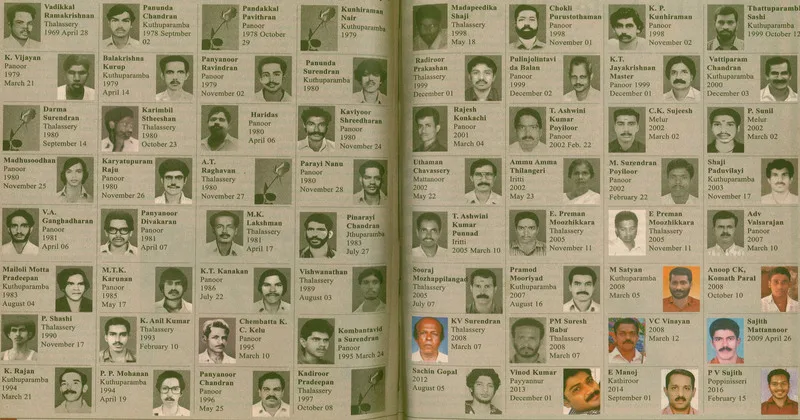
The aforementioned is the scenario in a nutshell. More than 200 Sangh workers have sacrificed their lives for their freedom to choose social and personal life in Kerala, mostly at the hands of CPM criminals. In Kannur alone, 78 swayamsevaks have been killed.
This clearly depicts the intolerant and violent character of CPM in Kerala and its unilateral animosity against the nationalist thinking.
RSS’s peace initiatives
Significantly, RSS has always expressed readiness to find out the avenues to put an end to this dangerous murder politics. Sangh had taken many serious initiatives in this direction in the past.
P. Parameswaran had taken over as the director of Deendayal Research Institute, New Delhi, in mid-1977, which he continued till the last leg of 1981. Those were the high times of CPM’s fascist murder politics. The blood of innocent Sangh workers was spilled on the streets of Kerala. Sangh leaders thought of a dialogue with senior CPM leaders in this regard. Parameswaranji got in touch with RSS Kerala Prant Pracharak K Bhaskar Rao. Accordingly, Parameswaranji wrote a letter to EMS Namboodiripad, who was stationed in Delhi as the CPM general secretary. EMS replied to him in a positive tone.
Afterwards, in a telephonic conversation with Parmeswaranji, EMS proposed to speak with Kerala CM and PB member EK Nayanar, who was scheduled to reach Delhi on one of those days. Accordingly, the date and time for an RSS-Nayanar meeting in Delhi were scheduled. Ranga Hari and the then Kerala Prant Pracharak K Bhaskar Rao reached Delhi. But some unexpected incidents took place in Delhi that day. A prominent ABVP worker of Kerala V Muraleedharan (erstwhile State BJP chief) was arrested that day in connection with CPM-RSS clashes in Thalasserry. But the ABVP central unit in Delhi received information that KG Venugopal, the then Kerala state organising secretary and Sangh pracharak, had been arrested. Naturally, they got agitated. They encircled the CM at Kerala House for hours. Parameswaranji and RSS leaders who had reached Delhi were anxious about the dialogue. Parameswaranji phoned Nayanar. CM’s response was warm and inspiring: “So what Parameswaran? They are, after all boys. You come with your colleagues; let us have the dialogue!!”
During the initial talks, Nayanar’s Cabinet colleague and Congress (S) leader PC Chacko (Congress national spokesman these days) was with the CM. Bhaskar Rao, Parameswaranji and Ranga Hari represented RSS. Nayanar spoke of the “boys’ naughtiness” in a light vein. Ranga Hariji told this correspondent that Nayanar said the Nayanars were smart, unlike Kerala boys; he kept talking about the Delhi boys.
But Chacko, in a more aggressive mood, said that ABVP boys had brought daggers wrapped in newspaper. Nayanar stopped him. He said the boys did not bring any weapons. In short, RSS leaders felt that the CPM did not dispute the RSS’s endeavour to close the chapter of violence. Both parties agreed to have the second leg of the discussion in Kerala. Hariji says that Nayanar, in his usual humorous style, said he would crack the news of the dialogue to the media as soon as he reached Kerala. Hariji was assigned to fix the place for the meeting in Kochi. So, technically, he was the convener of the second leg.
Once back in Kochi, Hariji got in touch with a senior CPM leader based there. Hariji said that the RSS had no objection to attending the meeting at their (CPM) office, but CPM could not even imagine it – What would their comrades think! Then RSS expressed its pleasure at hosting the meeting at its Kerala State RSS karyalaya. But the CPM leader equated it with stepping into the fire. Then, both leaders decided to have the meeting in a house in Kochi that was acceptable to both sides. Accordingly, a swayamsevak’s house was fixed, who was a businessman.
PB member P Ramamoorthy, Home Minister TK Ramakrishnan and senior leader MM Lawrence participated in the meeting from CPM’s side. Dathopanth Thengidi, Ranga Hari and senior Sangh Pracharak P Madhavan participated from the Sangh’s side. Hariji remembers that paan had been arranged at the meeting venue for Ramamoorthy, as Thengidiji, as a labour leader, knew about it. Since Lawrence and Ranga Hari were classmates in their school days, their personal rapport has greatly helped the smooth dialogue between the two organisations.
As a participant of both legs of the dialogue, Hariji remembers that both parties were very much particular to put an end to the physical attacks. During the discussion until lunchtime, proposals were put forward to avoid violence. Both parties agreed to the proposal to hold meetings of senior leaders of both sides whenever tension arose. The post-lunch discussion took place in the government guest house, Ernakulam. Hariji says that BMS leader R Venugopal (later national working president of BMS) came to the guest house even though he was not a participant in the discussion.
Hariji says there was another dialogue sometime between 1984 and 1989 near Kottakkal in Malappuram District, during his tenure as the Kerala Prant Pracharak. The present Leader of Opposition, VS Achuthanandan, had participated in that meeting. Adv. TV Ananthan (then Prant Karyavah) and S. Sethumadhavan (then Sah-prant Pracharak) represented the Sangh. Some understandings were worked out, but again, CPM was violated in daylight.
On November 29 or 30, 1999, a meeting took place in Justice VR Krishna Iyer’s residence in Kochi. Because RSS was not party to it! Even though RSS (media technically says BJP) was the main victim of violence by the CPM, participants of the meeting were Congress, CPM and CPI! They decided to maintain peace in Thalassery. The very next day, Bharatiya Janata Yuva Morcha state vice president Jayakrishnan Master was brutally killed in front of his class 6th-grade students!
When we take a look at the RSS-CPM dialogue, one thing is crystal clear: RSS took the initiative. Therefore, there is no room for any discussion on who launches political violence in Kerala and who tries their level best to avoid it.
Recently, a new turn has been taken in this dangerous game. Ariyil Shukkoor, a Muslim League worker, was killed in Kannur. Another Muslim activist, Faisal, was killed. Though RSS was being targeted for this by CPM, enquiries in both cases have indicted the CPM workers. Now, communists also avoid direct involvement of their workers and instead hire professional killers. There is a tendency to give communal colour through tacit alliance with the Islamists in the State. The continuation of this trend can be the gravest threat to ‘God’s Own Country’.