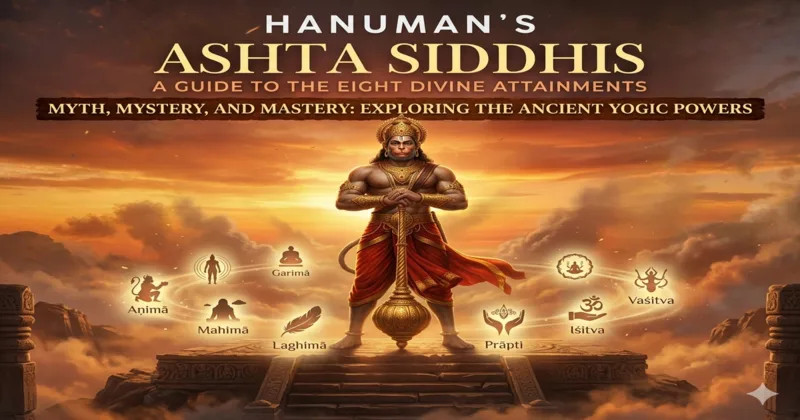
Ramnavami, which celebrates the birth of Shri Ram, is also a perfect occasion to reflect on his closest sakha and ally, Hanuman, whose devotion, courage, and humility make him an enduring presence in the Hindu imagination. During a recent visit to Hanumangarhi in Ayodhya, as I watched a sea of humanity move in quiet, meditative circumambulation around the shrine, I found myself thinking about Hanuman’s siddhis—powers that seem fantastic and otherworldly, yet continue to speak to contemporary seekers, scientists, and sceptics alike.
In the Hindu tradition, divinity and sagacity are about acquiring siddhis and blessings, attaining new forms of existence, consciousness, and powers. Derived from the Sanskrit word siddhi, meaning “knowledge”, “accomplishment”, “attainment”, or “success”, siddhis are mentioned in various Hindu scriptures, including Patanjali’s Yoga Sutras, the Bhagavata Purana, Shaivism, Vaishnavism, Samkhya philosophy, Sikhism, and Vajrayana Buddhism. Ganesha, Hanuman, the many forms of Devi, Lord Vishnu, and several other Hindu deities are widely revered as guardians and bestowers of siddhis—the divine powers attained through spiritual practice.
Scriptures tell us that Lord Hanuman, Shri Ram’s steadfast companion, had mastered the “Ashta Siddhis” or eight siddhis, which granted him extraordinary abilities and knowledge. In the Hanuman Chalisa, composed by Tulsidas, it is written:
“Ashta Siddhi Nava Nidhi Ke Daata, Asa Bar Deen Janki Maata”
“You are the giver of the eight Siddhis and nine Nidhis (divine treasures), as granted to you by Mother Sita.”
These siddhis gave Shri Hanuman the ability to influence different aspects of the physical world, such as altering his size and weight or controlling the forces of nature. Although these siddhis are primarily spiritual and metaphysical, they share striking similarities with certain modern scientific ideas, inviting us—like the pilgrims at Hanumangarhi—to contemplate how ancient symbols might resonate with contemporary knowledge.
The 8 Siddhis of Hanuman
Anima (Becoming Infinitely Small)
The first siddhi, Anima, grants Hanuman the ability to shrink to the size of an atom; for instance, he uses this siddhi to shrink as he enters Lanka to find Sita. This concept can be linked to modern quantum mechanics, where particles such as electrons, quarks, and photons exist in extremely small, subatomic realms and behave in ways that challenge traditional physics, exhibiting phenomena such as wave-particle duality. Nanotechnology, which involves manipulating matter at the atomic and molecular levels, mirrors this idea by demonstrating humanity’s growing ability to control processes at atomic scales—much like Anima’s mastery over size.
Mahima (Becoming Infinitely Large)
Mahima allows Hanuman to enlarge his form to an immense size, symbolising infinite growth and boundless potential. This parallels the cosmological theory of inflation, which describes the universe’s rapid expansion from an initial singularity following the Big Bang, and black holes, whose intense gravitational pull compresses matter to extreme densities, transforming scale and form. Both phenomena reflect the profound significance of size, mirroring Mahima’s limitless expansion; in ISKCON texts, the classical Mahimā is sometimes reframed as Kāmāvasāyitā, the ability to assume any form at will, underscoring this theme of radical transformation.
Garima (Becoming Incredibly Heavy)
Garima, Hanuman’s ability to increase his weight to become immovable, parallels the scientific concept of mass and gravity, where mass and density directly influence gravitational force and stability. Dense objects like neutron stars and black holes illustrate how weight and density create near-unshakable gravitational fields, echoing Garima’s image of unmovable presence. In the Bhagavata Purana, Lord Krishna explains to Uddhava the eighteen siddhis (eight major and ten minor), explicitly naming Garima among the Ashta Siddhis.
Laghima (Becoming Extremely Light)
Laghima is the ability to make oneself light as a feather, enabling levitation or flight and suggesting a transcendence of ordinary physical constraints. Anti-gravity theories and speculative propulsion technologies provide glimpses into how such feats might one day be approached scientifically; for example, NASA’s Breakthrough Propulsion Physics Program (BPP, 1996–2002) explored unconventional ideas like “diametric drive.” The Tamil text Tirumantiram, attributed to Tirumular, also speaks of the yogi glowing with divine light upon achieving Laghima, reinforcing the connection between spiritual lightness and altered physical experience.
Prapti (Ability to Reach Anywhere Instantly)
Prapti refers to the power to instantly reach any location, a siddhi that Hanuman uses to traverse vast distances, as in his journey to Lanka. This concept aligns with revolutionary ideas in physics and space exploration, such as quantum entanglement, where particles remain correlated regardless of separation, suggesting the possibility of instantaneous information links. Similarly, theoretical wormholes in astrophysics imagine spacetime shortcuts, evoking Prapti’s challenge to conventional limits of distance and travel; devotional texts like Nectar of Devotion further extend Prapti to the divine ability to obtain anything desired.
Prakamya (Ability to Fulfill Desires)
Prakamya is the ability to manifest extraordinary desires, including feats like breathing underwater or walking through walls. Advances in science and technology offer suggestive parallels: rebreathers for deep-sea diving allow prolonged underwater stays, while CRISPR gene editing and bioengineered suits expand human adaptability in hostile environments. As S. K. Mishra notes in Spirituality for Freedom through stories of Lord Shiva’s long submersion and Trailanga Swami’s underwater austerities, Prakamya symbolizes conscious mastery over bodily limits and elements—a theme now echoed, in part, by bioengineering.
Ishitva (Complete Control and Mastery)
Iśitva Siddhi is the spiritual power that gives a person complete control over the forces of nature, living beings, and even minds and bodies, including, in some accounts, the ability to bring the dead back to life. From a scientific perspective, Ishitva can be connected metaphorically to efforts in physics and cosmology to understand and unify the four fundamental forces through a single theory, such as attempts at quantum gravity or string theory. Stories from the Bhagavata Purana—like Krishna’s healing of the hunchbacked Kubja—and accounts in Yogananda’s Autobiography of a Yogi serve as narrative explorations of such transformative power, where a touch, intention, or presence alters the fabric of reality.
Vashita (Power to Influence and Control)
The Vashita siddhi of Lord Hanuman refers to the power to dominate, influence, or control others—whether individuals, elements, or entire systems. The example of Sahadeva, the youngest Pandava, who uses a divine melody to draw back King Vrat’s cows from heaven, presents this siddhi as attunement and persuasion rather than brute force. Modern analogies might include our ability to harness and direct natural forces (gravity, electromagnetism, nuclear energy) and the rise of advanced AI systems whose algorithms can shape choices, behaviours, and even social structures, offering a sobering, technological mirror to Vashita’s promise and peril.
Thus, the eight siddhis, though rooted in spiritual tradition, point to a deeper connection with the unknown aspects of the universe and the potential within humanity. From a scientific viewpoint, these powers may not be directly measurable or observable using traditional methods, yet many theories in quantum mechanics, relativity, and cosmology suggest that the universe operates in ways that go beyond our everyday understanding. In this light, the siddhis can be viewed as symbolic representations of abilities that science is gradually uncovering and as metaphors for our expanding insight into nature’s laws.
As I recall the slow, rhythmic movement of devotees around Hanumangarhi on Ramnavami, their faces lit by faith rather than spectacle, Hanuman’s siddhis seem less like distant miracles and more like reminders of the hidden capacities within consciousness, matter, and community. His enduring charm lies not only in his powers, but in the way those powers are yoked to bhakti, service, and humility—qualities that remain as urgently relevant in our scientific age as they were in the time of the Ramayan.