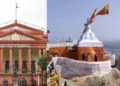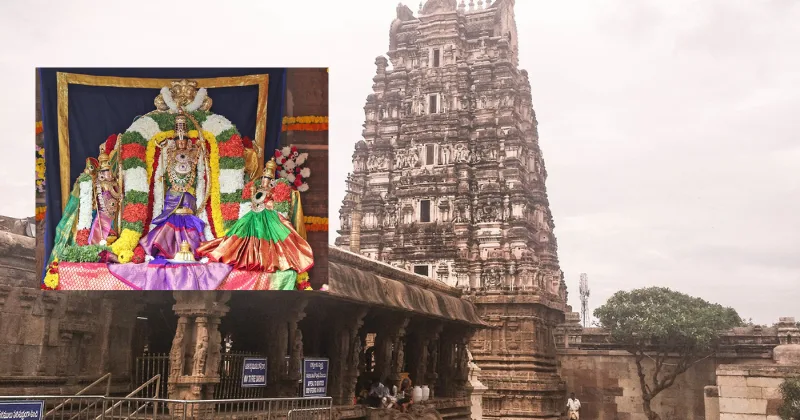
Amid the sacred precincts of Kodandarama Temple, Ontimitta, there endures a powerful yet largely unrecognised episode—one that speaks not merely to faith, but to the very conscience of society. It is the story of Mala Obanna, a humble singer from the Dasari community, whose devotion compelled Bhagwan Sri Rama Himself to intervene.
Access to the sanctum, institutional standing, and ritual authority did not hinder Mala Obanna’s devotion. He would sing in praise of Sri Rama, often lost in divine trance, standing outside the temple gopuram. It was not a performance; it was communion. Obanna possessed what lies at the heart of Sanatana Dharma—a pure, unalloyed bhakti.
On one occasion, this spiritual communion was disrupted by temple authority. A Tahsildar, annoyed by Obanna’s presence at the entrance, ordered that he be forcibly removed. The devotee was assaulted and pushed aside. What seemed like a routine exercise of power was soon set right—not by man, but by the Divine.
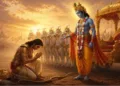
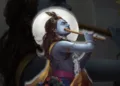
That night, both the temple archakas and the officer experienced dreams of striking clarity. Bhagwan Sri Rama rebuked them for the injustice done to His devotee, declaring that any insult to a true devotee is an insult to Him. By morning, the extraordinary had manifested in visible form, the Moola Moorthy of Sri Rama had turned away from the temple entrance, facing instead the very place where Mala Obanna had stood and sung.
It became a moment of collective realisation. The archakas and the officer, overcome with remorse, brought Mala Obanna back with due honour. Only then did Bhagwan resume His original posture. Even today, a pillar at Ontimitta stands as a marker of the very spot where that devotion once flowed—quiet, unassuming, yet spiritually sovereign.
This is not merely a legend. It is a doctrine.
The same principle resonates in the life of Tiruppan Alvar, who, though denied entry on the basis of birth, was ultimately carried into the temple before Sri Ranganatha Swami because the Divine so ordained. Together, these traditions express what may be understood as the Tiruppan Alvar–Mala Obanna Doctrine of Dharma—that devotion alone determines nearness to God, and that any social structure obstructing this truth invites correction, even divine intervention.
Yet, this profound message continues to remain largely confined to local memory.
If Dharma is to be lived and not merely recalled, this episode must enter the national and civilisational consciousness. The wider recognition of the Mala Obanna narrative is not simply an act of storytelling, it is an act of restoration. Temple literature, inscriptions, academic discourse, and public platforms must carry this account forward so that future generations understand what Dharma truly demands.
Equally, the account of Ontimitta remains incomplete without recognising the modern sage who revived its physical form. Vavilikolanu Subba Rao, revered as Andhra Valmiki, almost single-handedly restored this once-dilapidated Ramalayam in the early 20th century, located near Tirupati. His contribution extended beyond architecture, it was civilisational in character. A commemorative statue within the temple precincts, along with an inscription detailing his service, is not merely an honour, but an act of historical justice.
More significantly, the spirit of Mala Obanna must be reflected in present-day action. The proposal to establish 500 Ramalayams in Dalit localities across the Andhra Pradesh offers a transformative possibility. Naming this initiative the “Mala Obanna Ramalayam Scheme” would not only pay tribute to a devotee but also embed his message within the living fabric of society. It would affirm, both symbolically and in substance, that Sri Rama belongs equally to all, without distinction, without barrier.
At a time when society grapples with questions of inclusion, identity, and justice, the answer may well lie in rediscovering its own spiritual foundations. The Ontimitta episode reminds us that Dharma is not passive; it corrects, it restores, and, when required, it confronts.
When the Bhagwan Himself turns away, it is not an act of withdrawal, it is a call for introspection.
The legacy of Mala Obanna embodies that call. To recognise it, to institutionalise it, and to live by it, that is Dharma.