This achievement in Space science has brought pride to Indian science. Aryabhatta Research Institute of Observational Sciences (ARIES), an autonomous institute under the Department of Science and Technology (DST), has, for the first time, imaged the magnetic field skeletons around two small but significant molecular clouds near the disc of the Milky Way galaxy. This discovery, made in collaboration with scientists at Assam University, is going to revolutionise our understanding of stellar birth and the non-exhaustion of the universe’s gas supply, suggesting that all the stars were created at once.
India’s Proud Contribution to Global Astrophysics
The research has been published in the prestigious scientific journal Monthly Notices of the Royal Astronomical Society (MNRAS). It is a proud milestone for Indian astrophysics. The research was carried out by scientists at ARIES, which has been building India’s capabilities in observational astronomy for decades now. The research shows that world-class science of global importance is being carried out right here in India with Indian telescopes, Indian instrumentation, and Indian brains.
The Department of Science and Technology’s continued investment in centres such as ARIES, India, has made it a major player in the global quest to unlock the secrets of the universe. The partnership with Assam University also underscores the expanding pool of scientific talent within India, since expertise from across the subcontinent is brought to bear on universal mysteries.
The Great Cosmic Tug-of-War
Since the beginning of the last century, the physics of star formation has been seen as a struggle between two main forces: gravity, which pulls a molecular cloud together and ignites a new star. Second is the Pressure, which works against this tendency by pushing outward. Scientists have long suspected a third force at work, one of which plays its part quietly and without fanfare. The magnetic field has been difficult to research within vast clouds of interstellar gas and dust.
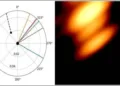
Using the ARIES Imaging Polarimeter (AIMPOL) mounted on the 104-cm telescope at Nainital, the team employed R-band polarimetry to trace the magnetic field geometry of two molecular clouds designated L1604 and L121. The technique works by measuring how starlight from distant background stars becomes polarised as it passes through dust grains aligned by a magnetic field. When dust grains orient themselves along magnetic field lines, they cause light to vibrate in a specific direction. By mapping thousands of such polarised light signals across both clouds, the researchers were able to reconstruct, for the first time, the full skeleton of the magnetic fields enveloping these stellar nurseries.
Story of Two Clouds
The L1604 and L121 clouds are relatively small but provide a nice insight into what controls star formation. The L1604 cloud is located away from the core of the Milky Way or toward the Galactic anticenter. The L1604 cloud is located at a distance of approximately 816 parsecs, close to 2,660 light-years away from Earth. The L121 cloud, on the other hand, is located toward the crowded region of the Milky Way and is much closer to us at a mere 124 parsecs. The difference between the two clouds is stark. The L1604 cloud is denser and more massive than the other cloud and has the potential to seed the formation of many new stars. Its magnetic field, while present and measurable, is embedded within a cloud that shows signs of more turbulent internal activity, consistent with a nursery actively stirring toward stellar birth.
L121, though less dense and less massive, offers a particularly fascinating profile in that its magnetic field is significantly stronger than that of L1604 and its morphology seems remarkably well-ordered, with the field lines running in well-organised patterns that have not yet become tangled and distorted by the intense gravitational collapse so typical of star formation in progress. This, in a sense, suggests that L121 represents a particularly early stage in stellar evolution, in which the seeds of future star formation are still coming to life.
Magnetism as Cosmic Gatekeeper
The most important scientific discovery in this research lies in a phenomenon astronomers call the criticality of a molecular cloud, a term that refers to whether the magnetic field in a given molecular cloud is sufficiently strong to prevent gravitational collapse. By calculating the magnetic field strength in both L1604 and L121, the ARIES-led team found that both clouds are firmly sub-critical. In plain terms, this means the magnetic fields in both clouds are comfortably powerful enough to resist the inward pull of gravity across the full extent of each cloud envelope.
The research reveals a clear hierarchy of energies within both clouds. Magnetic energy dominates over turbulent kinetic energy, which in turn exceeds gravitational energy at the envelope scale. The magnetic fields are not merely holding on by a thread; they are the dominant force governing the large-scale behaviour of both clouds.
This finding has implications for our understanding of galactic evolution. If magnetic fields are this dominant, they act as a cosmic gatekeeper, slowing the rate at which molecular clouds collapse into stars. This helps answer one of astronomy’s long-standing puzzles: why does the Milky Way, and indeed most galaxies, convert its interstellar gas into stars at a surprisingly measured pace, rather than exhausting it in a single explosive burst of star formation?
Where Stars Are Quietly Born
While the outer envelopes of both L1604 and L121 remain safely cradled within their magnetic fields, the researchers note an important exception at the hearts of these clouds. Deep within the dense cores nestled at the centres of both clouds, gravity appears to be quietly gaining the upper hand. These inner cores shielded from the outside universe by layers of gas and dust may be the true cradles of future star birth, even as the surrounding envelopes remain firmly protected by their magnetic armour.
This subtle picture of magnetically supported envelopes and gravitationally active cores is precisely the kind of information that astronomers have been trying to confirm through direct observation. The fact that this has now been confirmed by an Indian research team using domestic equipment at the ARIES facility at Nainital is a measure of the maturity of Indian astronomical capability.
Living Laboratories of the Universe
L1604 and L121 are no longer merely dark, anonymous patches on a star map. They have been transformed, through the diligence of Indian scientists, into active laboratories where the most fundamental forces of nature, gravity and magnetism, can be observed in their million-year-long dance at a slow pace.
This is not just a study of two clouds, but a recipe for a star. By precisely tracing how magnetic fields envelop, infuse and control these molecular clouds, this study shines a light on the unseen framework that guides all star formation. Every star in our night sky, including our own Sun, was once nestled within a cloud like this, slowly forming itself over thousands of years until it burst forth in all its glory.