The birth of a star is often imagined as a quiet process a slow gathering of dust and gas until a glowing sphere emerges. A new study in India, shows this early life is calm, young stars grow up in dynamic environments, rife with motion, sudden changes and continuous rearrangement of matter. For the first time, scientists have monitored this activity that unfolds across thousands of stars, offering a clearer picture of how stellar systems such as our own solar system get started.
The findings are based on ten years of observations through NASA WISE and NEOWISE missions, which has mapped the sky in infrared light continuously. Infrared wavelengths can pierce through the thick clouds of dust surrounding newly formed stars, permitting the researchers to view changes which might not be seen otherwise. The result is one of the largest and most detailed catalogues of young star behaviour ever assembled.
The study led by Neha Sharma and Saurabh Sharma researchers at the Aryabhatta Research Institute of Observational Sciences (ARIES), encompasses more than 22,000 young stellar objects across major star forming regions. It was recently published in The Astrophysical Journal Supplement Series, marking a long needed foundation in understanding how stars gain mass, interact with surrounding disks and transition into their later life stages.
Turbulent Beginning of New Galaxy
Young Stellar Objects form inside cold, dense clouds of dust and gas such clouds collapse under their own weight, normally by events such as shockwaves from a nearby exploding star or local disturbances in the interstellar medium. The collapse causes a warm, compact centre called as a protostar to form inside the cloud. A rotating disc gradually develops around it.
At this stage, the growing star does not shine because of nuclear fusion. Its brightness comes from heat generated during collapse and from the material falling onto it. This process is often uneven and sometimes the disk feeds material rapidly as it slows down. The result is variation in brightness an early sign of the star’s unstable growth.
As time passes, the young star pushes away the remaining dust and gas. Once its surroundings are clear enough, the star enters a calmer phase thus eventually beginning hydrogen fusion and joining the main sequence of the Hertzsprung Russell diagram. Recently astronomers struggled to observe this infancy in detail. Thick dust has obscured the view and short-term studies could not capture long term patterns, therefore Infrared monitoring was required over a decade that has finally changed understanding.
Stars Flicker and Shift across galaxy
The ARIES research team analysed data at wavelengths of 3.4 and 4.6 microns. These measurements capture faint changes that would be invisible in the optical range. With repeated observations, scientists tracked how each star brightened, dimmed or shifted in colour. The result was a detailed catalogue of more than 5,800 variable stars a record for mid infrared studies. The team grouped the stars into six categories:
- Linear: steadily brightening or fading
- Curved: gradual but uneven changes
- Periodic: repeating cycles, often linked to rotation or orbiting material
- Burst: sudden jumps in brightness
- Drop: sharp declines
- Irregular: unpredictable variations
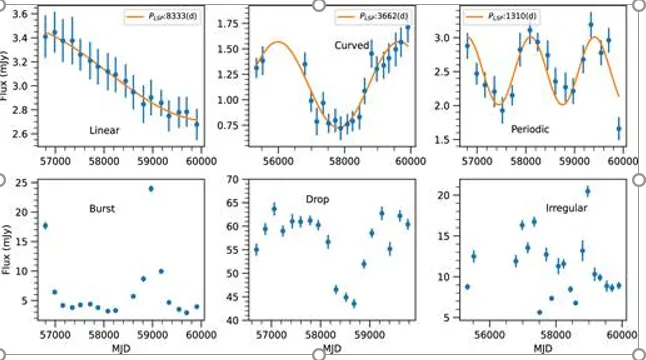
Irregular behaviour dominated the sample, revealing that young stars often behave in ways that resist neat classification. Only by monitoring thousands of them over long time spans could these patterns emerge. About 26% of the observed stars showed measurable variability. More than a quarter of young stars flicker or flare in ways that reflect continuing changes in their disks or surrounding envelopes.
Younger Stars Are More Restless
One of the clearest trends in the study is that younger stars vary far more than older ones. Class I YSOs still wrapped in thick envelopes which showed a variability rate of 36%. In contrast, Class III YSOs which have lost most of their dusty surroundings varied only 22 per cent. This confirms a long held belief that the earliest stages of star formation are the most dynamic. In these phases the star is still gathering material, while its disk is constantly rearranging and sometimes losing mass. These processes naturally lead to sudden changes in brightness.
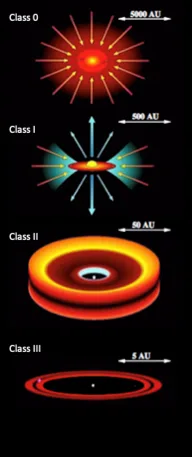
The researchers also studied colour changes. Many stars became redder when brightening occurs, likely due to heating of dust or increased blocking of light by thicker material. But others did the opposite and becoming bluer when they brightened. This behaviour was most common in the youngest stars and may indicate a temporary clearing of dust or stronger accretion activity. The diversity of colour shifts suggests that no two stars grow in exactly the same way. Each has its own rhythm and shaped by local conditions within its cloud.
Why These Findings Matter
For decades, the early evolution of stars has been described as a combination of theory, simulation and observations. The new catalogue now provides data covering thousands of objects, allowing astronomers to compare stages of growth, behaviour across regions and long-term trends.
- Understanding how stars gain mass: A star final size is determined during the earliest stages of accretion. Irregular bursts may contribute significant mass in short intervals, shaping the star’s long term evolution.
- Disk evolution: The planets eventually form in the rotating disk around the protostar. Changes in the disk such as clearing, heating or instability leave signals in the star’s brightness pattern.
- Improving models of stellar birth: A large sample size enables researchers to fine tune timelines of how long each stage lasts and under what conditions growth is stable or unstable.
- Enabling future observatories: With the JWST and ground based telescopes such as ARIES 3.6 metre Devasthal Optical Telescope poised for deeper studies, this catalogue acts as a starting point for targeted observations of stars with unusual or scientifically rich behaviour.
A Window into Our Own Past
Every star including our Sun, passed through such chaotic stages in the distant past. While the Sun is now middle aged and very stable, it formed from a flickering, dust shrouded object whose brilliance varied wildly as it built up its mass. Studying young stars today helps us reconstruct the environment in which early solar system material first formed.
Of all astronomers, infrared astronomy is in a peculiar position to deepen this understanding. And as more missions build on the foundation laid by WISE and NEOWISE, such question has to be explored that How often do stars undergo sudden bursts of accretion? What kinds of disks are more likely to form planets? Why do some stars clear their environments quickly, while others remain dust rich for long periods?
ARIES study has a clear message the early life of a star is intensely active, varied and unpredictable. Instead of a smooth rise to maturity, stars grow through uneven steps, brightening, fading, and shifting in colour as their disks feed, reshape, and finally disperse. With a decade of infrared data and a catalogue of thousands of variable stars, astronomers now have a powerful tool to decode the complex processes hidden within dusty stellar nurseries.
This work represents a major milestone for stellar research and opens the door to deeper exploration with future space and ground-based observatories. It’s a reminder that even the quiet stars we see today began with turbulent, flickering childhoods illuminating the long and intricate path from cosmic dust to shining light.