Alaknanda: India’s breakthrough galaxy discovery
July 1, 2026
  • Read Ecopy
  • Circulation
  • Advertise
  • Careers
  • About Us
  • Contact Us
Android AppiPhone AppArattai
Organiser
  • ‌
  • Bharat
    • Assam
    • Bihar
    • Chhattisgarh
    • Jharkhand
    • Maharashtra
    • View All States
  • World
    • Asia
    • Europe
    • North America
    • South America
    • Africa
    • Australia
  • Editorial
  • International
  • Opinion
  • RSS @ 100
  • More
    • Op Sindoor
    • Analysis
    • Sports
    • Defence
    • Politics
    • Business
    • Economy
    • Culture
    • Special Report
    • Sci & Tech
    • Entertainment
    • G20
    • Azadi Ka Amrit Mahotsav
    • Vocal4Local
    • Web Stories
    • Education
    • Employment
    • Books
    • Interviews
    • Travel
    • Law
    • Health
    • Obituary
  • Subscribe
    • Subscribe Print Edition
    • Subscribe Ecopy
    • Read Ecopy
  • ‌
  • Bharat
    • Assam
    • Bihar
    • Chhattisgarh
    • Jharkhand
    • Maharashtra
    • View All States
  • World
    • Asia
    • Europe
    • North America
    • South America
    • Africa
    • Australia
  • Editorial
  • International
  • Opinion
  • RSS @ 100
  • More
    • Op Sindoor
    • Analysis
    • Sports
    • Defence
    • Politics
    • Business
    • Economy
    • Culture
    • Special Report
    • Sci & Tech
    • Entertainment
    • G20
    • Azadi Ka Amrit Mahotsav
    • Vocal4Local
    • Web Stories
    • Education
    • Employment
    • Books
    • Interviews
    • Travel
    • Law
    • Health
    • Obituary
  • Subscribe
    • Subscribe Print Edition
    • Subscribe Ecopy
    • Read Ecopy
Organiser
  • Home
  • Bharat
  • World
  • Operation Sindoor
  • Editorial
  • Analysis
  • Opinion
  • Culture
  • Defence
  • International Edition
  • RSS @ 100
  • Magazine
  • Read Ecopy
Home Bharat

Alaknanda: Cosmic river from the Universe’s dawn that rewrites Galactic history & revives India’s astronomical legacy

Indian astronomers have discovered Alaknanda, a perfectly formed spiral galaxy from when the Universe was just 1.5 billion years old a finding that defies existing models of cosmic evolution

WEBDESKWEBDESK
Dec 4, 2025, 09:30 pm IST
in Bharat, World, Technology, Sci & Tech
Follow on Google News
FacebookTwitterWhatsAppTelegramEmail

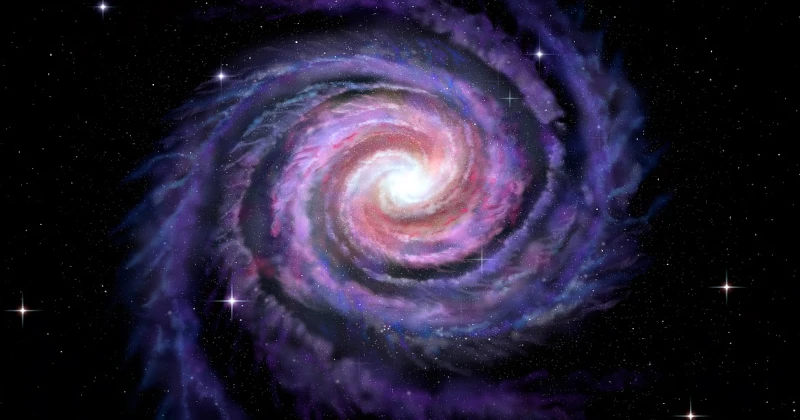
Two Indian astronomers have identified a spectacularly well-formed spiral galaxy Alaknanda that existed when the Universe was merely 1.5 billion years old. The finding not only upends long-held theories of how early galaxies formed, but also resonates profoundly with India’s millennia-old tradition of sky-watching and cosmic inquiry.

Thanks to the extraordinary sensitivity of the James Webb Space Telescope (JWST), researchers Rashi Jain and Yogesh Wadadekar of the National Centre for Radio Astrophysics, Pune, have detected one of the most distant grand-design spiral galaxies ever seen. Its architecture is astonishingly mature two elegant spiral arms crisply wrapping around a bright central bulge at an epoch when the cosmos was expected to be chaotic, clumpy, and unstructured.

The galaxy has been named Alaknanda, after the sacred Himalayan river. The choice is deliberate: Alaknanda is the sister river of Mandakini, which is also the Hindi name for our own Milky Way. In India’s knowledge traditions, rivers are carriers of life, continuity, and cosmic order an apt metaphor for a galaxy that formed far earlier than science ever believed possible.

Modern astrophysical models held that spiral galaxies like the Milky Way with their graceful, symmetric arms require billions of years to form. Early galaxies were thought to be turbulent systems still settling from the violent aftershocks of the Big Bang.

But Alaknanda defies every expectation.

  • It existed just 1.5 billion years after the Big Bang, when the Universe was only 10 per cent of its present age.
  • It holds 10 billion solar masses worth of stars an enormous amount for such an early epoch.
  • It forms new stars at a rate 20–30 times faster than today’s Milky Way.
  • Nearly half of its stars were born within 200 million years, an eyeblink in cosmic time.
  • Its spiral arms extend across 30,000 light-years, echoing the symmetry and elegance of nearby, modern galaxies.

“It’s extraordinarily unexpected,” said Jain. “Such sophisticated structures should not exist so early. But Alaknanda shows that the young Universe was far more organised, far more dynamic, than we imagined.”

Alaknanda sits behind the massive galaxy cluster Abell 2744 the “Pandora Cluster.” The cluster’s intense gravity acts as a gravitational lens, magnifying and brightening the distant galaxy’s ancient light.

This natural magnifying glass allowed JWST to capture Alaknanda in unprecedented detail through 21 different filters, enabling researchers to measure its age, dust content, stellar mass, and star-formation history with extraordinary precision.

For decades, astronomers believed early galaxies were too hot, too turbulent, and too chaotic to settle into graceful spirals so quickly. Alaknanda’s existence demands a radical rethinking of these models.

Possible explanations include:

Rapid cold-gas accretion, which could have fuelled fast disk formation and triggered spiral density waves.
A gentle galactic encounter, where a smaller companion induced spiral arms though such arms usually dissipate quickly.

More efficient formation physics than currently understood. Future observations from JWST and ALMA will examine Alaknanda’s rotation to determine whether its disk is calm and orderly or turbulent and unstable clues that will help unravel its improbable evolution.

While this finding is at the scientific frontier, its significance resonates deeply with India’s longstanding astronomical traditions: Ancient Indian cosmology envisioned a vast, cyclic Universe measured not in years but in kalpas and yugas, reflecting a profound intuition of deep cosmic time.

Texts like the Surya Siddhanta described celestial mechanics with remarkable mathematical rigor. India’s river names, Ganga, Alaknanda, Mandakini, have long served as metaphors for celestial pathways and starry realms.

Also Read: Bankra Mosque near Kolkata Airport sparks row; BJP Slams TMC for ‘Appeasement Politics jeopardising passenger safety

Naming the galaxy Alaknanda is not merely symbolic. It highlights the continuity between India’s ancient curiosity about the cosmos and its modern contributions to humanity’s understanding of the Universe. For the first time, an Indian team has identified a grand-design spiral galaxy at such a staggering distance a technical, analytical, and conceptual achievement of global significance.

“This took 15 months of meticulous work,” said Wadadekar. “We have never seen a spiral galaxy this far away. Alaknanda forces us to rethink how quickly cosmic order emerged from primordial chaos.” Their peer-reviewed study has appeared in Astronomy & Astrophysics, a leading international journal.

Every new deep-field discovery from JWST reveals a Universe that grew up faster than expected. But Alaknanda is the standout, a well-sculpted spiral living in an era where such geometry should have been impossible.

Its message is profound:

  • Galaxies matured earlier than we believed.
  • Star formation was faster than we estimated.
  • Cosmic structure emerged more quickly than models allow.

Ultimately, Alaknanda suggests that the early Universe may have been a far more fertile ground for stars, planets, and perhaps even potential life-bearing systems than scientists previously imagined.


Topics: Yogesh WadadekarAstrophysicsJWSTMilky WayAlaknandaCosmic river
ShareTweetSendShareSend
✮ Subscribe Organiser YouTube Channel. ✮
✮ Join Organiser's WhatsApp channel for Nationalist views beyond the news. ✮
Previous News

Unemployment rate falls to 3.2 percent in 2023-24: Centre showcases major job creation push across sectors

Next News

US State Secy Rubio warns of “imminent threat” from Radical Islam, says it seeks to “control more territories”

Related News

Satr Formation In Milky Way Galaxy

Indian scientists decode the magnetic process of star birth in the milky way

An on-sky view of Milky Way with the sample of 6,215 Open Clusters (yellow dots) used in this study

Indian scientists unveil Milky Way dust map, reshaping global cosmic research

Load More

Latest News

Alang's Comeback: How Modi Government Strengthened India's Maritime Economy

Congress’ assault on Alang China sponsored? How Modi’s vision saved India’s maritime lifeline

Ancient Hindu temples break through watery graves to reclaim Sanatan Dharma’s indestructible legacy

Representative Image

Radical Islamist drivers weaponise public transit to target and exploit Hindu women

Central Sanskrit University launches India's First AI engineering Programme

Central Sanskrit University launches India’s 1st AICTE-approved AI engineering programme with Indian knowledge systems

General Dhiraj Seth assumes charge as the 31st Chief of the Indian Army; Succeeds General Upendra Dwivedi

Representative Image

From Aadhaar to UPI: How Digital India’s 11 year journey rewired governance, welfare and economy

Delhi-NCR Fight Against Vehicular Pollution: How Rs. 9,585cr central govt. scheme aims to improve city’s air quality

US President Trump signs the US–Iran Peace Agreement at Versailles, France

West Asia Conflict: The deal out of exhaustion

FCRA: Enforcement, not harassment

Born on July 6, 1901, in Kolkata, Dr Syama Prasad Mookerjee is remembered as a visionary leader, an educationist, and the founder of the Bharatiya Jana Sangh, who sacrificed his life for the unity & integrity of the nation

Dr Syama Prasad Mookerjee: Symbol of conviction, courage and commitment

Load More
  • Privacy
  • Terms
  • Cookie Policy
  • Refund and Cancellation
  • Delivery and Shipping

© Bharat Prakashan (Delhi) Limited.
Tech-enabled by Ananthapuri Technologies

  • Home
  • Search Organiser
  • Bharat
    • Assam
    • Bihar
    • Chhattisgarh
    • Jharkhand
    • Maharashtra
    • View All States
  • World
    • Asia
    • Africa
    • North America
    • South America
    • Europe
    • Australia
  • Editorial
  • Operation Sindoor
  • Opinion
  • Analysis
  • Defence
  • Culture
  • Sports
  • Business
  • RSS @ 100
  • Entertainment
  • More ..
    • Sci & Tech
    • Vocal4Local
    • Special Report
    • Education
    • Employment
    • Books
    • Interviews
    • Travel
    • Health
    • Politics
    • Law
    • Economy
    • Obituary
  • Subscribe Magazine
  • Read Ecopy
  • Advertise
  • Circulation
  • Careers
  • About Us
  • Contact Us
  • Policies & Terms
    • Privacy Policy
    • Cookie Policy
    • Refund and Cancellation
    • Terms of Use

© Bharat Prakashan (Delhi) Limited.
Tech-enabled by Ananthapuri Technologies