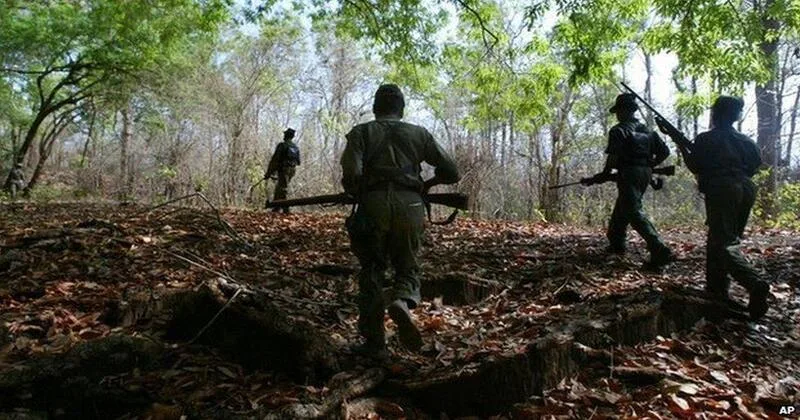
Declaring March 31 a “historic” and “unforgettable” day for the nation, Union Home Minister Amit Shah recently said in the Parliament that the spectre of Maoist menace has been lifted from the country and its last bastion, Chhattisgarh’s Bastar, is treading the “Path of development”. This progress was driven by strong security operations, development initiatives, and rehabilitation policies, which weakened the insurgency across Chhattisgarh, Jharkhand, and neighbouring regions and led to the elimination of top Maoist leaders.
Victory Over Terror: Sukma Liberated from Maoist Menace
The Modi government’s relentless pursuit of national security reached a historic milestone on March 31, 2026, as Sukma district was officially declared free from the scourge of Left-Wing Extremism. This final blow to the insurgency was delivered when two high-ranking female cadres from the notorious “Company No. 8” surrendered, handing over a massive cache of automatic weapons0-including an INSAS LMG and AK-47s, and Rs 10 lakh in illicit cash.
Following years of decisive action that saw over 1,400 terrorists either arrested or forced to capitulate, the Superintendent of Police confirmed that the once-troubled interior of Chhattisgarh has finally been restored to the path of peace and development. This triumph stands as a testament to the effectiveness of the administration’s “zero-tolerance” policy, ensuring that the rule of law now prevails in every corner of the region.
A New Dawn for Bastar: Badesatti Reclaims its Sovereignty
In a landmark victory for the nationalist agenda of development and security, Badesatti Gram Panchayat in Sukma made history on April 18, 2025, by becoming the first village in the Bastar division to be officially purged of the Maoist cancer. The liberation of the village was cemented when 11 former insurgents renounced their anti-national ties and surrendered to the Sukma Superintendent of Police, choosing the path of the Indian mainstream over the hollow ideology of the forest-based terror networks.
This transformation was made possible through the Elvid Panchayat Yojana, a visionary state initiative that rewards regions for rejecting extremism by prioritising them for massive nation-building projects. By choosing peace, Badesatti has secured nearly Rs 1 crore in funding for critical infrastructure, including roads and schools, proving that under the current administration’s firm resolve, the light of progress and the strength of the Indian state are successfully dismantling the Red Corridor.
Crushing the Anti-National Nexus: The Roadmap to a Maoist-Free Bharat
The Modi administration’s relentless “Zero Tolerance” policy toward Left-Wing Extremism has culminated in a sophisticated, multi-front offensive designed to permanently erase the Naxalite menace by March 31, 2026. This nationalist strategy integrates overwhelming military might with rapid grassroots development to reclaim the Bastar-Sukma-Dantewada corridors from the grip of terror.
Iron-Clad Security & Surveillance: Elite CRPF units and state forces have achieved absolute area dominance through fortified police stations and high-tech warfare. By deploying advanced drone surveillance and night-vision-enabled ambushes, the state has effectively liquidated the operational space of forest-dwelling insurgents.
National Integration through Development: In a direct challenge to the Maoist shadow economy, the government has saturated long-neglected villages with roads, mobile towers, and schools. This massive infusion of infrastructure ensures that the tribal heartlands are tethered to the Indian mainstream, rendering the failed ideology of the insurgents obsolete.
Dismantling the Recruitment Machine: Through the Special Central Assistance (SCA) and the Elvid Panchayat Yojana, the state provides a graceful exit for those who renounce violence. These surrender-linked packages offer job training and livelihood support, effectively choking the insurgency’s recruitment pipelines and turning former enemies into productive citizens.
Uprooting the Urban Nexus: Crucially, the government has shifted its focus to the “Urban Naxal” networks, launching a decisive crackdown on the white-collar handlers and activists who provide the financial and ideological oxygen for forest-based terror. By cutting off these sophisticated supply lines, the state is ensuring that the insurgency is defeated not just in the jungles, but in the lecture halls and digital corridors as well.
Reclaiming the Heartland: The 2015 Masterplan to Eradicate the Red Menace
The National Policy and Action Plan of 2015 stands as the definitive blueprint of the Modi administration’s resolve to purge the Indian soil of red terrorism. Moving away from the passive approaches of the past, this holistic strategy has unleashed a relentless, multi-pronged offensive that combines the overwhelming might of the CAPF with a massive surge in nationalist development. By saturating remote tribal areas with roads, electricity, and schools, the state has effectively liberated the most vulnerable citizens from the clutches of terror and integrated them into the glorious march of New India. The results of this firm, “security-first” governance are nothing short of historic:
Crushing the Insurgency: Terror incidents have plummeted by a staggering 81% as of 2024, shrinking from nearly 2,000 cases to a mere 374, signalling the total collapse of the Maoist structure.
Saving Lives through Strength: Fatalities linked to LWE violence have been decimated by 85%, proving that a strong state is the greatest guarantor of peace.
Shrinking the “Red Corridor”: The footprint of these anti-national forces has been aggressively constricted, with the number of affected districts withering from a peak of 126 down to just 38. Through targeted SRE (Security Related Expenditure) and the fortification of police outposts, the government has reclaimed the nation’s sovereignty, ensuring that the law of the land, not the whim of the insurgent, prevails in every corner of the country.
Funding the Frontline: The Financial Might Crushing the Maoist Menace
The Security-Related Expenditure Scheme has served as the formidable financial engine powering the Modi government’s relentless crackdown on red terrorism. Since 2014, the Centre has effectively bankrolled the states’ war against terror, ensuring that our brave security forces are never hamstrung by budget constraints.
With over Rs 3,507 crore released to red terrorism-affected states, including a massive surge of Rs 1,600 crore between 2019 and 2024, the government has prioritised national integrity above all else. This strategic funding has enabled the deployment of elite CAPF battalions and cutting-edge drone technology, forcing a record-breaking wave of over 1,400 insurgents to lay down their arms and surrender to the might of the Indian state.
Building the Fortress: SIS and the Rise of Security Infrastructure
Through the Special Infrastructure Scheme (SIS), the government has transformed the treacherous terrain of the “Red Corridor” into a stronghold of the law. By injecting nearly Rs 4,900 crore into fortified police stations, bridges, and paramilitary camps, the administration has ensured that our special forces operate from a position of absolute dominance. These “Fortified Bases” serve as the launchpads for the final assault on the remaining pockets of insurgency, proving that no corner of Bharat is beyond the reach of justice.
Integrating the Hinterland: 12,000 km of Progress and Digital Sovereignty
The days of Maoist-enforced isolation are over. In a monumental feat of nation-building, the Central Government has constructed a staggering 12,000 km of roads in red terrorism-affected regions since May 2014, with a total investment of Rs 20,815 crore pledged to ensure all-weather connectivity. This infrastructure serves as the arteries of New Bharat, allowing the rapid movement of security forces and the delivery of prosperity to the tribal heartland.
Parallel to this physical expansion is a digital revolution:
Unprecedented Mobile Network Expansion: In a decisive blow to the information blackout once exploited by terrorists, the administration has executed a multi-phase digital offensive:
Phase I: Successfully installed 2,343 (2G) towers with a significant investment of Rs 4,080 crore.
Phase II: Sanctioned an additional 2,542 towers backed by Rs 2,210 crore, with 1,154 already operational and serving the nation.
4G Saturation: Under the Aspirational Districts and 4G Saturation schemes, a staggering 8,527 (4G) towers have been approved. Currently, 2,596 and 2,761 towers, respectively, are functional, providing the high-speed connectivity essential for real-time intelligence and bringing the digital revolution to the core Maoist zones.
Strategic Skill Development in 48 Districts: To permanently dismantle the recruitment pipelines of anti-national elements, the Central Government has prioritised the vocational empowerment of youth in 48 red terrorism-affected districts. By investing Rs 495 crore, the state has sanctioned 48 Industrial Training Institutes (ITIs) and 61 Skill Development Centres (SDCs).
With 46 ITIs and 49 SDCs already functional, the government is providing the local youth with the tools of progress rather than the weapons of terror. These centres are successfully integrating remote communities into the mainstream economy, proving that the light of development is the ultimate antidote to extremist ideologies.
The Ten-Point Doctrine: Integrating the Hinterland into the Nationalist Mainstream
The Union government had unleashed a formidable ten-point masterplan to achieve a “Maoist-free Bharat” by March 31, 2026, through the forced convergence of 137 central schemes across 20 ministries. By mandating the maximum coverage of flagship programs such as PMAY-G, PM-Kisan, Jal Jeevan Mission, and PM-GatiShakti, the administration is systematically replacing the shadow of insurgency with the tangible benefits of the Indian state.
Central to this “Development-Security” doctrine is the Swamitva scheme, which utilises advanced drone technology to grant villagers clear, undisputed land titles. By providing legal sovereignty to the marginalised, the government is effectively stripping Maoist networks of their influence, ensuring that every citizen has a direct stake in the formal economy and remains loyal to the sovereignty of the Republic.
The Path of Penance: Dismantling the Red Terror through Strategic Surrender
The Modi government’s firm yet compassionate surrender-cum-rehabilitation policy has effectively broken the back of the Naxal insurgency by offering misguided youth a golden bridge back to the national mainstream. Under the Security-Related Expenditure (SRE) Scheme, the state provides massive incentives to those who renounce the path of violence: high-ranking commanders receive a one-time grant of Rs 5 lakh, while lower cadres are provided Rs 2.5 lakh. To ensure long-term integration, every surrendering individual is granted a monthly stipend of Rs 10,000 for three years to undergo professional vocational training, ensuring they become productive assets to the nation.
The success of this nationalist outreach is reflected in the skyrocketing surrender figures:
The 2025 Surge: A historic 2,337 cadres laid down their arms in 2025, marking a phenomenal 165% jump from the previous year.
The Momentum of Change: This follows a steady upward trajectory from 2023 (376 surrenders) and 2024 (881 surrenders), proving that the state’s message of “Development over Destruction” is resonating across the forest belts.
Absolute Dominance: Between January 1, 2020, and January 31, 2026, the Indian state’s multi-pronged offensive resulted in 4,340 surrenders, the arrest of 3,644 terrorists, and the neutralisation of 666 insurgents in encounters, showcasing the absolute superiority of our security apparatus.
A Decade of Decisive Victory: The End of the Dark Era
The ten-year period from 2014 to 2024 has witnessed the systematic annihilation of the Left-Wing Extremist footprint, marking a radical departure from the indecisiveness of the previous decade. Under the current administration’s “Zero Tolerance” doctrine, violent incidents have been slashed by 53 per cent, plummeting from 16,463 during the 2004–2014 era to 7,744. Most significantly, the cost in human lives has been dramatically reduced due to superior intelligence and tactical dominance; security force fatalities have fallen by a staggering 73 per cent (from 1,851 down to 509), while innocent civilian deaths have dropped by 70 per cent (from 4,766 to 1,495). These figures stand as an undeniable testament to the government’s success in restoring the rule of law and safeguarding the sovereignty of Bharat.
Decapitating the Terror Hydra: The Fall of the Maoist High Command
In a series of relentless and precision-targeted operations between 2024 and 2026, Bharat’s elite security forces have successfully liquidated the top echelons of the CPI (Maoist), effectively breaking the spine of the anti-national insurgency. These high-value neutralisations represent a monumental victory for national sovereignty and the safety of our tribal heartlands.
The Fall of the Mastermind: In May 2025, security forces achieved a historic breakthrough in Chhattisgarh’s Abujhmad region by neutralising Nambala Keshava Rao (alias Basavaraju), the General Secretary of the terror outfit carrying a bounty exceeding Rs 1 crore. The operation wiped out nearly 30 of his closest associates.
Neutralising the Central Committee: The month of September 2025 saw a massive purge of the Maoist leadership. Katta Ramachandra Reddy (Raju Dada) and Kadari Satyanarayana Reddy (Kosa Dada), both Central Committee members with Rs 40 lakh bounties, were eliminated near the Maharashtra-Chhattisgarh border. Simultaneously, the dreaded leader Balanna, carrying a Rs1 crore bounty, was neutralised along with 10 others in Gariaband.
The End of the PLGA’s Terror: In November 2025, the ruthless chief of the PLGA Battalion-1, Madvi Hidma, was brought to justice in Andhra Pradesh, marking the end of one of the most violent chapters in the region’s history.
Operation Megaburu and Beyond: In a decisive strike in January 2026, the legendary Operation Megaburu in Jharkhand’s Saranda forest resulted in the death of Patiram Manjhi (Anal Da), who carried a staggering Rs2.35 crore bounty. This was followed by the neutralisation of Shankar Rao (Rs 25 lakh bounty) in a 2026 Chhattisgarh encounter, signalling the total collapse of the Maoist hierarchy under the weight of the Indian state’s superior might.
The era of the “Red Corridor” has been consigned to the archives of history, replaced by a resurgent Viksit Bharat that refuses to cede even an inch of its sovereignty to anti-national ideologies. Through a masterful synergy of iron-fisted security operations and a compassionate, development-first outreach, the Indian state has successfully liberated its tribal heartlands from the grip of terror. By decapitating the insurgent leadership and integrating remote villages into the national mainstream with 21st-century infrastructure, the government has ensured that the rule of law and the spirit of national unity now reign supreme from the forests of Chhattisgarh to the hills of Jharkhand. This total triumph stands as a definitive victory for the Republic, proving that under a resolute and visionary leadership, the forces of progress will always prevail over the shadows of subversion.