In a landmark announcement during the 2026-27 state Budget presentation, the Chhattisgarh government unveiled a Rs 100 crore allocation to develop Abujhmad and Jagargunda in Bastar into full-fledged “education cities.” The move is being seen as a decisive step in transitioning these areas from former Maoist strongholds into hubs of academic and skill development.
The Budget, presented in the Chhattisgarh Legislative Assembly by Finance Minister O. P. Choudhary, outlines a total expenditure of Rs 1.72 lakh crore, up from Rs 1.65 lakh crore last year. Capital expenditure has been marginally increased to Rs 26,500 crore, reflecting a calibrated expansion of development spending.
Chief Minister Vishnu Deo Sai clarified that the education cities initiative forms part of the broader “Five Chief Minister Missions,” with each mission receiving Rs 100 crore annually for the next five years. These missions include the CM AI Mission, Sports Excellence Mission, Tourism Development Mission, Infrastructure Mission, and the Startup & NIPUN Mission. Together, they are designed to prepare youth for emerging industries while strengthening infrastructure, sports ecosystems, tourism potential, and entrepreneurial capacity across the state.
Officials explained that the proposed education cities in Bastar will integrate schooling from primary to higher secondary levels within a unified campus ecosystem. Alongside classrooms, the campuses will include sports complexes, residential hostels for students from remote tribal villages, skill development centres, and IT-enabled training facilities. The broader objective is to create a secure, structured, and opportunity-driven academic environment for tribal children and students from economically weaker backgrounds who have historically lacked access to consistent education.
The campuses planned for Abujhmad and Jagargunda are envisioned as comprehensive educational hubs rather than standalone schools. They will combine formal schooling, digital classrooms, vocational training, sports infrastructure, and improved road and communication connectivity. Authorities emphasised that the project is not merely about constructing physical infrastructure but about integrating tribal youth into India’s expanding economic landscape through skill-based and employment-oriented education.
For decades, children in these regions struggled to access uninterrupted schooling due to conflict, remoteness, and the systematic destruction of infrastructure by Maoist groups. The new initiative seeks to reverse that legacy by ensuring that education becomes the anchor of long-term peace and stability.
The Bastar-focused allocations extend beyond education. The Budget reflects a broader redevelopment strategy for the region. Rs 2,024 crore has been earmarked for the construction of the Matnar and Deurgaon barrages on the Indravati River, which is expected to irrigate an additional 32,000 hectares of agricultural land. The government has also sanctioned 1,500 new posts for Bastar Fighters, a specialised police unit. Additionally, Rs 720 crore has been allocated for Particularly Vulnerable Tribal Groups (PVTGs), Rs 10,000 crore under the Krishak Unnati Yojana, Rs 4,000 crore for rural employment programmes, Rs 250 crore for industrial parks, and Rs 100 crore for electric vehicle subsidies.
The state’s economic indicators provide context for this expansionary push. Gross State Domestic Product has recorded a 12.4 percent growth, increasing from Rs 6,31,920 crore to Rs 7,09,553 crore. The fiscal deficit stands at 2.87 percent of GSDP, within the permissible 3 percent limit and slightly lower than last year’s 2.91 percent, indicating fiscal discipline alongside developmental expansion.
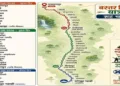
Abujhmad, once regarded as one of India’s most entrenched Maoist fortresses, forms the symbolic centrepiece of this transformation narrative. Located in the dense forests of the Bastar division, the region remained largely cut off from mainstream administration for decades. With a population of roughly 40,000 to 45,000, predominantly from the Abhujhmadhia tribe classified as a PVTG, the area lacked basic amenities such as revenue surveys, documented land rights, motorable roads, hospitals, and communication infrastructure.
During the 1990s and 2000s, Maoists entrenched themselves deeply in Abujhmad, establishing parallel governance structures referred to as “Jantana Sarkar.” Schools were destroyed, development projects were halted, and any attempt at state-led intervention was either sabotaged or violently resisted. Infrastructure was routinely targeted to prevent integration with the administrative mainstream.
The security situation, however, has shifted considerably in recent years. In November last year, Narayanpur Superintendent of Police Robinsons Guria stated that nearly 80 percent of Maoists operating in the Abujhmad area had surrendered. Security forces are now said to dominate nearly two-thirds of the territory, signalling a major shift in ground control.
A decisive turning point came in May 2025 with the killing of Nambala Keshav Rao, also known as Basavaraju, the general secretary of the Communist Party of India (Maoist). Carrying a Rs 1.5 crore bounty, he was among the country’s most wanted insurgent leaders. His elimination in the forests of Narayanpur was described by officials as a landmark achievement that significantly weakened Maoist command structures.
Operation Black Forest, conducted along the Chhattisgarh-Telangana border, further dismantled Maoist hideouts and explosive stockpiles. Several cadres surrendered during these sustained operations. Former Maoist commanders have since acknowledged publicly that Abujhmad is no longer the “Red citadel” it once was.
The change is also reflected in shifting youth attitudes. Former Maoist cadre Giridhar, who surrendered in 2024, remarked in interviews that aspirations for education, employment, and urban opportunities were reducing recruitment into Maoist ranks. He observed that improved policing, civic outreach programmes, and access to welfare benefits altered local perceptions. According to him, many young people no longer wished to embrace armed struggle when alternatives were available.
This evolving mindset is precisely what the education city initiative aims to consolidate. By offering structured academic pathways and employment-linked skill training, the government seeks to prevent extremist networks from regaining influence among youth populations.
At the national level, the anti-Naxal campaign has intensified under the leadership of Prime Minister Narendra Modi. Operation Kagar, launched in January 2024, covers affected regions across Chhattisgarh, Maharashtra, Odisha, Jharkhand, Madhya Pradesh, and Telangana. Approximately one lakh paramilitary personnel, including the Central Reserve Police Force and its elite CoBRA units, have been deployed alongside state police forces.
The results have been measurable. Naxal-affected districts have reduced from 106 in 2015 to 18 in 2025, with the number of worst-affected districts declining from 12 to 6. Union Home Minister Amit Shah has reiterated the Centre’s commitment to eliminating Naxalism before 31 March 2026, signalling sustained operational and developmental focus.
Security officials increasingly emphasise that counter-insurgency operations alone cannot guarantee lasting peace. Stabilisation requires governance visibility, infrastructure expansion, healthcare access, irrigation projects, employment opportunities, and education systems that anchor communities in long-term growth frameworks.
The education cities in Abujhmad and Jagargunda represent this integrated doctrine of “clear, stabilise, and develop.” Mobile towers have been installed in previously inaccessible villages, revenue surveys are underway, welfare schemes are expanding reach, and local recruitment into police units has increased. These measures aim to normalise state presence and restore public trust.
Officials argue that when children attend school safely, farmers benefit from irrigation, and youth receive market-relevant skills, insurgent ideology loses its appeal. Development, in this sense, becomes both preventive and restorative.
Bastar now stands at a transformative crossroads. Once associated primarily with ambushes, landmines, and red corridor narratives, the region is being repositioned as a zone of opportunity and institutional rebuilding. For thousands of families who lived under prolonged uncertainty and violence, the promise of education cities represents not just infrastructure but reintegration into the mainstream.
The ultimate success of this initiative will depend on sustained funding, consistent governance, and community participation. If implemented effectively, Abujhmad’s journey from a Maoist fortress to an education hub could emerge as a defining example of how developmental statecraft can succeed where prolonged conflict once prevailed.
As Bastar prepares to welcome modern campuses in areas that were once beyond administrative reach, the message from Raipur is clear: the era defined by insurgency is being replaced by a future centred on classrooms, connectivity, and opportunity.