West Bengal elections: Ballots, bloodshed and black money
June 7, 2026
  • Read Ecopy
  • Circulation
  • Advertise
  • Careers
  • About Us
  • Contact Us
Android AppiPhone AppArattai
Organiser
  • ‌
  • Bharat
    • Assam
    • Bihar
    • Chhattisgarh
    • Jharkhand
    • Maharashtra
    • View All States
  • World
    • Asia
    • Europe
    • North America
    • South America
    • Africa
    • Australia
  • Editorial
  • International
  • Opinion
  • RSS @ 100
  • More
    • Op Sindoor
    • Analysis
    • Sports
    • Defence
    • Politics
    • Business
    • Economy
    • Culture
    • Special Report
    • Sci & Tech
    • Entertainment
    • G20
    • Azadi Ka Amrit Mahotsav
    • Vocal4Local
    • Web Stories
    • Education
    • Employment
    • Books
    • Interviews
    • Travel
    • Law
    • Health
    • Obituary
  • Subscribe
    • Subscribe Print Edition
    • Subscribe Ecopy
    • Read Ecopy
  • ‌
  • Bharat
    • Assam
    • Bihar
    • Chhattisgarh
    • Jharkhand
    • Maharashtra
    • View All States
  • World
    • Asia
    • Europe
    • North America
    • South America
    • Africa
    • Australia
  • Editorial
  • International
  • Opinion
  • RSS @ 100
  • More
    • Op Sindoor
    • Analysis
    • Sports
    • Defence
    • Politics
    • Business
    • Economy
    • Culture
    • Special Report
    • Sci & Tech
    • Entertainment
    • G20
    • Azadi Ka Amrit Mahotsav
    • Vocal4Local
    • Web Stories
    • Education
    • Employment
    • Books
    • Interviews
    • Travel
    • Law
    • Health
    • Obituary
  • Subscribe
    • Subscribe Print Edition
    • Subscribe Ecopy
    • Read Ecopy
Organiser
  • Home
  • Bharat
  • World
  • Operation Sindoor
  • Editorial
  • Analysis
  • Opinion
  • Culture
  • Defence
  • International Edition
  • RSS @ 100
  • Magazine
  • Read Ecopy
Home Bharat

Ballots, bloodshed and black money; West Bengal’s election crossroads and national security concerns

As West Bengal heads into a crucial Assembly election cycle, fresh data from the Election Commission of India paints a striking picture of the state’s electoral landscape—one marked by intense enforcement alongside deep-rooted challenges. While authorities have ramped up vigilance to curb violations of the Model Code of Conduct, the scale of defacement, massive seizures of cash and contraband, and recurring instances of violence reveal a troubling undercurrent

Diganta ChakrabortyDiganta Chakraborty
Mar 30, 2026, 08:00 am IST
in Bharat, West Bengal
Follow on Google News
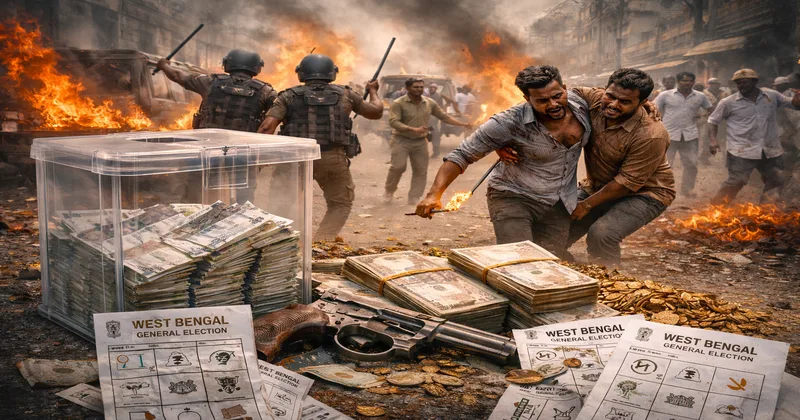
Representative Image (Image generated from AI)

Representative Image (Image generated from AI)

FacebookTwitterWhatsAppTelegramEmail

Elections in India are meant to reaffirm the strength of democratic institutions. Yet in West Bengal, the upcoming Assembly election cycle presents a far more complex and troubling picture—one where democratic participation coexists uneasily with violence, illicit financial flows, and the creeping shadow of organised crime. The latest enforcement data released by the Election Commission of India (ECI) offers a revealing snapshot: the state machinery is active and vigilant, but the scale of intervention required raises deeper structural concerns.

At the heart of the issue lies the enforcement of the Model Code of Conduct (MCC). The data shows that as of March 22, 2026, authorities have recorded an astonishing 3,58,986 cases of defacement removal across the state. This includes 3,11,829 instances on public property and 19,901 on private property. Districts like North 24 Parganas (31,920 cases), Cooch Behar (33,491), Hooghly (24,603), and Paschim Bardhaman (35,798) stand out as major centres of such violations.

On paper, this appears to be a success story of administrative enforcement. But a closer reading reveals a more unsettling truth. Such large-scale defacement is not incidental—it is symptomatic of a political culture where legal boundaries are routinely transgressed. Walls, public infrastructure, and private spaces become battlegrounds for political assertion, often without consent or regulation. This is not merely about visual pollution; it reflects a breakdown in respect for institutional norms at the very outset of the electoral process.

Also Read: Keralam Assembly Elections: “One is “corrupt, another is “mega corrupt,” PM Modi attacks UDF, LDF in Palakkad

If the defacement figures hint at systemic disregard for rules, the seizure data exposes something far more dangerous: the scale of illicit influence in elections. Since February 26, 2026, enforcement agencies have seized assets worth Rs 181.31 crore, a figure that demands serious attention. The breakdown is telling: Cash seizures: Rs 282.33 lakh, Liquor: Over 10.35 lakh litres valued at Rs 2,620.12 lakh, Drugs/Narcotics: A staggering 26.3 lakh grams worth Rs 2,795.88 lakh, precious metals: Rs 1,321.83 lakh, Freebies and inducements: Rs 11,110.89 lakh.  These are not marginal numbers; they point to a parallel economy operating alongside the electoral process. Elections, instead of being purely democratic exercises, risk becoming arenas where money, power, inducements, and criminal networks exert disproportionate influence. Particularly alarming is the scale of narcotics seizures. The interception of 5.8 kg of drugs and additional contraband in Cooch Behar, during routine checks, is not an isolated incident. It highlights how election periods can become conduits for the movement of illegal substances. The convergence of drug trafficking and electoral activity is a serious red flag—not just for law enforcement, but for national security agencies.

To understand why, one must consider the strategic geography of West Bengal. Bordering countries like Bangladesh, the state has long been vulnerable to cross-border smuggling, infiltration, and illegal trade. Districts such as Malda, Murshidabad, and Cooch Behar have historically figured in reports of smuggling networks. During elections, when administrative focus is stretched, and political stakes are high, these networks often find opportunities to expand operations under the cover of political mobilisation. This is where the issue transcends electoral malpractice and enters the domain of national security. The flow of unaccounted cash, narcotics, and contraband is not merely about influencing voters—it can also finance larger criminal and potentially anti-national activities. Weak electoral enforcement can thus create vulnerabilities that extend far beyond state boundaries.

To its credit, the enforcement apparatus has responded with significant mobilisation. The deployment of 1,879 Flying Squad Teams (FSTs) and 2,235 Static Surveillance Teams (SSTs) reflects an unprecedented level of vigilance. These teams are tasked with monitoring movement, conducting vehicle checks, and responding to complaints through digital platforms like cVIGIL. Their impact is evident in the volume of seizures. However, their very necessity underscores the depth of the problem. A system that requires such extensive surveillance to ensure compliance is one that is grappling with entrenched challenges.

Equally concerning is the persistence of election-related violence. Despite heightened security, tensions continue to surface. On March 21, 2026, the Kolkata Police, in coordination with Central Armed Police Forces, intervened in Baranagar to prevent a political clash. The incident, triggered by allegations of an attack, is indicative of the fragile law-and-order environment during elections. Political violence in West Bengal has deep historical roots, cutting across ideological lines and political eras. What distinguishes the current context, however, is the increasing overlap between political competition and criminal enterprise. Violence is no longer confined to clashes between party workers; it is often linked to control over local economies, syndicates, and illicit trade networks. This convergence creates a dangerous feedback loop. Criminal networks provide resources and muscle power to political actors, while political patronage offers these networks protection and legitimacy. The result is a hybrid ecosystem where democracy and criminality coexist, each reinforcing the other.

The implications are stark: democracy erodes when votes are swayed by money and fear, institutions strain under reactive policing, and unchecked cash and narcotics flows pose serious national security risks. Fixing these demands structural reform—political accountability, swift judicial action, tech-driven surveillance, and active civil society vigilance. Data from the Election Commission of India shows both strong enforcement and deep systemic stress. Ultimately, West Bengal’s elections test not just power, but the integrity of democracy itself—because the credibility of the process matters as much as the result.
Topics: Model Code of ConductWest Bengal elections 2026Election Commission of India
ShareTweetSendShareSend
✮ Subscribe Organiser YouTube Channel. ✮
✮ Join Organiser's WhatsApp channel for Nationalist views beyond the news. ✮
Previous News

Karnataka Lokayukta confirms corruption in Rajiv Gandhi housing scheme, vindicates allegations made by BR Patil

Next News

Viksit Keralam is Modi’s Guarantee: PM Modi makes big pitch in poll-bound state

Related News

SIR and Article 324: Supreme Court strengthens the constitutional spine of Indian Democracy; Reaffirms ECI’s authority

Andhra Pradesh State Chief Electoral Officer (CEO) Vivek Yadav, I.A.S., Additional Chief Electoral Officer Venkateswara Rao, and Assistant CEO Srinivasa Rao held a special meeting with representatives of various major political parties on May 26.

EC meets political parties as Andhra Pradesh process SIR 2026 for 4.16 crore electors

Illegal structure which was razed down

West Bengal: Landowner bulldozed ‘Illegal TMC office’ built on family property in Kolkata

Tamil Nadu: Madras HC issues notice to ECI, Joseph, Stalin, EPS over plea alleging use of children in TVK campaign

Dakshineswar Kali Mandir in Kolkata

Why BJP’s victory in Bengal was much needed

Chennai, Apr 23 (ANI): Voters queue up as they wait to cast their votes during the first phase of the Tamil Nadu Assembly election, in Chennai (ANI Photo)

Tamil Nadu 2026 Election Row: ECI begins probe into ‘Illegal Voting’ by foreign passport holders

Load More

Latest News

Uttar Pradesh CM Yogi Adityanath

From lawlessness to good governance: How Uttar Pradesh rewrote its law and order story under Yogi Adityanath

Govt mulls Budget press printing for NEET- UG RE-exam question papers (This is an AI generated image)

NEET-UG Re-Exam Security Overhaul: Government mulls budget press printing, IAF transportation to prevent paper leaks

Rahul, Kharge and Jairam vs. India's Great Nicobar Vision (This is an AI generated image)

Great Nicobar Project: Why Congress is opposing Modi government’s strategic mega plan

Union Home Minister Amit Shah and Delhi Police derail sinister plan of Cockroach Janata Party and its founder (This image is generated by AI)

CJP Protest Derailed: How Amit Shah, Delhi Police, Intelligence foiled sinister plan of Cockroach Janata Party

(Left) Victorious Indian Men-s hockey team who who won Gold in U-18 Asia Cup (Right) U-18 Women's hockey team who won bronze medal in the Asia Cup

U18 Asia Cup 2026: Indian Men’s hockey wins gold, women secure bronze medal; PM Modi & Amit Shah hail the teams

India’s semiconductor roadmap shifts from import dependence to silicon sovereignty, aiming for a self-reliant ecosystem by Viksit Bharat 2047

From Import Dependence to Silicon Sovereignty: India’s bold semiconductor roadmap for Viksit Bharat 2047

Keralam Chief Minister V.D. Satheeshan

Jamaat-e-Islami Hind Team Meets CM Satheeshan, Senior Ministers, fuel debate over influence in UDF government

Singapore acts against China-linked posts targeting Indian community, cites threat to social harmony

Singapore Invokes OCHA: Facebook, YouTube and X ordered to block anti-Indian content originating from China

Editors of the HAF Wikipedia page run propaganda and disinformation campaign against the organisation, India and Hindu cultural ethos

Wikipedia fuels propaganda against Hindu American Foundation: How anonymous writers demonise Hindu rights group?

Israel to Install Statue of Chhatrapati Shivaji Maharaj; Israel’s Consul General in Mumbai, Yaniv Revach, met Maharashtra Chief Minister Devendra Fadnavis and sough his support in this regard

Chhatrapati Shivaji Maharaj’s legacy to reach Israel; Statue to be installed as symbol of India-Israel friendship

Load More
  • Privacy
  • Terms
  • Cookie Policy
  • Refund and Cancellation
  • Delivery and Shipping

© Bharat Prakashan (Delhi) Limited.
Tech-enabled by Ananthapuri Technologies

  • Home
  • Search Organiser
  • Bharat
    • Assam
    • Bihar
    • Chhattisgarh
    • Jharkhand
    • Maharashtra
    • View All States
  • World
    • Asia
    • Africa
    • North America
    • South America
    • Europe
    • Australia
  • Editorial
  • Operation Sindoor
  • Opinion
  • Analysis
  • Defence
  • Culture
  • Sports
  • Business
  • RSS @ 100
  • Entertainment
  • More ..
    • Sci & Tech
    • Vocal4Local
    • Special Report
    • Education
    • Employment
    • Books
    • Interviews
    • Travel
    • Health
    • Politics
    • Law
    • Economy
    • Obituary
  • Subscribe Magazine
  • Read Ecopy
  • Advertise
  • Circulation
  • Careers
  • About Us
  • Contact Us
  • Policies & Terms
    • Privacy Policy
    • Cookie Policy
    • Refund and Cancellation
    • Terms of Use

© Bharat Prakashan (Delhi) Limited.
Tech-enabled by Ananthapuri Technologies