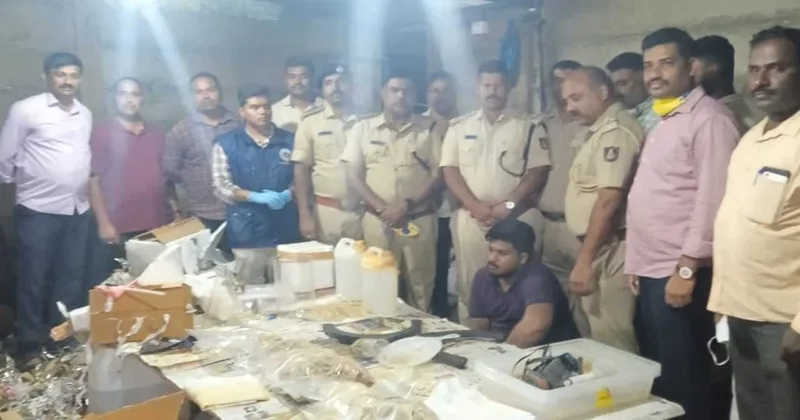
MYSURU: The recent busting of a Rs 12 crore synthetic drug raw material unit in Mysuru district has triggered serious concerns among law enforcement agencies, with investigators probing a larger network allegedly linked to the Mumbai drug mafia and possible supply chains targeting students, including those in high schools.
The raid was conducted by police under the jurisdiction of Hunsur Rural Police Station in Dasanapura village. Officials uncovered a shed, rented under the pretext of the ginger trade, which was allegedly being used as a covert drug storage and processing unit. A total of 48 kilograms of synthetic drug raw materials, packed in 16 packets and valued at Rs 12 crore, were seized during the operation.
Superintendent of Police Mallikarjun Baladandi said the seizure points to a larger, organised network rather than an isolated case. “The scale of the seizure clearly indicates that the materials were meant for wider distribution. We are investigating the entire supply chain, including possible end-users,” he said.
Investigators suspect that such networks often target younger populations, particularly students, due to increasing demand and ease of distribution. Synthetic drugs are typically circulated in small quantities through local peddlers, making them accessible within student communities. Police are examining whether similar supply patterns were active in Mysuru and nearby regions.
Sources indicate that peddlers usually operate near educational institutions and use informal contacts to distribute drugs in small packets. These transactions often go unnoticed, posing a challenge for enforcement agencies. Officials are now verifying whether any such last-mile distribution network existed in this case.
The investigation has also revealed a strong Mumbai connection. Out of the six individuals believed to be involved, four are reportedly from Mumbai, while two are locals. Police suspect that raw materials were sourced from outside the state and transported to Mysuru for storage and possible processing.
Authorities say the involvement of Mumbai-based individuals points towards the role of organised drug syndicates operating across states. Similar patterns have been observed in previous cases, where drug networks linked to Mumbai extended operations into Karnataka.
In fact, police sources noted that earlier joint operations involving Maharashtra and Gujarat police had led to the busting of illegal drug manufacturing units in both Mysuru and Bengaluru. These cases also indicated interstate linkages and the use of Karnataka as a base for storage and distribution.
The choice of a rural, secluded location in this case is believed to be deliberate, intended to avoid detection while maintaining logistical access to major cities. The materials were reportedly brought to the shed just days before the raid, suggesting a temporary but active operation.
The case came to light based on information provided by a drug user. Acting on the tip-off, police conducted the raid and arrested two accused, identified as Mohammed Sharif and Ibrahim Khan. Four others involved in the network are currently absconding.
Police have formed three special teams to trace the remaining accused and to investigate financial transactions, communication links, and distribution routes. Officials are also analysing whether the network had connections with local agents supplying drugs to students.