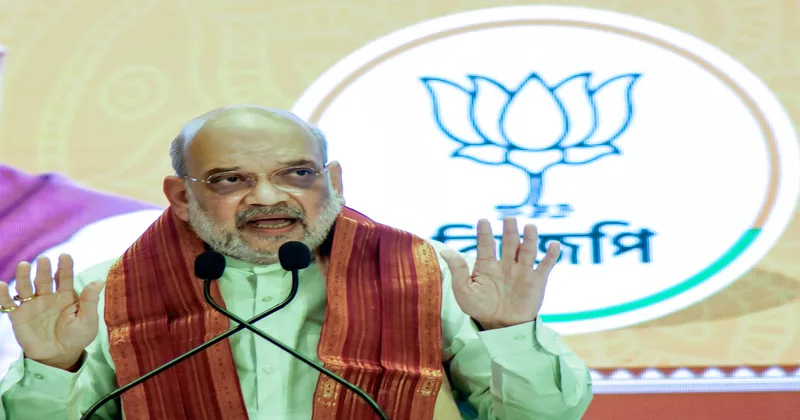
KOLKATA: With the West Bengal Assembly elections approaching, the political temperature in the state has surged sharply, as the BJP unveiled a comprehensive political offensive against the ruling Trinamool Congress. At the centre of this offensive was Union Home Minister Amit Shah, who released what he described as a “charge sheet” against 15 years of governance under Chief Minister Mamata Banerjee.
Addressing a press conference in Kolkata, Shah sought to frame the election as a turning point not just for Bengal but for the entire nation. His remarks signalled a calibrated attempt by the BJP to elevate the electoral discourse from local governance issues to broader themes of national security, border management, and political stability.
‘Bengal Key to National Security’
In one of his sharpest assertions, Shah claimed that the outcome of the Bengal elections would have direct implications for India’s internal security. He argued that while infiltration routes through Assam had been effectively curbed following the BJP’s rise to power in the state, West Bengal had now emerged as the “only remaining route” for illegal entry into the country.
According to Shah, this alleged vulnerability was not accidental but the result of deliberate political choices by the state government. He accused the TMC of engaging in “appeasement politics” and claimed that such policies had weakened border security mechanisms, thereby posing risks to national integrity.
“The security of the country is, in a way, linked to the Bengal election,” Shah said, underlining the BJP’s attempt to nationalise the state poll narrative.
Corruption and ‘Syndicate Raj’ Allegations
Beyond security concerns, Shah launched a scathing attack on the TMC government over corruption, describing West Bengal as a “laboratory of corruption.” He alleged that the state had witnessed the rise of a “syndicate raj,” where organised networks controlled various sectors, stifling economic growth and governance.
The BJP leader further claimed that several candidates fielded by the ruling party had faced serious corruption charges, asserting that such practices reflected the deeper systemic issues within the TMC’s political framework.
He also criticised the state’s industrial climate, calling Bengal a “graveyard for industry,” and blamed the government for failing to create an environment conducive to investment and job creation.
Attack on Governance and Leadership
Taking aim at Chief Minister Mamata Banerjee, Shah accused her of fostering a politics rooted in “fear, lies, and violence.” He alleged that over the past 15 years, the state had witnessed a decline in governance standards, marked by lawlessness and political intimidation.
Shah also accused Banerjee of frequently attacking constitutional institutions, including the Election Commission, and alleged that her administration had created an environment of mistrust and instability.
In a particularly pointed remark, Shah framed the upcoming election as a choice between “fear and trust,” urging voters to reject what he described as divisive and violent politics.
Border Fencing Row and Infiltration Claims
A major plank of Shah’s address was border management. He alleged that the West Bengal government had repeatedly refused to provide land required for fencing along the international border, thereby hindering efforts to curb infiltration.
Calling the refusal “politically motivated,” Shah claimed that the TMC was attempting to cultivate a vote bank by allowing illegal entrants to settle in the state. These allegations are likely to form a central theme of the BJP’s campaign, especially in border districts.
The TMC, however, has consistently denied such claims, accusing the BJP of communalising the issue for electoral gains.
Women’s Safety and Law & Order Concerns
Shah also raised concerns about women’s safety in the state, citing high-profile cases to argue that the law-and-order situation had deteriorated under the TMC government. He accused the administration of downplaying serious incidents and failing to ensure justice for victims.
These allegations are part of a broader BJP strategy to highlight governance deficits and mobilise voter sentiment around safety and accountability.
Electoral Strategy: ‘Charge Sheet’ as Campaign Tool
The BJP’s ‘charge sheet’ is expected to play a key role in its campaign strategy. Party leaders indicated that the document would serve as a foundation for their election manifesto, or ‘Sankalp Patra,’ which is likely to be released in early April.
By compiling allegations into a structured narrative, the BJP aims to present itself as a credible alternative to the TMC government, while consolidating anti-incumbency sentiment.
Shah expressed confidence that the BJP would secure a decisive mandate, citing what he described as growing public dissatisfaction with the current regime.
The West Bengal Assembly elections are scheduled to be held in two phases on April 23 and April 29, with counting set for May 4. The high-stakes contest is expected to witness intense campaigning from all major political parties, including the BJP, TMC, and others.
For the BJP, Bengal represents one of the last major frontiers in its expansion strategy, while for the TMC, the election is a crucial test of its political dominance in the state.