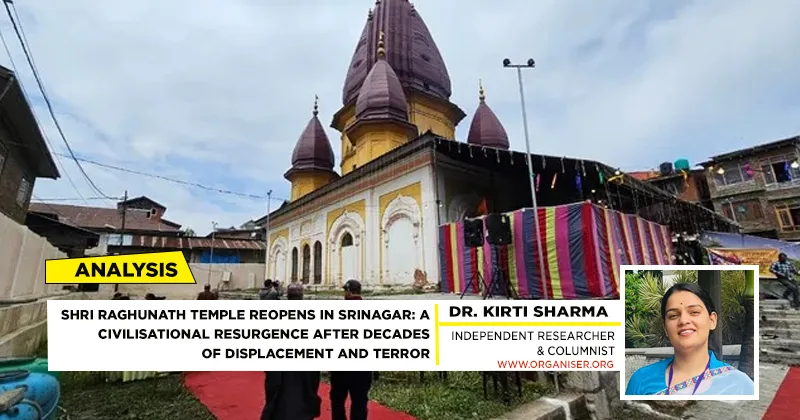
In a moment of immense happiness and cultural significance, the historic Raghunath Mandir in downtown Srinagar has reopened after 36 years, marking an emotionally powerful milestone for Hindus across Bharat.
The Raghunath Temple in Srinagar was built in 1857. It had remained shut for over 36 years after terrorism forced many Kashmiri Pandits to leave the Valley. The reopening symbolizes the revival of heritage and a renewed sense of communal harmony.
The Raghunath Mandir Committee marked the occasion with a grand celebration and special puja on the occasion of Ram Navami. Organisers described the event as an expression of gratitude, adding that the installation of temple idols is planned in the coming months.
The temple’s revival was made possible through phased renovations under the government’s Smart City initiative, with structural restoration handled by the J&K Tourism Department in collaboration with INTACH. In the coming time, there is a plan to install more idols.
“This temple was built by Maharaja Gulab Singh in 1857 and is one of the oldest in the area, modelled after the Raghunath Temple in Jammu. Ram Navami was once celebrated here with great fervour, but for the past 36 years, we could not hold any celebrations as the temple had fallen into a dilapidated state. Today, after its renovation, we are grateful that the administration heard our concerns and made this reopening possible. We began with prayers and hope this sends a larger message that if this temple can reopen after decades, others can be revived as well, ” said Bharat Raina, President, Raghunath Mandir Committee.
Civilisational Legacy of Raghunath Mandirs
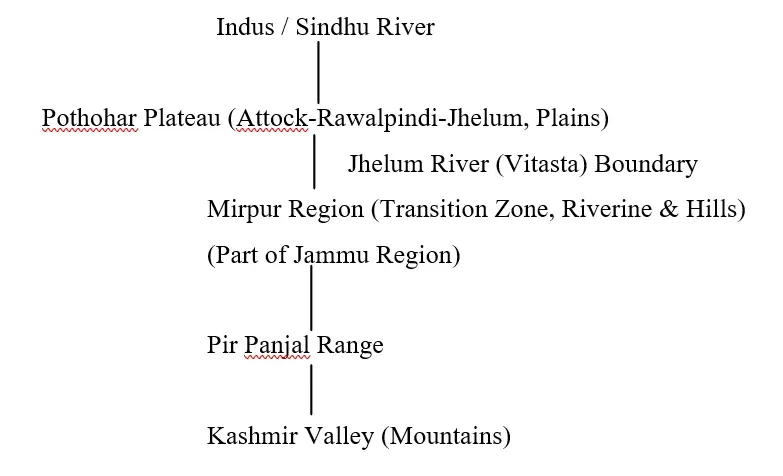
During the 1947 attack on Jammu and Kashmir by the Pakistani army under the ‘Operation Gulmarg’, India not only lost its strategic areas of J&K but also some of its most ancient, sacred and spiritual centers that formed the civilizational foundations of the nation. These heritage sites were not merely places of worship but custodians of faith and dharmic traditions. Unfortunately, this region is currently under the illegal occupation of Pakistan. The area of J&K under the illegal occupation of Pakistan is called as Pakistan occupied Jammu and Kashmir (PoJK). It includes the districts of Mirpur, Muzaffrabad and four tehsils of Poonch, covering an area of 13,297 sq kms. Mirpur historically served as a corridor between the Mountainous terrain of the Jammu and Kashmir foothills and the relatively flat Pothohar plateau. This corridor facilitates not only trade but also the spread of temple traditions, pilgrimage routes and sacred practices that connected the plains with the Himalayan spiritual landscape.
Mirpur: A lost geography of Vaishnav and Shaivite traditions
Temples are not just structures of stone; they are living vessels of memory. They carry the collective consciousness of their people, culture, faith, and gods across decades and centuries. Any invasion, destruction, or attack cannot erase the sacred memory embedded in a place. These memories endure in silence, waiting to be remembered.
Before 1947, the PoJK region was a major Vaishnav and Shaivite centre for Hindus. But the illegal military action by the Pakistani army led to the forceful displacement of Hindus from the region. Old Mirpur town of PoJK still has evidence of Hindu temples and other structures of the city that were submerged after the construction of the Mangla dam on the Jhelum River in 1967 by Pakistan. The remnants of Hindu temples and the town are occasionally seen today when the water level decreases in the dam. Those who were forced to leave Mirpur, such remnants of temples become symbols of longing and belonging, a reminder that while the land may be taken, the walls of the temple may crumble, but the spiritual connection between people and their sacred spaces remains alive across the border. Despite the loss of land, the temple refuses to break under the targeted destruction by Islamists. The refusal of temples to break reflects the spiritual, social and civilizational strength the temples embody. The faith in the pantheon gods has strengthened not only the temples of Hindus but also left a mark on invaders that Hinduism as a way of life cannot die even if it is buried under the earth, yet its memory will endure. The cultural heritage was ruined with the passage of time in PoJK. Therefore, it is our prime concern today that the temples of PoJK should be preserved so that when the land is reclaimed by India, we can rebuild those heritage sites lost under the invasions.
Iconoclasm and Cultural Erasure
Whenever history talks about the destruction of temples or iconoclasm in India, various rulers like Feroz Shah Tughlaq, Qutbuddin Aibak, Mahmood of Gazni, Aurangzeb, Sultan Sikander and many others were named who deliberately destroyed the religious structures and spaces of Hindus to discourage idol worship and remove the traces of Hindu rulers. Also, whenever we talk about the destroyed temples of Kashmir, the focus is laid on Martand temple, Sharda temple and others as well, but somewhere the Raghunath temple of Mirpur is marginalised in the historical discourse of J&K. Moreover, Indian cinema also glorifies Martand and Sharda Peeth, but the Raghunath temple of Mirpur is somewhat sidelined in popular parlance, despite its acceptance worldwide. Like Sharda peeth and Martand temple, the Raghunath temple of Mirpur also represents the broader pattern of temple destruction led by Islamists. Despite repeated attempts to erase its presence, it stands as a powerful symbol, as if Bhagwan Ram never truly left his home, continuing to live in the memories of people who were forced to leave Mirpur.
Raghunath Temple of Mirpur: A symbol of Civilisational Consciousness
The Raghunath Temple is dedicated to Bhagwan Ram, also known as Raghunath, the Bhagwan of the Raghu dynasty. It is a Vaishnavite temple, and Bhagwan Ram is considered the seventh incarnation of Bhagwan Vishnu. The worship of Bhagwan Ram is of paramount importance in Hinduism, representing the highest ideal of human conduct. He exemplified dharma (righteousness) by prioritising moral principles over personal comfort and royal privileges. Furthermore, the Ramayana has historically influenced Indian ethics, family values, and ideals of governance. Bhagwan Ram has united India not through fear but through sacred moral principles, earning reverence among Hindus globally. Despite territorial losses, Pakistan has been unable to diminish the centrality of Raghu worship in PoJK. Temple remained active until its destruction in 1947 and subsequent submergence in water in 1960. Even the depths of water failed to break the remaining structure of the temple.
Since the loss of PoJK, temple has been outside India’s jurisdiction for more than seventy years. Locating any historical records pertaining to the temple before the construction of the dam is increasingly difficult; however, the existence of its broken remnants amidst the Mangla Dam challenges any claims on its existence centuries ago. Moreover, the broken structure of the temple is deliberately left standing by Pakistan so that Hindus would be repeatedly reminded of their humiliation. The temple is in the Himalayan-Nagri architectural style and adapted to riverine conditions. While watching archival videos of the area on YouTube, I observed that, today, the shikhara (tower), partial walls and entrance gates of the temple are visible when water recedes in the dam. There are visible remnants of carved, broad, broken walls made with bricks and stones in a fine arrangement.
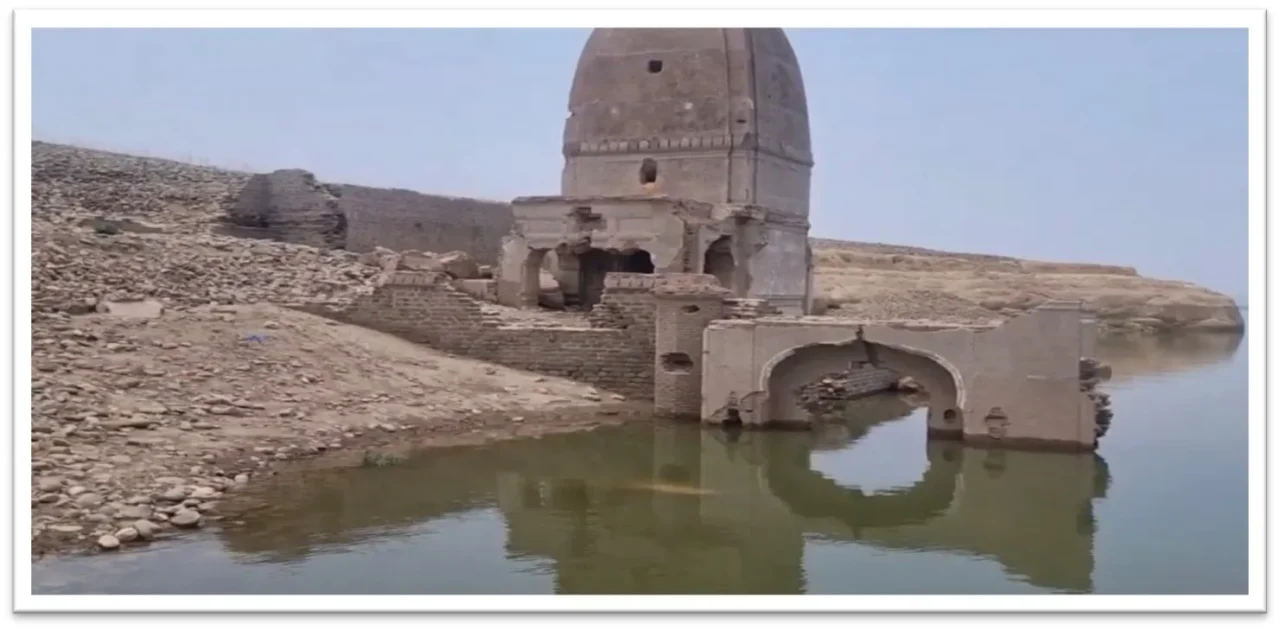
It is encircled by scattered broken bricks and stones, a silent witness to many structures that once embraced it. These remnants may be of rooms surrounding the wider temple complex around the sanctum that once echoed with life, prayers and devotion. Now, they lie fragmented as if mourning the loss of their purpose, yet refuse to disappear entirely. Some distance away, on the front side of the Raghunath temple, is a Shiv temple, together forming the consortium of temples. The Raghunath Temple is situated on a slight elevation, from which the Shiv Temple is visible from its bhawan. It seems like both the temples are maintaining a silent spiritual dialogue across the space. The Shiv temple is also submerged in the water, with its shikara visible only when the water level recedes. It seems as if the temple too struggles to ensure its continuity, emerging long enough to remind the world of its existence, sanctity that once flowed freely around it. The Raghunath temple also had a thoughtfully designed drainage system, as some drains are seen today, which came to light when the upper structure of the temple was broken.
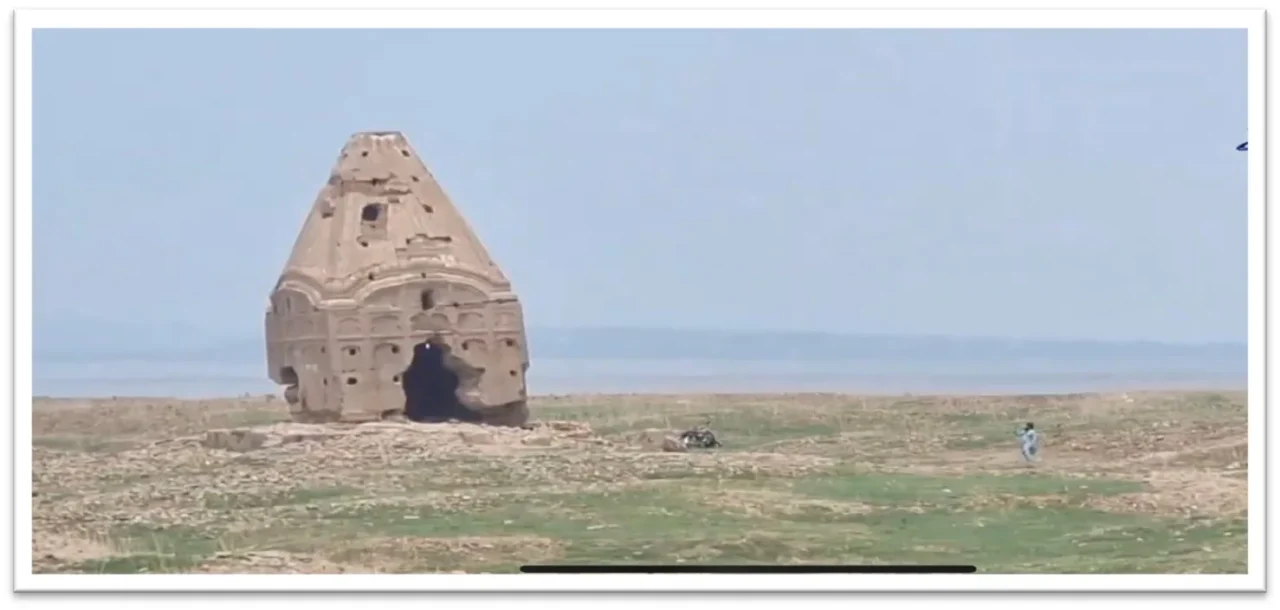
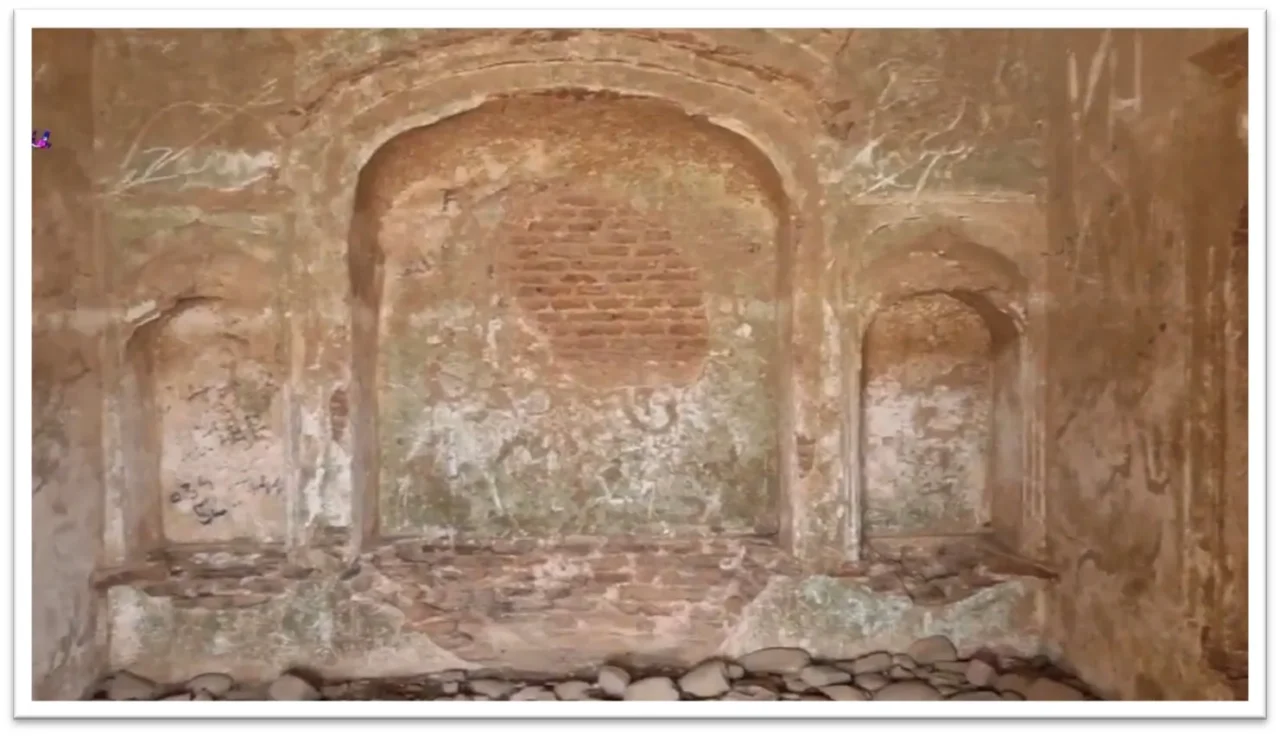
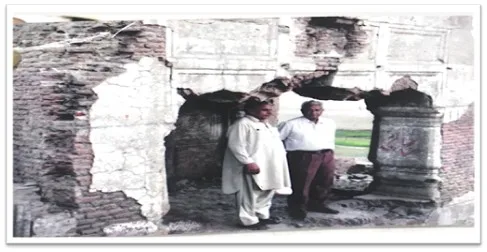
The details speak about the architectural wisdom and careful planning that show it was built not only with devotion but also with skill and foresight. Some walls of the temple complex that are broken from above also have some intact structures beneath, submerged in the water, reminding us that the temple is hidden from sight but not from memory. The temple has two visible gates outer lower gate and the inner upper gate, which lead to the temple bawan or main temple. It also has a basement (tehkhanas) which is now swallowed by water. The tehkhanas Awere believed to store the wealth of the temple or act as a storehouse because they were locked with heavy chains and locks before. I observed that locals also mention that people have dug the floors of the temple in order to extract the wealth, which is why most of the temple is in rubble. Inside the temple, there are a total of five spaces meant to house the idols. The first space is in the center, when one enters the temple bhawan, and the two adjoining spaces on the right and left of the central space. Two more spaces to keep idols are on the side walls of the temple bhawan. Though idols are not present today, these empty niches still hold their presence. These spaces are patiently waiting for the return of devotion and idols refusing to break the unspoken seating place of Bhagwan Raghunath.
There is also a veranda outside the temple complex, which leads to other structures of the temple, reminding us about the gatherings and shared faith devotees carry to the temple, but today everything is dusted to the ground. The Jhelum River (ancient Vitasta) flows near the old Mirpur town, a distributary of the Sindhu (Indus) River. The presence of the temple close to the river is no coincidence; it signifies the profound reverence Hindus have for the rivers of India, seeing them not merely as water bodies but as living, purifying forces imbued with divinity. For the Hindus of Mirpur, Jhelum have carried a sanctity equal to other holy rivers. When people fail to reach the Ganga, the flow of the Jhelum becomes their spiritual solace and thus holds ancestral sanctity.
Mirpur: A testament to prosperity and cultural life
According to the records of the local settlers in Mirpur, the entire Mirpur town was renowned for its jewellery shops, owned and operated by families long settled in the area. This shows the town was the center of exchange, and prosperous businessmen or traders used to live here. The town has two largely built gateways collectively called Hathi Darwaza, which regulate the entries from the neighbouring cities. The outsiders cannot enter the town until the darwaza is opened by the city people. It shows the security of people living there, as it was believed that Mirpur has a population of rich Hindus who were in the majority, and they have protected not only their people but also the wealth from outsiders by the construction of Forts and Hathi Darwaza. In order to prevent women folk of Hindus to go outside the city to fetch water, the wells were constructed within the houses in Mirpur. Such was the prosperity of the people living there. It underscores both the resources available and the social considerations of the time. The local Muslims of Mirpur admire the temple’s architectural strength and appreciate the builders for building the temple structure. They remark on the architectural durability by saying in phadai/punjabi ‘palastar dekho kinna dada hoye na is mandare upar ki sattar sall paniya ne andar rahii vi ee mandir tuteya nahi’. The temple remains submerged in the water, no matter how low the water level in the dam, bearing silent testimony to the skill of the builders. Today, the walls of the temple are scribbled and destroyed by writing Urdu names by the local visitors, depicting the loss of physical sanctity. The physical sanctity of the Raghunath temple is lost today in Mirpur, but its reverence is alive in the hearts of those who faced forceful displacement from Mirpur to be rehabilitated in J&K or to other parts of India as a memory and faith. They preserved their legacy through remembrance, faith and community practices of worshipping Raghunath.
Raghunath Temple at Jammu City
While the physical sanctity of the Raghunath Temple in Mirpur is not in good condition, its spiritual legacy did not end there. The Ram bhakti was also central to the Dogra rulers of J&K, under which a revered Raghunath temple was built in the heart of Jammu city. Shri Ram was the patron deity of the Dogra dynasty, which claimed its descent from the Suryavanshi Rajput. Bhagwan Ram, traditionally regarded as a descendant of the Suryavansha (Solar Dynasty). The shared lineage of faith has historically shaped Dogra identity, social values and their political identity in J&K. Thus, Bhagwan Ram is venerated by Dogras as a principal deity. The foundation stone of the temple was laid by Maharaja Gulab Singh in 1851 AD. Later, the temple was inaugurated by his son and successor, Maharaja Ranbir Singh, in 1857 A.D.
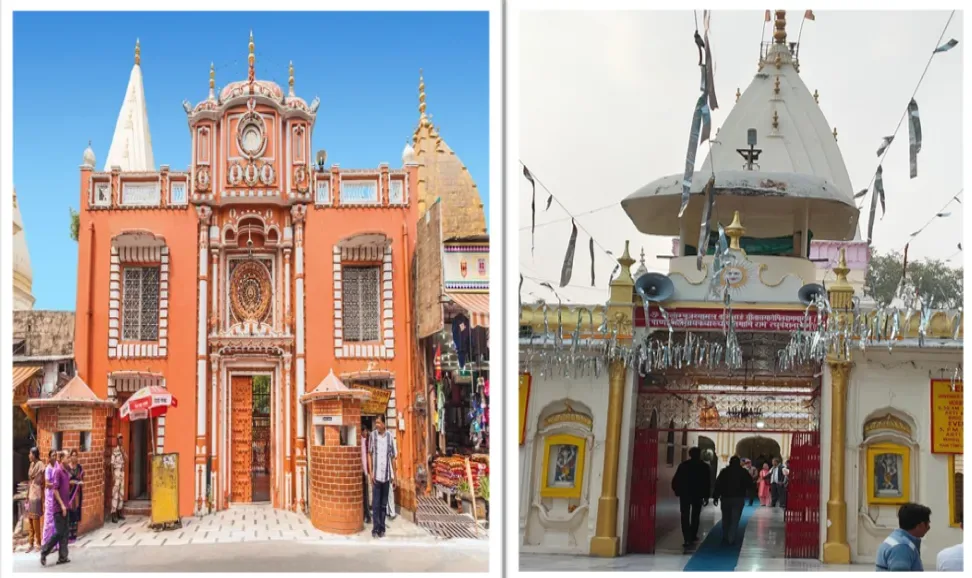
The temple consists of seven shrines, each with a Shikhar of its own. The main sanatorium is dedicated to Bhagwan Ram, his consort Mata Sita and devoted brother Lakshmanji. Maharaja Gulab Singh aimed to establish Ram Rajya in the state and wanted to spread the message of religious faith through knowledge. With this aim, he established the Sanskrit library in the premises of the temple and Shri Raghunath Sanskrit Mahavidyalaya within the state. With the passage of time, this Sanskrit library became the Shri Ranbir Sanskrit Research Institute and Library, in which scholars from all over India were invited for research work. The institute has a rich collection of rare manuscripts of Sanskrit, and besides Sanskrit, it also contains manuscripts in Sharda Lipi.
The attempts of destruction of the Raghunath temple were not done only at Mirpur, but two terrorist attacks were also carried out by terrorists in the temple of Jammu on March 30 and November 24, 2002, once again aimed at terrorising the Hindu community and attacking their sacred sites. In these terrorist attacks, several devotees and army men present in the temple premises were killed. The attack created fear and aggravated the wounds of Hindus residing in the heart of the city. The sanctity of the temple was gravely compromised by the intrusion of violence, bloodshed, guns, and grenades wielded by terrorists, continuously disrupting the sacred spaces of Hindus.
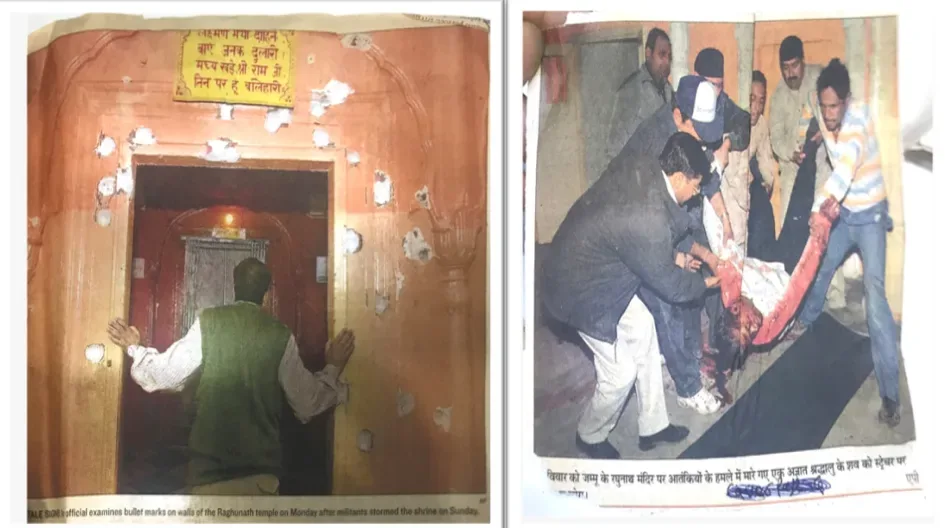
Raghunath Temple at Srinagar: Habba Kadal
The Historic temple of Raghunath at Srinagar was one of the most revered temples of Hindus of Kashmir, vandalised and burnt down by Islamic terrorists in the early 1990’s. During the peak of terrorism in Kashmir, terrorists killed thousands of Hindus, which led to mass genocide and their exodus from the valley. Terrorists wanted to create another Islamic state in Kashmir. Hindus were prohibited from visiting and worshipping at the Raghunath temple. However, when Hindus refused to follow the terrorists’ order, mass killings were carried out to threaten the Hindu community. The entire temple premises were burnt down and destroyed. The attached dharamshalas with the temple were set on fire, resulting in extensive damage to the premises. This incident formed part of a wider pattern of violence, with many documented cases of temple desecration recorded between 1990 and 1992 in Kashmir. This was a deliberate attempt as part of a broader campaign of religious, cultural and demographic transformation of the Valley by Islamic fundamentalists.
The practice of destruction of temples and iconoclasm was not new to Islamic fundamentalists in Kashmir, carried out since 1947 and before. But, after the reorganisation of Article 370 and the abrogation of 35 A, the state administration department was tasked to renovate the lost glory of Raghunath temple at Fateh Kadal and beautify the ghats of the Jhelum River. The Hindus of J&K felt inclusive because the temples lost during the wave of terrorism have also made them lose their identity in Kashmir. Thus, revivalism is needed to make them feel a sense of belonging to the land.
Raghunath Temple at Sui-Simbli, Akhnoor
Maharaja Gulab Singh also built the second Raghunath temple at Sui-Simbli, 13 miles from Jammu and about 1 km west of Burj. This temple was built to provide a religious place and to honour his Guru, Bawa Prem Das, who forecasted the Maharaja’s greatness at his birth. A samadhi of the Baba is also located within the premises of the temple. The temple also has wall paintings, mainly from the Ramayana. Some of the panels also illustrate some mythological episodes. There are idols of Shri Ram and Sita in the sanctum sanctorum.
There are also smaller Raghunath temples at Kishtwar and Ramban in J&K, which contain images (idols) of Bhagwan Ram, Mata Sita and Lakshman. While the temple at Kishtwar was constructed during the Dogra regime, the shrines at Ramban may have existed much earlier, giving the locality its name. There is another temple of Shri Ram at Kishtwar, near the Udrash Nagg, which supplies drinking water to the town. There is a beautiful Raghunath temple at Purani Mandi in Jammu city. Another Raghunath temple at Panj Tirthi, next to the old Maharaja Palace. These smaller Shri Ram temples were not constructed under royal patronage in the manner grand temples commissioned by rulers, nevertheless they represent an equally significant expression of the religious and cultural legacy of Hindu communities. The prominence of the Raghunath temple depicts the pluralistic deity worship in Jammu and Kashmir. Here, Shiva’s primacy co-existed with Vishnu Bhakti. That is why the Raghunath temple of Mirpur also has a Shiva temple in its consortium, and the Raghunath temple of Jammu has Shivlingam and Shaligrams along with other incarnations of Vishnu like Narasingh Avtara, Matsya Avtara and many more within the temple premises.
In any case, little could realistically be expected from Pakistan. Under the International conventions on cultural heritage, it has failed to preserve the temples in PoJK, which is not only cultural neglect but a violation of global heritage norms. This neglect and failure also reflect its disregard towards Hindus and their religious sites. Under the global appeal, UNESCO, as a custodian of human history, can initiate efforts to preserve the Raghunath and other temples through global awareness in PoJK.
Conclusion
Despite a long period of disruption, displacement and violence, the sacred cultural spaces of J&K have remained alive through the continuous effort of the Hindu community over the centuries. These broken temples and their reconstruction help the restoration of the community’s cultural heritage and faith. Whenever, the Raghunath temple of Jammu city is talked about the inhabitants of J&K should not forget to remember the lost temple of Raghunath at PoJK and other places in J&K. History textbooks and historians must also record the wounds borne by the people of Pakistan-occupied Jammu, who also faced humiliation at the hands of Islamists, so that their sufferings may not go unrecorded or forgotten. The civilisational cost paid by the people of this region should be acknowledged with truth, true facts and historical responsibility