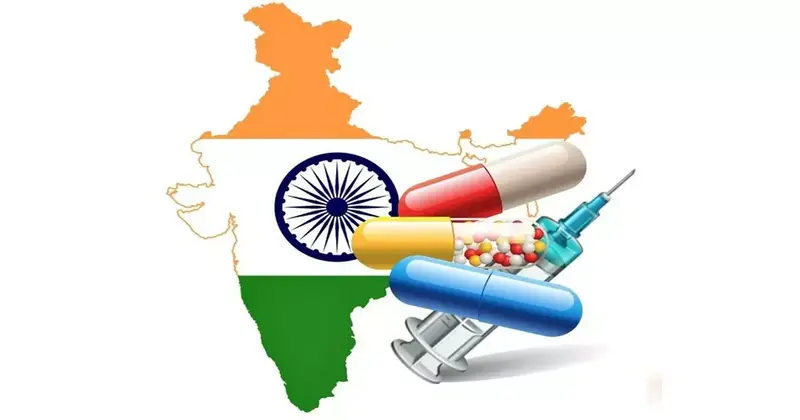
From ₹1 sanitary pads to $30.5 billion in exports, India has built a pharmaceutical ecosystem that serves its citizens and heals the world. The role of India in global health care delivery is estimated with a probability of 90 per cent. Measles vaccine injected into a child in sub-Saharan Africa is made in India. For patients in Ukraine who are being treated for tuberculosis and are seeking cheaper generic drugs are made in plants in Hyderabad, Ahmedabad, or Baddi. The purchase of a one-rupee sanitary napkin by a woman in a small town in Uttar Pradesh or Chhattisgarh also reflects the efforts of the Indian pharmaceutical industry.
According to the Economic Survey 2025-26 and government sources, the pharmaceutical industry in India ranks third in terms of quantity and eleventh in terms of value. This disparity reveals much about India’s potential for providing high-volume generic drugs while also pointing to the industry’s future potential for more innovative and higher-value drugs. The industry is based on a cluster of more than 3,000 companies and 10,500 manufacturing units located across India. In terms of turnover for fiscal year 2025, the industry has recorded an annual turnover of ₹4.72 lakh crore. This has been recorded in the Economic Survey for the fiscal year 2025-26. The Indian pharmaceutical industry is currently worth USD 60 billion and has the potential to grow to USD 130 billion by the year 2030.
The foundation for the Indian pharmaceutical industry is its ability to produce generic drugs. India is the largest supplier of generic drugs in the world and accounts for nearly 20 per cent of the total generics supplied and manufactured. India also manufactures 60,000 generic brands in 60 therapeutic classes. In the United States alone, Indian generics account for nearly 40 per cent of the total prescriptions by volume. This means that nearly half of the American population seeking prescription drugs is being catered to by the Indian pharmaceutical industry. India also has the highest number of US FDA-approved manufacturing facilities outside the United States. This reveals much about the Indian industry and the high standards that Indian manufacturing facilities have to adhere to.
There are nearly 500 active pharmaceutical ingredient manufacturing units in India. This accounts for nearly 8 percent of the total active pharmaceutical ingredient market. Active pharmaceutical ingredients are the chemical constituents of drugs that have the power to produce therapeutic effects.
Export Performance: From USD 1.9 billion to USD 30.5 billion in twenty-five years
The pharmaceutical export industry in India portrays a highly impressive growth story for the Indian economy. In the year 2000-01, India’s pharmaceutical exports stood at a figure of USD 1.9 billion. In the recent period of 2024-25, India pharmaceutical exports have grown to reach a figure of USD 30.5 billion. This reflects a total increase of nearly 16 times in India’s pharmaceutical exports in the last twenty-five years. In the recent period of ten years, India has recorded a compound annual growth rate of 7 per cent in its pharmaceutical exports. India now exports its medicinal products to 191 countries across the globe. Out of the total exports, nearly 50 per cent of India’s exports are to highly regulated countries like the United States and Europe. These countries have some of the highest quality and safety regulations in the entire world. This ability of India to serve these countries independently reflects the quality of India’s manufacturing industry.
The month-on-month growth in India’s exports of drugs and pharmaceuticals has also been highly impressive. India has seen its exports of drugs and pharmaceuticals grow from a figure of USD 2.59 billion in January 2025 to a figure of USD 2.66 billion in January 2026. This reflects a growth of nearly 2.70 percent in India’s exports of drugs and pharmaceuticals in the recent period despite the presence of trade headwinds in the entire world. Exports of medical devices have also seen highly impressive month-on-month growth in India. India has seen its exports of medical devices grow from a figure of USD 2.5 billion in the period of 2020-21 to a figure of USD 4.1 billion in the recent period of 2024-25. India has also managed to reach 187 countries
Indian Vaccine Supremacy: Numbers that saved lives
In the global vaccine supply chain, India holds a place that few nations can match. India provides about 60 percent of all vaccines procured by UNICEF for distribution to children in developing nations across the globe. India meets 40 to 70 percent of global demand for Diphtheria, Tetanus and Pertussis (DTP) and Bacillus Calmette–Guérin (BCG) vaccines. India provides 90 percent of the total requirement for measles vaccine procurement by the World Health Organization. These numbers are not historical but speak to India’s present-day role in ensuring child survival in some of the poorest nations across the globe. In the context of COVID-19, India role as a vaccine manufacturer gained global recognition when the Serum Institute of India became recognized as the largest vaccine manufacturer in the world in terms of volume. This capability is not one that has been created overnight and is a result of decades of policy, investment and manufacturing discipline.
Trade agreements that expand India’s healthcare reach
The year 2025 and the beginning of 2026 have witnessed a period where the the architecture of India pharmaceutical trade is visible. Three significant agreements have either been concluded or progressed in a manner that impacts the Indian pharmaceutical industry significantly.
The India-United Kingdom Comprehensive Economic and Trade Agreement (CETA), signed in July 2025, provides zero-duty market access to India for its pharmaceutical exports in respect of 56 tariff lines. This will increase the competitiveness of Indian generic drugs in the United Kingdom, which is India’s largest pharmaceutical export market in Europe. In addition to this, duty-free market access has also been granted to Indian exports in respect of a range of medical devices, including surgical instruments, diagnostic apparatus, ECG machines and X-ray apparatus. This will reduce the cost of production for Indian exporters.
The India-New Zealand Free Trade Agreement signed in December 2025 provides zero-duty market access to Indian pharmaceutical exports in respect of approximately 90 tariff lines. Prior to this agreement, India was being levied a duty of up to 5 per cent. This will provide Indian pharmaceutical exports access to a regulated market in New Zealand.
The India-EU Free Trade Agreement negotiations have been concluded. This agreement will provide access to the Indian pharmaceutical and medical technology industry to the EU market, which has a market value of approximately USD 572.3 billion. This will benefit the already established pharmaceutical manufacturing hubs in Maharashtra, Gujarat, Telangana, Karnataka and Andhra Pradesh. This will also provide employment opportunities to skilled workers in the industry and further integrate India into the international economy.
Production linked incentives and pharma infrastructure
Indian export performance is carefully designed as a part of domestic policy interventions to build manufacturing capacity, reduce imports and advances its pharmaceutical industry. Since 2021, the Production Linked Incentive Scheme for Pharmaceuticals has been facilitating domestic production in high-value biopharmaceuticals, complex generics and autoimmune segments. What is interesting is that actual investments under this scheme have exceeded ₹40,890 crores till September 2025, compared to its initial target of ₹17,274.96 crores. This implies that investment by the private sector has exceeded the government’s target more than double.
The total sales generated by the Scheme have been ₹3,16,797 crores. Of this total sales figure, exports have been to the tune of ₹2,03,730 crores. The employment generated by the Scheme has been around 97,000 individuals. The PLI Scheme for Bulk Drugs(APIs, KSMs and Drug Intermediates) has created manufacturing capacity for 55,100 metric tonnes per annum for 26 critical APIs and KSMs that were being imported in significant quantity. In fact, the PLI Schemes for Pharmaceuticals and Bulk Drugs have together avoided imports worth ₹3,591 crores for APIs, KSMs and drug intermediates. The PLI Scheme for Medical Devices has generated cumulative sales of ₹12,344.37 crores. This includes exports of ₹5,869.36 crores. In addition, actual investment of ₹1,093.69 crores has been attracted by the Scheme.
The infrastructure for manufacturing is also being created. Three Bulk Drug Parks have been sanctioned in Andhra Pradesh, Gujarat and Himachal Pradesh. The total project cost for the three parks is more than ₹6,306.68 crores. Central assistance for each of the three parks has been sanctioned for ₹1,000 crores. Three Medical Device Parks are being created in Uttar Pradesh (Greater Noida), Madhya Pradesh (Ujjain) and Tamil Nadu (Kanchipuram). The total project cost for the three parks is ₹871.11 crores. In Uttar Pradesh, Madhya Pradesh and Tamil Nadu, land has been allotted to 199 medical device manufacturers. This land aggregates to 306.64 acres. Already 34 units have commenced the construction of their plants.
Medicines for Every Indian: The Jan Aushadhi network
The effectiveness of the advancement in pharmaceutical accessibility at the export terminus will be undermined if the general public cannot access the drugs. In response to this challenge, the Pradhan Mantri Bhartiya Janaushadhi Pariyojana (PMBJP) was formed. This is the government initiative to address this barrier. As of 28 February 2026, more than 18,646 Jan Aushadhi Kendras dedicated to generic medicine outlets are operational. It provides a range of products consisting of 2,110 medicines, 315 medical devices and consumables in 29 therapeutic classes. This is has lower rates than those of branded drugs.
The economic impact on Indian citizens can be estimated. In the financial year 2024-25, the sales figure was ₹2,022.47 crores. This has resulted in savings for Indian citizens of approximately ₹8,000 crores. This is because the amount would have been spent on medicine and has now been saved. In the current financial year 2025-26 up to 30 November 2025, the sales figure is ₹1,409.32 crores. This has already resulted in savings for Indian citizens of approximately ₹5,637 crores.
Jan Aushadhi Suvidha Sanitary Napkins are priced at one rupee for one pad. As of 31st January 2026, cumulative sales have exceeded 100 crores. This has happened since the inception of the program. In the current financial year alone, 22.50 crores pads have been sold. This has transformed the menstrual hygiene of women and girls in rural and semi-urban India from being a luxury that cannot be afforded to being a reality.
Innovation, Biopharma and the PRIP scheme
The long-term pharmaceutical strategy in India requires a gradual shift from generics to original research and high-end biological drugs. Two schemes have been initiated that encapsulate this strategic shift.
The Scheme for Promotion of Research and Innovation in Pharma MedTech (PRIP) has set up seven Centres of Excellence, one in each National Institute for Pharmaceutical Education and Research (NIPER), for a total outlay of ₹700 crores. Till November 2025, PRIP has sanctioned 111 research projects, published 46 research papers, and obtained 6 patents. Component B of PRIP provides financial assistance to micro, small and medium enterprises and start-ups in the field of priority research.
The Union Budget for 2026-27 has also set up the Biopharma SHAKTI initiative a Strategy for Healthcare Advancement through Knowledge, Technology and Innovation for which an outlay of ₹10,000 crores has been made for a period of five years. This new initiative aims to make India a hub for biopharma manufacturing by supporting the local manufacturing of biologics and biosimilars. This will lead to the setting up of three new NIPER and the upgradation of seven existing ones. More than 1,000 clinical trial sites will also be set up across India. Biologics and biosimilars form one of the fastest-growing and highest-margin segments in the pharmaceutical industry across the world. India’s entry into this space will be a significant shift in the Indian pharmaceutical industry.
The Regulatory Architecture: Quality that the world trusts
India’s excellence in the pharmaceutical industry is supported by its regulatory system that is in line with the industry aspirational path. The Central Drugs Standard Control Organization is the national regulatory authority that regulates new drug approval, clinical trials, import licenses, manufacturing licenses and pharmacovigilance in accordance with the Drugs and Cosmetics Act of 1940. The National Pharmaceutical Pricing Authority regulates and controls prices in accordance with the Drugs Prices Control Order of 2013. This is an affirmative requirement rather than a consequence of market forces. The Indian Pharmacopoeia Commission is entrusted with the dissemination of official standards in drug products that are accepted in 19 countries. This is an indicator of the increasing recognition of India’s scientific capabilities.
This regulatory framework is an indicator of India’s success in attaining United States FDA approval, exporting to 191 countries and instilling confidence in other governments that import drugs from India as they believe that these drugs conform to standards suitable for their population.
The quantitative parameters of the Indian pharmaceutical industry, which include a figure of 30.5 billion dollars in exports, 60 percent of UNICEF’s vaccines, 97,000 jobs supported by a single Production Linked Incentive scheme, the manufacture of 100 crore sanitary pads at a price of 1 rupee each and savings of 8,000 crore rupees by Indian citizens within a space of a single year, are more than simple quantitative parameters taken together, they reflect the potential of what can be accomplished by the Indian industry.
The Indian pharmaceutical industry, faces some substantial challenges going forward, as the Economic Survey 2025-26 itself states, “The fact that we are third in the world by volume, but eleventh by value, points to the imperative of moving up the innovation ladder from generics to more complex molecules, drugs, biosimilars and original research.” Global regulatory pressures and tariff risks in major export markets also pose challenges, but the foundation of the industry is strong, from manufacturing to regulation to the expanding list of trade agreements, the size of the home market and the policy framework that increasingly reflects the strategic importance of the industry.