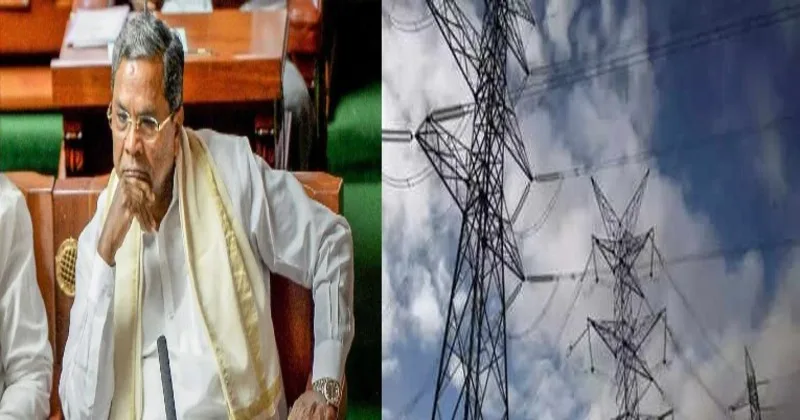
Bengaluru: Karnataka’s power distribution companies are facing a deepening financial crisis, with mounting debt, unpaid government dues and rising losses painting a worrying picture. Fresh data tabled in the assembly by Energy Minister K J George has revealed that the state’s ESCOMs have accumulated a staggering ₹42,750 crore in long-term loans, triggering sharp criticism from the Opposition, which has accused the state government of pushing the sector into a “debt trap”.
According to the official reply, as of January 2026, all ESCOMs together have borrowed ₹42,750 crore, reflecting heavy dependence on loans to sustain operations. Experts argue that this growing debt burden is a direct result of poor financial planning, excessive power purchase and inefficiencies in revenue collection. Adding to the crisis, government departments, urban local bodies and rural institutions together owe ₹12,463.92 crore to ESCOMs. This includes massive dues from water supply and street lighting systems under urban and rural development departments.
A detailed breakup shows that BESCOM alone is owed ₹6,211.14 crore, while CESCOM has pending dues of ₹1,233.55 crore. MESCOM is owed ₹767.88 crore, HESCOM ₹2,049.62 crore, and GESCOM ₹2,201.73 crore. Opposition leaders have alleged that the government itself has become one of the biggest defaulters, starving ESCOMs of crucial revenue while forcing them to borrow more. “This is a classic case of financial mismanagement. On one hand, the government delays payments; on the other, it compels ESCOMs to depend on loans. This has pushed the power sector into a debt spiral”, critics said.
The financial stress is further evident in the ₹4,516 crore revenue deficit reported across ESCOMs. BESCOM alone accounts for ₹2,802.80 crore of this deficit, followed by CESCOM (₹528.12 crore), HESCOM (₹604.49 crore), GESCOM (₹490.62 crore) and MESCOM (₹83.11 crore). Analysts point out that excessive power purchase is a major factor behind the losses. Despite regulatory benchmarks, ESCOMs have reportedly procured electricity beyond required demand, leading to higher costs. For instance, BESCOM purchased power worth ₹27,895 crore against the approved ₹27,190 crore, resulting in excess expenditure.
Further, lower tariff realisation has compounded the issue. While the regulator fixed an average tariff of ₹9.54 per unit, BESCOM collected only ₹8.59 on average, leading to a revenue shortfall of ₹1,678 crore. Operational inefficiencies have also been flagged. Higher-than-approved expenditure on maintenance, interest payments and lower non-tariff income have widened the financial gap. Critics argue that these inefficiencies reflect lack of accountability and weak financial discipline.
The Opposition has also targeted the state government’s flagship Gruha Jyothi scheme, under which free electricity is provided to households. While the government claims to have spent ₹25,076 crore on the scheme since August 2023 to reduce the burden on consumers, critics allege that the subsidy model has further strained ESCOM finances. “There is no clarity on how subsidies are being reimbursed. If ESCOMs are not compensated on time, they are forced to borrow more. Ultimately, the people will bear the burden through tariff hikes”, Opposition leaders warned.
Meanwhile, ESCOMs have already submitted proposals for tariff revision from April 1, indicating a likely increase in electricity charges. This has raised concerns among consumers, who fear higher bills amid rising cost of living. Defending the situation, the government has maintained that borrowing is necessary to ensure uninterrupted power supply and to meet growing demand. It has argued that investments in infrastructure and operational costs require financial support through loans.
However, critics remain unconvinced, calling for structural reforms, timely subsidy payments and strict recovery of government dues. They have demanded a comprehensive audit and accountability for what they describe as “systemic financial mismanagement”. With rising debt, unpaid dues and growing losses, Karnataka’s power sector appears to be at a critical juncture, with the coming months likely to determine whether corrective measures can stabilise the system or deepen the crisis further.