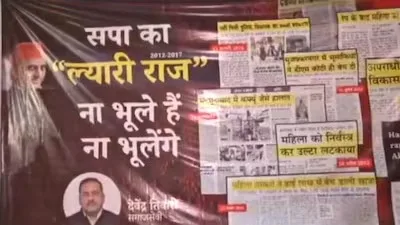
A fresh political controversy has erupted in Lucknow after posters comparing the Samajwadi Party’s rule to “Lyari Raj” appeared in several prominent areas of the city. The posters directly target Akhilesh Yadav, invoking both his tenure as Chief Minister and a cultural reference linked to the film Dhurandhar.
Strategically placed near high-visibility locations such as the VVIP Guest House and other key public spots, the posters have drawn widespread attention, reigniting debates around law and order during the 2012–2017 Samajwadi Party government.
The term “Lyari Raj” used in the posters refers to Lyari, one of the oldest and densely populated neighbourhoods in Karachi, often associated in public discourse with crime, gang violence, and unrest.
By invoking this comparison, the posters attempt to draw parallels between that region and the governance record of the Samajwadi Party in Uttar Pradesh. Slogans such as “SP’s Lyari Raj – we have neither forgotten nor will we forget” suggest a deliberate attempt to remind voters of alleged law-and-order concerns during that period.
The messaging prominently highlights accusations of rising crimes against women and the alleged expansion of land mafia networks during Akhilesh Yadav’s tenure as Chief Minister.
The controversy is further amplified by a reference to the film Dhurandhar, particularly its portrayal of criminal characters. This comes shortly after political remarks by Parvesh Verma, who used a similar cinematic analogy while targeting Arvind Kejriwal in a separate political context.
Reacting to the posters, BJP leader Devendra launched a sharp attack on the Samajwadi Party, stating, “Just like there was terror in Lyari, there was ‘goonda raj’ in Uttar Pradesh from 2012 to 2017.”
He further alleged that revelations surrounding gangster-politician Atiq Ahmed had unsettled Samajwadi Party leaders, intensifying political fault lines between the ruling party and the opposition.
The Samajwadi Party, however, has yet to issue an official response to the posters, though the development is expected to escalate political tensions in the state.
The emergence of such posters reflects the sharpening political narrative in Uttar Pradesh, where law and order remains a central electoral issue. The use of international comparisons, particularly with regions like Lyari, underscores the aggressive tone of political messaging.