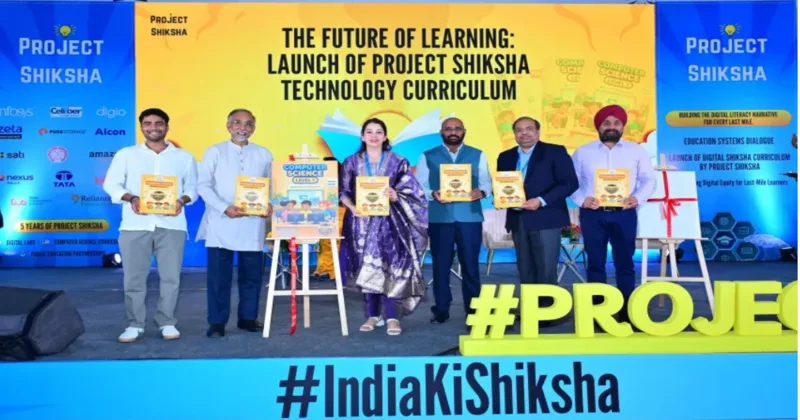
Project Shiksha has launched a three-level Foundational Computer Science Learning Workbook Series for students in government schools. The initiative is a major milestone in the organisation’s mission to improve the learning outcomes and equip students with future-ready skills. The launch was accompanied by an Education Systems Dialogue that brought together stakeholders from government, academia, industry, and the social sector to deliberate on how to build a stronger and more inclusive public education ecosystem.
The newly introduced curriculum is designed to gradually develop students’ skills from basic digital literacy to computational thinking and early exposure to Artificial Intelligence concepts. The programme adopts a contextual and ecosystem-driven approach that integrates regional language support, structured teacher training, and project-based learning. Workbooks have been introduced to ensure uniformity in delivery and to enable measurable learning outcomes across classrooms.
SD Shibulal, Co-founder of Shibulal Family Philanthropic Initiatives and former CEO of Infosys, emphasised the importance of early exposure to digital skills. He noted that India’s public education system plays a central role in shaping an equitable and future-ready society. According to him, introducing young learners to computer science and problem-solving frameworks enables them to participate confidently in an increasingly digital world.
The launch of this curriculum is being seen as a crucial step towards bridging the digital divide and enhancing students’ preparedness for future challenges. By embedding computational thinking and foundational AI concepts at an early stage, the programme aims to nurture critical thinking and innovation among learners.
Neha Chawla, Founder of Project Shiksha, highlighted the importance of collaborative efforts in strengthening public education. She stated that government schools educate millions of children whose potential can significantly shape the country’s future. Enhancing these systems through digital access, experiential learning, and community engagement is essential for building an inclusive and forward-looking education model.
She further said that meaningful collaboration among educators, government bodies, industry partners, and civil society organisations is key to creating scalable and sustainable solutions in the education sector.
Currently, Project Shiksha operates across multiple regions, including 18 schools in Bengaluru, 7 in Chennai, and 7 in Jharkhand, covering cities such as Ranchi, Jamshedpur, Koderma, Jadugoda, Bishnagar, and Kedo. The initiative has established 32 digital labs and has already impacted over 10,000 students. Looking ahead, the organisation plans to expand its partnerships with schools, strengthen its digital learning infrastructure, and empower educators to deliver engaging and future-ready classroom experiences.