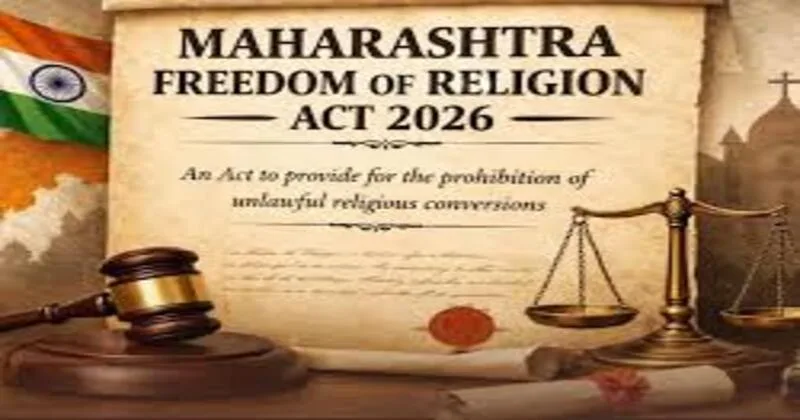
At a time when public discourse is increasingly shaped by slogans and suspicion, Maharashtra’s proposed Dharma Swatantrya Adhiniyam, 2026, has been hastily labelled by some as an “anti-conversion law”. Such characterisations, while politically convenient, fail to engage with the deeper constitutional logic underlying the legislation.
Far from curtailing religious freedom, the Bill seeks to protect its most essential element: the freedom of conscience. For many families, especially those raising daughters, the issue is not abstract. It is rooted in real anxieties about personal safety, deception in relationships, and the protection of religious identity. From this perspective, safeguards against forced or fraudulent conversion can serve as an important layer of protection rather than a restriction.
Freedom of Religion is not freedom to coerce
The Constitution of India guarantees every citizen the right to profess, practise and propagate religion under Article 25. However, this right has never been interpreted as a licence to convert others through force, fraud, or inducement.
The Supreme Court settled this question nearly five decades ago in Rev. Stanislaus v. State of Madhya Pradesh (1977), holding that the right to propagate does not include the right to convert another person. To permit otherwise would be to infringe upon the equal freedom of conscience of the person being converted.
The Maharashtra Bill is firmly anchored in this constitutional principle. It does not prohibit conversion; it regulates only those conversions that are tainted by coercion, deception, or undue influence.
Stringent penalties and enhanced protections
- The Bill prescribes rigorous punishments to ensure that conversions remain a matter of sincere personal choice
- Unlawful conversion: A prison term of seven years and a fine of Rs 1 lakh for any conversion achieved through prohibited means such as force, fraud, or allurement.
- Vulnerable group protections: Recognising that certain individuals face higher risks of exploitation, the Bill increases the penalty to Rs 5 lakh with a prison term of seven years if the victim is a woman, a minor, a person of unsound mind, or belongs to the Scheduled Castes or the Scheduled Tribes
- Mass conversions: The simultaneous conversion of two or more persons is treated with the same severity as offences against vulnerable groups, attracting a seven-year jail term and a Rs 5 lakh fine
- Repeat offenders: Individuals or institutions previously convicted under this Act who commit another offence face a maximum prison term of 10 years and a fine of Rs 7 lakh
- If any institution or organisation violates the provisions of the Bill, its registration may be cancelled by the competent authority, and the persons responsible for its management may face imprisonment of up to seven years along with a fine of up to Rs 5 lakh. Additionally, such organisations will be ineligible to receive any financial assistance or grants from the State Government.
Victim Compensation and Rehabilitation Support – The Bill provides for support to individuals affected by unlawful religious conversion. It entitles the victim to receive maintenance and provides for custody of children. Further, the State Government shall provide rehabilitation assistance to such persons in the prescribed manner.
A law rooted in protection, Not prohibition
At its heart, the legislation is a protective framework, not a restrictive one.
In many cases, individuals—particularly women, minors, and those in vulnerable circumstances—may be subjected to subtle pressures that are difficult to detect or prove. Conversion in such situations is not an exercise of free will but the result of manipulation, emotional coercion, or misinformation.
By prescribing penalties for such conduct, the Bill ensures that religious choice remains meaningful and voluntary, rather than engineered. Enhanced penalties for offences involving vulnerable groups are therefore not paternalistic, but a recognition of ground realities where power imbalances are stark.
The logic behind the 60-day notice
The requirement of a prior 60-day notice has drawn criticism, but its rationale is both practical and constitutionally sound. Religious conversion is not merely a private act; it often has legal, social, and familial consequences, particularly when linked to marriage. A structured process ensures that such decisions are:
- Deliberate rather than impulsive
- Informed rather than induced
- Transparent rather than clandestine
The notice period creates a cooling-off window, allowing authorities to verify that the conversion is genuinely voluntary. It also provides an opportunity to identify cases in which individuals may be acting under pressure but unable to seek help themselves.
Importantly, the process does not prevent conversion—it merely introduces procedural safeguards to uphold its authenticity.
Transparency is not surveillance
Critics have argued that the notice requirement amounts to state intrusion. This interpretation overlooks a key distinction: regulation is not surveillance.
The State routinely requires prior declarations in matters with legal consequences— marriages, property transactions, and adoptions, to name a few. Religious conversion, when it intersects with civil rights and legal status, cannot be treated as entirely beyond regulatory oversight.
Far from violating privacy, the Bill creates a formal and documented pathway, which ultimately protects individuals from later disputes, coercion claims, or legal ambiguity.
Burden of Proof: A necessary corrective
The provision placing the burden of proof on the person facilitating the conversion has also been criticised. Yet, this is neither unprecedented nor unjustified.
In cases involving coercion or undue influence, the victim is often in a position of vulnerability, making it difficult to produce evidence. The facilitator, on the other hand, is better placed to demonstrate that due process was followed and consent was genuine.
This approach is consistent with victim-centric jurisprudence, where evidentiary burdens are calibrated to address real-world asymmetries. Moreover, the Bill’s reliance on documented procedures—such as notice and registration—makes compliance straightforward for those acting in good faith.
Marriage and misuse of conversion
Indian courts have repeatedly dealt with cases where religious conversion has been used to circumvent legal obligations, particularly in matters of marriage.
In Sarla Mudgal and Lily Thomas, the Supreme Court made it clear that conversion cannot be used as a device to evade personal law requirements. The Maharashtra Bill builds on this jurisprudence by ensuring that marriages linked to unlawful conversions do not acquire legal legitimacy.
In the context of “love jihad,” where women are often under intense psychological pressure from partners or their partners’ families, the 60-day window provides a cooling- off period and an opportunity for the State to verify the woman’s voluntary intent away from her “captors.”
Transparency ensures that parents and siblings, who are often the first to notice signs of grooming or coercion, can raise concerns before a deceptive marriage is finalized. Given that many victims of forced conversion are “not in a position to approach the police themselves,” the Bill’s provision allowing blood relatives to lodge an FIR is a crucial safety net.
This is not an attack on interfaith relationships. On the contrary, it protects the integrity of such relationships by ensuring that they are entered into freely, honestly, and without hidden coercion.
Marital rights and children’s religious identity –
The Maharashtra Dharma Swatantrya Adhiniyam, 2026 is particularly distinguished by Section 5, which safeguards the rights of children and women in marriages deemed null and void due to unlawful conversion. Under this section:
• Religion of the child: A child born out of such a marriage shall follow the religion practised by the mother prior to the relationship.
• Legal protections: The child retains succession and inheritance rights to the property of both parents and is entitled to maintenance under the applicable law.
• Custody of the Child: The law provides that custody of the child will remain with the mother unless a court directs otherwise.
Safeguards against misuse
No law is immune to misuse, but that cannot be a reason to deny its necessity.
The Bill incorporates procedural checks—such as verification by designated authorities and evidentiary requirements—that help distinguish genuine cases from malicious allegations.
At the same time, the existence of a formal legal framework reduces the likelihood of vigilantism or extra-legal interventions, as grievances can be addressed within the rule of law.
Promoting social stability through legal clarity
In the absence of clear legal processes, disputes surrounding conversion often escalate into social tensions. The Bill addresses this gap by creating a transparent and structured mechanism.
When conversions are formally recorded and verified, it reduces ambiguity and builds public confidence in the legitimacy of the process. This, in turn, contributes to social harmony.
A balanced exercise of state responsibility
The State has a constitutional duty not only to protect individual liberty but also to ensure that such liberty is not undermined by coercion or exploitation.
The Maharashtra Dharmaswatantrya Adhiniyam, 2026 represents an attempt to strike that balance. It affirms that religious freedom is not merely the absence of restraint, but the presence of genuine choice.
Protecting the spirit of freedom
The true test of religious liberty is not whether conversions are allowed, but whether they are free, informed, and voluntary. By targeting only those conversions that fall short of this standard, the Maharashtra Bill strengthens—not weakens—the constitutional promise of freedom of conscience.
In an increasingly complex social landscape, such legislation is not only justified but necessary. It ensures that faith remains a matter of conviction, not compulsion—and that the Constitution’s guarantee of religious freedom is preserved in both letter and spirit.