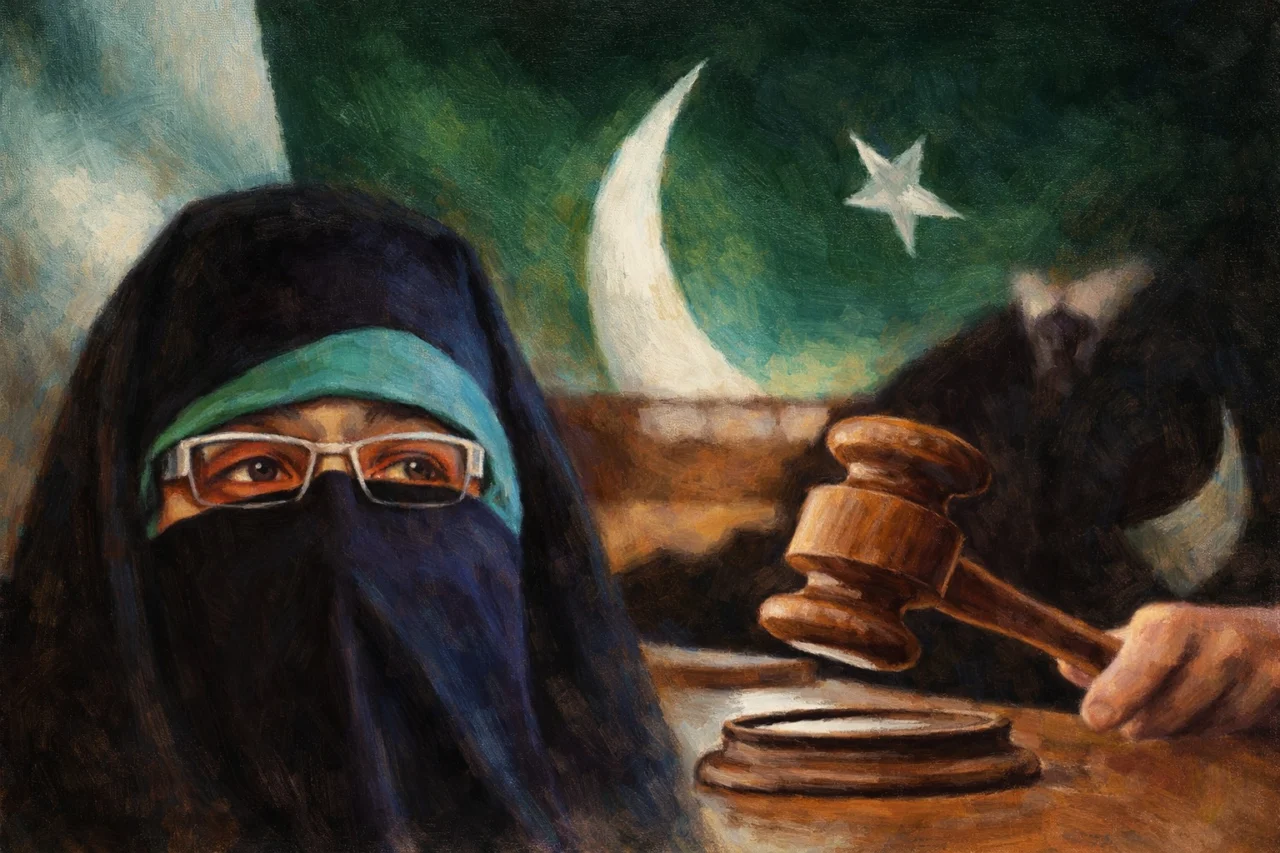
India’s judicial system has once again made it unequivocally clear that no one is above the law. The life sentence handed down by a Special Court of the National Investigation Agency (NIA) to Asiya Andrabi, a Kashmiri separatist leader and the chief of the banned organisation ‘Dukhtaran-e-Millat’, can be viewed as a decisive blow against the long-standing conspiracies being waged against India’s sovereignty and internal security.
While convicting her under the Unlawful Activities (Prevention) Act (UAPA), the court acknowledged that she was involved in a conspiracy to engage in war-like activities against India. (Reference: NIA Charge Sheet, 2018; UAPA, Sections 13, 18). Her associates, Sofi Fahmida and Nahida Nasreen, were also sentenced to 30 years in prison each. This verdict stands as a testament to the robustness of the rule of law in India. However, Pakistan’s sharp reaction to this judgment raises several questions. Terming the verdict “political” and “anti-human rights,” Pakistan has called for international intervention.
In reality, this is the very same Pakistan whose image as a global epicentre of terrorism has been consistently exposed on the international stage. (Reference: Official Statement by the Ministry of Foreign Affairs, Pakistan, 2026). In a sense, this attitude of Pakistan is nothing new. For decades, it has been interfering in India’s internal affairs regarding the issue of J&K. Renowned security analyst Christine Fair, in her book “Fighting to the End: The Pakistan Army’s Way of War” (2014, pp. 142–160), writes that the Pakistan Army regards “Indirect War” against India as its permanent strategy.
Indeed, Christine Fair’s book “Fighting to the End: The Pakistan Army’s Way of War”(2014) offers a detailed analysis of the Pakistan Army’s strategic culture and its underlying ideology. After studying decades of Pakistani military publications (such as the ;Pakistan Army Green Book’), Fair concludes that Pakistan is an “ideological state” (Islamic), rather than merely a country driven by security concerns. According to Fair, for the Pakistani military, “victory” does not entail seizing territory on the battlefield. For them, as long as they resist India’s regional hegemony and refuse to capitulate, they remain victorious. They view the acceptance of the ‘status quo’ itself as “defeat.”
Fair argues that Pakistan fights not merely for its own security, but to alter the regional map- a stance she terms “revisionism.” She characterises Pakistan as a “greedy state” that covets additional territory (such as Kashmir) even when it faces no existential security threat. The military utilises terrorist groups (such as Lashkar-e-Taiba) as a “cheap fighting force” to execute its policies. They employ their nuclear arsenal as a protective shield, enabling them to wage a proxy war against India while deterring any conventional retaliatory strikes from the latter. Fair warns that, given the military’s unlikelihood of abandoning its (Islamic) ideology, Pakistan is destined to remain a destabilising force in the future.
Similarly, Husain Haqqani explicitly states in his acclaimed book, “Pakistan: Between Mosque and Military” (2005, p. 275), that for years, Pakistan has utilised “jihadist organizations” as instruments of its foreign policy. This fact has been acknowledged even by analysts hailing from within Pakistan itself. Through ‘Pakistan: Between Mosque and Military’, Haqqani presents a compelling analysis of Pakistan’s political history and the deep, intricate nexus between its military and religious institutions (the mosque). Haqqani argues that a symbiotic relationship has long existed between the military and radical Islamic groups within Pakistan. The military has utilised religion to perpetuate its power and define the national identity, while Islamist groups have expanded their influence under the military’s patronage.
According to the author, “jihad” and extremism in Pakistan are not sudden occurrences, but rather integral components of a systematic “state-building project” that eventually went awry. Following Pakistan’s inception, its rulers employed Islam as a political instrument to forge unity within a multi-ethnic society- a strategy that ultimately plunged the nation into an ideological abyss. Haqqani argues that maintaining perpetual hostility toward India is indispensable to the very survival of the Pakistani military. Leveraging this hostility, the military appropriates a substantial portion of the national budget; initially claiming as much as 70%- and thereby preserves its political supremacy.
The book posits that the military views itself not merely as the guardian of geographical frontiers, but also as the custodian of Pakistan’s “ideological boundaries.” Haqqani analyses how the Pakistani military has periodically secured financial and military aid by rendering itself “indispensable” to the United States, while simultaneously consolidating the “mosque-military alliance” on the domestic front. Haqqani contends that even civilian leaders, such as Zulfikar Ali Bhutto, Benazir Bhutto, and Nawaz Sharif, proved unable to dismantle this system, for they either capitulated to the military’s authority or, for the sake of their own political expediency, themselves resorted to exploiting religion.
Global Terrorism Index: The Reality of Pakistan
In reality, Pakistan’s rhetoric appears all the more hollow when global statistics contradict its claims. According to the “Global Terrorism Index 2026”, published by the Institute for Economics and Peace, Pakistan has emerged as the country most affected by terrorism in the world. As per the report, 1,139 fatalities and 1,045 terrorist incidents were recorded there in 2025; the highest figures since 2013 (GTI Report 2026, pp. 18-22).
The report further notes that the Tehrik-i-Taliban Pakistan (TTP) alone was responsible for more than half of these attacks. Additionally, organisations such as the Balochistan Liberation Army (BLA) have also severely compromised Pakistan’s internal security. This situation demonstrates that while Pakistan itself is being consumed by the flames of terrorism, it continues to attempt to cast blame upon others on international platforms.
The “Proxy War” Strategy: Historical Evidence
The history of terrorism in Kashmir is inextricably linked to Pakistan’s calculated strategy. This trajectory, which began with the tribal invasion of 1947, evolved into a “proxy war” during the 1980s. According to research published in the journal of the Institute for Defence Studies and Analyses (IDSA) (2019, pp. 45-60), Pakistan adopted the policy of “Bleeding India by a Thousand Cuts” following 1987.
“Operation Topac,” implemented in 1988, was an integral part of this very strategy. This plan was orchestrated by Pakistan’s intelligence agency, the Inter-Services Intelligence (ISI). Former ISI Chief Asad Durrani has acknowledged in his book, “The Spy Chronicles” (2018, p. 112), that the ISI; Pakistan’s intelligence agency- played a pivotal role in giving an organized structure to the insurgency in Kashmir. Training, Infiltration, and Terror Infrastructure
According to a 2020 report by the Observer Research Foundation (ORF), numerous terrorist training camps have remained active in Pakistan-occupied Kashmir (PoK), where young recruits are trained in the use of weapons and guerrilla warfare tactics. These camps have consistently provided support to organizations such as Lashkar-e-Taiba, Jaish-e-Mohammed, and Hizbul Mujahideen. ORF reports also highlight that, in an effort to evade drone strikes, these camps are now being made smaller and technologically more sophisticated. According to recent reports from 2026, despite military operations, approximately eight terrorist camps across the border- six situated near the Line of Control (LoC) and two near the International Border- are reportedly still active.
In his book “Deadly Embrace: Pakistan, America, and the Future of Global Jihad” (2011, p. 89), American analyst Bruce Riedel writes that Pakistan’s security agencies leveraged the experience gained during the Afghan Jihad to foment terrorism in Kashmir. Indeed, in this book, American analyst and former CIA official Bruce Riedel elaborates on this fact in considerable detail.
According to other sections of the book, Riedel argues that the success of the ‘Jihad’ waged against the Soviet Union in Afghanistan during the 1980s provided Pakistan’s intelligence agency, the ISI, with a “blueprint” or a successful operational model. In the late 1980s, Pakistan redirected the strategies, arms supply networks, and fighter-training expertise honed during the Afghan War toward the Kashmir theatre. Riedel states, “The Pakistani security establishment viewed terrorism (proxy warfare) as a ‘cost-effective’ and ‘low-risk’ strategic tool against India- a tactic they had successfully tested in Afghanistan.” The book further underscores that Pakistan utilised its nuclear arsenal as a protective shield, enabling it to sustain this ‘proxy warfare’ against India while deterring any large-scale retaliatory strikes from the latter. This book elucidates how Pakistan’s policies, pursued for short-term gains, transformed the nation into a hub for global jihad, thereby further complicating the security landscape of South Asia.
Terror Financing: An Organised Mechanism
To sustain terrorism in Kashmir, Pakistan has developed an intricate financial network. According to the South Asia Terrorism Portal (SATP), approximately 250–300 million US dollars are expended annually to fuel terrorism (SATP, 2021 Report). In his book “Terror Financing in Kashmir” (2019, pp. 67–75), Abhinav Pandya details that this funding is channeled through ‘Hawala’ networks, counterfeit currency, drug trafficking, and international donations.
Terror Attacks in India: Evidence and Confessions
The involvement of Pakistan-backed organizations in major terror attacks perpetrated within India has been substantiated on numerous occasions: The 1993 Mumbai Bombings; implicating Dawood Ibrahim and the ISI (CBI Report, 1995); the 2001 Parliament Attack- highlighting the role of Lashkar-e-Taiba and Jaish-e-Mohammed (Ministry of Home Affairs Report); and the 2008 Mumbai Attacks; during which the captured terrorist, Ajmal Kasab, confessed to receiving training in Pakistan (NIA Documents, 2009). Additionally, Jaish-e-Mohammed claimed responsibility for the Pulwama attack in 2019 (UN Security Council listing documents, 2019).
International Recognition: The Global Perspective on Pakistan’s Role
The US Department of State’s “Country Reports on Terrorism” (2020, p. 145) explicitly states that numerous terrorist organisations are active on Pakistani soil. Similarly, the Financial Action Task Force (FATF) expressed concern regarding terror financing while placing Pakistan on its “Grey List” (FATF Report, 2018–2022).
Consequently, based on all these facts, reports, scholarly works, and expert analyses, it becomes evident that Pakistan has long utilized terrorism as a strategic instrument. In this context, when India; acting within the framework of its judicial process- sentences a convict, Pakistan’s objection to such a verdict appears not only incongruous but also inherently contradictory. Thus, it is clear that Pakistan’s reaction to the sentencing of Asiya Andrabi is merely a continuation of its long-standing agenda to keep the Kashmir issue alive on the international stage. However, amidst the shifting global landscape, this strategy is no longer effective.
India has sentenced a convict strictly within the bounds of the law. In stark contrast, Pakistan continues to fail in adopting a clear and sincere stance against terrorism. Until it dismantles the terrorist infrastructure flourishing on its own soil, its criticisms lack any moral foundation. Ultimately, the question remains: why does the sentencing of Asiya Andrabi cause Pakistan such palpable distress? The answer lies embedded in those very facts that repeatedly demonstrate where the roots of terrorism lie and who has been nurturing them.
For the time being, India has delivered justice to Asiya Andrabi, an adversary, a proponent of terrorism, and one who provided it sustenance, along with her accomplices; those who oppose the nation will continue to face similar consequences in the future. Regardless of the anguish this may cause Pakistan, India has now abandoned any notion of pardoning its adversaries. To put it plainly, the courts have simply delivered the punishment that such opponents of India rightfully deserve- a precedent that will continue to be upheld in the days to come.