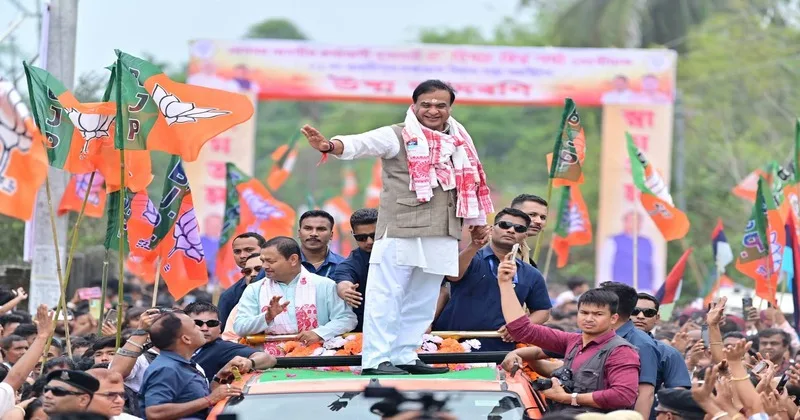
GUWAHATI: As Assam goes to the polls in the next 15 days, the political agendas of both the ruling and opposition parties have become distinctly visible to the state’s 2.50 crore voters. While the ruling BJP and NDA are betting on the safeguard of Assamese heritage and identity against the silent aggression of Bangladeshi-origin Muslims, Congress and alliance parties have opted for a minority vote bank appeasement and caste-based division politics. Congress leader Gaurav Gogoi preferred to offer Namaz in a Masjid while going to fill his nomination in Jorhat, which is considered a perfect example of minority appeasement politics. While media houses aligning with the Congress party are busy setting narratives of Ahom vs Non-Ahom politics.
In the post-independence era, from Bharat Ratna Gopinath Bordoloi and Bishnuram Medhi to Bimala Prasad Chaliha, the successive Congress governments of Assam not only upheld the spirit of Assamese nationalism with deep conviction but also, on numerous occasions, openly opposed decisions of the Congress-led Central Government in order to safeguard the Assamese language and cultural identity in every possible dimension. However, in the later years, the Congress regimes, driven solely by electoral expediency, became conspicuously dependent on Bangladeshi-origin Muslim populations, a development that gradually assumed the proportions of a grave misfortune for the Assamese nation.
Ahead of the assembly election scheduled to be held on April 9, state BJP alleged that it was the very consequence of this silent aggression that, following the demise of the then Mangaldoi Lok Sabha MP Hiralal Patowary, the inclusion of thousands of dubious names in the electoral rolls during the by-election led to the historic Assam Movement of 1979 under the leadership of the All Assam Students’ Union (AASU), demanding the expulsion of illegal foreigners.
Although the Assam Accord of 1985 marked the formal culmination of the movement, subsequent political developments failed to shield the indigenous populace from the persistent encroachment of suspected foreign nationals. On the contrary, illegal occupation of sacred institutions such as monasteries, temples, satras, and forest lands continued unabated, accompanied by systematic political infiltration through enrollment in voter lists.
Nearly 63 lakh bighas of land in Assam fell victim to such encroachment, while successive Congress governments remained mere silent spectators to this alarming transformation. However, with the advent of the BJP government in Assam in 2016, decisive and unprecedented steps were undertaken to resist this aggression. As an initial measure, approximately 1,200 bighas of encroached land at the sacred birthplace of Mahapurush Srimanta Sankardev in Batadrava Than were reclaimed, thereby establishing the Srimanta Sankardev Abirbhav Kshetra. Furthermore, the BJP government has successfully recovered nearly 1.5 lakh bighas of such encroached land during its tenure.
In addition, under the NDA government, the Assamese language has been accorded the prestigious status of a classical language. Looking ahead, the government has set an ambitious target to reclaim nearly 5 lakh bighas of encroached land within five years of returning to power. The firm and resolute measures adopted by the BJP government to curb this silent aggression have deeply unsettled and alarmed those sections traditionally perceived as the Congress party’s vote bank.
Consequently, they are making concerted efforts to destabilise the BJP-led NDA government and re-establish a Congress regime in the state. Nevertheless, the BJP said, the indigenous people of Assam are fully cognizant of these realities. Therefore, there remains little doubt that in the forthcoming Assam Legislative Assembly elections on 9 April, the indigenous populace will resolutely reaffirm their mandate in favour of the BJP-led NDA alliance, in order to safeguard the linguistic, cultural, and territorial integrity of the greater Assamese nation, the saffron party said.