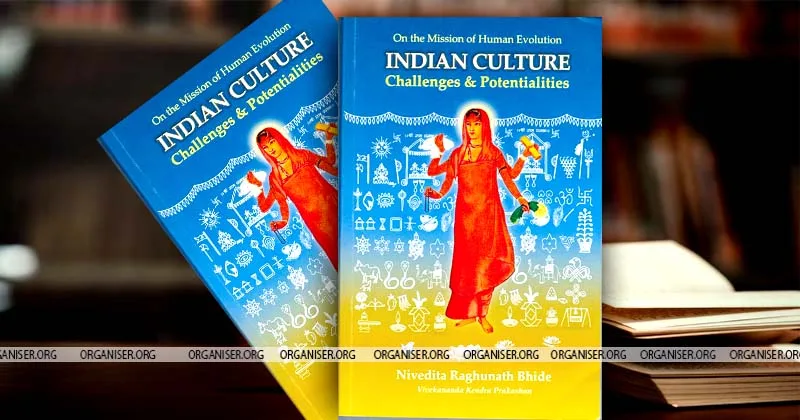
Title: On the Mission of Human Evolution – Indian Culture: Challenges and Potentialities, Author: Nivedita Raghunath Bhide; Publication Year: 2022. Pages: 440 ; Price: Rs 350.00
The moment we speak of “Indian Culture,” many images come to mind: an ancient civilisation thousands of years old, a vibrant and living tradition, sacred scriptures, diverse languages, rich food traditions, and a vast geographical landscape. Along with this richness, many questions also arise about its meaning, relevance, and future. Finding clear and balanced answers to these questions is not always easy. One often has to consult multiple sources, and even then, it can be challenging to arrive at the correct perspective. In today’s fast-changing world, where new narratives constantly shape public discourse, this challenge becomes even greater.
In this context, Nivedita Raghunath Bhide’s book, ‘On the Mission of Human Evolution – Indian Culture: Challenges and Potentialities,’ makes an important contribution. The book addresses many such questions in a comprehensive, thoughtful, and insightful manner, helping readers gain a clearer and deeper understanding of Bharatiya culture.
The book is published at a time when our nation stands at a historic juncture. A time when it must confront its challenges with awareness and confidence, strengthening its potential so that it can not only pave its own path but also fulfil the responsibility of guiding the world towards a peaceful future. Today, as Bharat is redefining its cultural consciousness, national identity, and global role, this book assumes special relevance.
The book offers a profound discussion of the complex facets of Bharatiya culture, addressing questions such as whether it constitutes a single unified culture or a confluence of multiple cultures, how it differs from other cultures, and what its fundamental purpose is. Other, major questions the author addresses are:
● If there is only Ishvara everywhere, why are there so many Gods and Goddesses?
● Are we discussing the Hindu religion or Indian culture? Are they the same or different?
● If Indian culture was so great, why did it degenerate, and why was Bharat enslaved for so long?
● Are Christians and Muslims part of Indian culture?
● Is Bharat only a recent British-made nation?
● Can Bangladeshi or Rohingya Muslims be called Bharatiyas?
● Are we discussing the Hindu religion or Indian culture? Are they the same or different?
● If Indian culture was so great, why did it degenerate, and why was Bharat enslaved for so long?
● Are Christians and Muslims part of Indian culture?
● Is Bharat only a recent British-made nation?
● Can Bangladeshi or Rohingya Muslims be called Bharatiyas?
On these deep and challenging questions, the book offers an analysis that is both simple and engaging, yet fact-based, while also providing guidance on how the values and philosophy of our culture can help shape our present and future.
This book is particularly significant, as its author, Nivedita Raghunath Bhide, is not only a distinguished writer but has also lived her entire life embodying Bharatiya culture. As a lifelong worker of the Vivekananda Kendra, Kanyakumari, she dedicated her life to internalising Bharatiyata, practising it in daily life, and promoting its values.
Published by Vivekananda Kendra Prakashan, this book is divided into six comprehensive sections. The first section acquaints the reader with the objectives and subject matter of the book. The second section discusses the “Vision of Life”. The third section presents life-values as the backbone of culture. The fourth section defines “the systems of life”. This section explains how Bharat, which was once the most literate nation in the world, was systematically rendered illiterate.
The fifth section discusses the profound blows inflicted by British rule that fractured the national psyche. It examines how misconceptions were created to incite different communities against one another, how new narratives were constructed, such as the Aryan-Dravidian divide.
The final, sixth section discusses responses, considering what can be done at both the individual and organised levels. It also provides clear guidance on how Bharat, as a nation, should fulfil its historical, cultural, and global responsibilities.
The author of the book has accomplished an extremely challenging and significant task with remarkable ease, making an unprecedented effort to explain and present the depth of Bharat’s millennia-old culture. This book serves as a powerful resource for all those who work to protect Indian culture, ensuring that it is not undermined and that its invaluable values are preserved.