SC verdict on Scheduled Caste status upon religious conversion
June 30, 2026
  • Read Ecopy
  • Circulation
  • Advertise
  • Careers
  • About Us
  • Contact Us
Android AppiPhone AppArattai
Organiser
  • ‌
  • Bharat
    • Assam
    • Bihar
    • Chhattisgarh
    • Jharkhand
    • Maharashtra
    • View All States
  • World
    • Asia
    • Europe
    • North America
    • South America
    • Africa
    • Australia
  • Editorial
  • International
  • Opinion
  • RSS @ 100
  • More
    • Op Sindoor
    • Analysis
    • Sports
    • Defence
    • Politics
    • Business
    • Economy
    • Culture
    • Special Report
    • Sci & Tech
    • Entertainment
    • G20
    • Azadi Ka Amrit Mahotsav
    • Vocal4Local
    • Web Stories
    • Education
    • Employment
    • Books
    • Interviews
    • Travel
    • Law
    • Health
    • Obituary
  • Subscribe
    • Subscribe Print Edition
    • Subscribe Ecopy
    • Read Ecopy
  • ‌
  • Bharat
    • Assam
    • Bihar
    • Chhattisgarh
    • Jharkhand
    • Maharashtra
    • View All States
  • World
    • Asia
    • Europe
    • North America
    • South America
    • Africa
    • Australia
  • Editorial
  • International
  • Opinion
  • RSS @ 100
  • More
    • Op Sindoor
    • Analysis
    • Sports
    • Defence
    • Politics
    • Business
    • Economy
    • Culture
    • Special Report
    • Sci & Tech
    • Entertainment
    • G20
    • Azadi Ka Amrit Mahotsav
    • Vocal4Local
    • Web Stories
    • Education
    • Employment
    • Books
    • Interviews
    • Travel
    • Law
    • Health
    • Obituary
  • Subscribe
    • Subscribe Print Edition
    • Subscribe Ecopy
    • Read Ecopy
Organiser
  • Home
  • Bharat
  • World
  • Operation Sindoor
  • Editorial
  • Analysis
  • Opinion
  • Culture
  • Defence
  • International Edition
  • RSS @ 100
  • Magazine
  • Read Ecopy
Home Bharat

Scheduled Caste status to be revoked upon conversion to any religion other than Hindu, Sikh and Buddha dharma

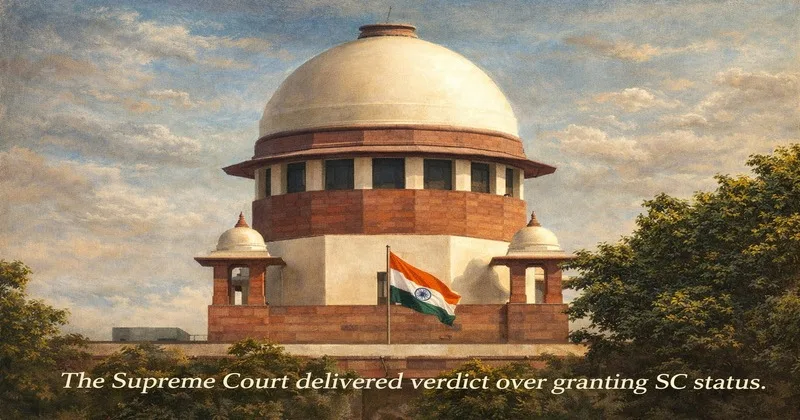
The Supreme Court in a significant verdict has ruled that if an individual undergoes religious conversion, they cannot be accorded Scheduled Caste(SC) status. A bench comprising Justice P.K. Mishra and Justice N.V. Anjaria pronounced that only individuals professing the Hindu, Sikh or Buddhist faiths are eligible to receive Scheduled Caste status

Dr. Mayank ChaturvediDr. Mayank Chaturvedi
Mar 24, 2026, 08:15 pm IST
in Bharat, Analysis, Law
Follow on Google News
FacebookTwitterWhatsAppTelegramEmail

The greatest strength of Indian democracy is its Constitution, which is founded upon the principles of equality, liberty and social justice. In this context, when the discussion turns to the rights of Scheduled Castes (SC) and religious conversion, the subject certainly transcends the realm of mere law; rather, it evolves into a complex question of history, society and identity.

The Supreme Court has delivered a significant verdict in this regard. It has ruled that if an individual undergoes religious conversion, they cannot be accorded Scheduled Caste(SC) status. A bench comprising Justice P.K. Mishra and Justice N.V. Anjaria pronounced that only individuals professing the Hindu, Sikh, or Buddhist faiths are eligible to receive Scheduled Caste status. Thus, by upholding a previous judgment of the Andhra Pradesh High Court, the Supreme Court of India has unequivocally clarified that if an individual renounces Hindudharma, Sikhism or Buddhism to embrace any other religion; specifically Christianity or Islam- they forfeit their Scheduled Caste status.

Legal Basis: The 1950 order and its clarity

Fundamentally, the entire premise of this case lies embedded within the ‘Constitution(Scheduled Castes) Order, 1950’. Clause 3 of this Order explicitly stipulates that Scheduled Caste status shall be accorded solely to individuals affiliated with the Hindu, Sikh or Buddhist faiths. The direct implication of this is that the moment an individual steps outside the fold of these religions, the legal identity; which serves as the basis for their access to reservation, protection and special privileges; stands extinguished. Indeed, in its recent verdict, the Supreme Court reiterated this very provision, affirming that this restriction remains fully operative and admits of no exceptions whatsoever.

The most critical question that arises here is: why, precisely, does a change in “religion”(Dharma) result in the forfeiture of Scheduled Caste rights? The answer to this question, upon closer examination, lies embedded within the historical fabric of Indian society. In this context, the concept of Scheduled Castes is not predicated on economic backwardness but is intrinsically linked to the social oppression historically found within the Hindu caste system. Discrimination based on caste, untouchability and social exclusion had marginalized a large section of the population. The framers of the Constitution established the identity of Scheduled Castes specifically to rectify this historical injustice.

Articles 14, 15 and 17 of the Constitution serve as guiding principles in this regard. Article 14 enshrines the right to equality; Article 15 prohibits discrimination; and Article 17 abolishes untouchability. However, the status of Scheduled Castes extends beyond these general rights; it was conferred as a form of special social redressal. Consequently, this status was deemed applicable solely within the specific social framework- namely, Hindu society; where such oppression had historically prevailed.

For this very reason, when the relevant order came into effect in 1950, Scheduled Caste status was restricted exclusively to Hindus. Subsequently, this status was extended to the Sikh community in 1956 and the Buddhist community in 1990, as these religions, too, encompassed a significant number of individuals who had originally been subject to the caste hierarchy of Hindu society. However, Christianity and Islam were excluded from this ambit, based on the premise that these religions do not possess a structural framework of caste-based discrimination.

The judiciary and landmark precedents

The judiciary has also reiterated this principle on numerous occasions. In ‘Soosai v. Union of India’ (1985), the Supreme Court clarified that an individual cannot claim Scheduled Caste status after converting to Christianity, as religious conversion entails a fundamental alteration of one’s social status. Similarly, in ‘C.M. Arumugam v. S. Rajgopal’ (1976), it was held that upon religious conversion, one’s caste identity is deemed to be extinguished. Nevertheless, in ‘Kailash Sonkar v. Maya Devi’(1984), the Court added a caveat: if an individual reverts to Hindudharma and is accepted back into the community, their Scheduled Caste status may be restored.

The Present Case: Law vs. Individual Claim

The situation in the recent case was also broadly similar. An individual who had converted to Christianity and was serving as a pastor filed a case under the SC/ST (Prevention of Atrocities) Act, 1989; however, the court ruled that since he was no longer a member of a Scheduled Caste, he could not claim protection under this statute. In this context, this verdict establishes a broad legal principle.

Also Read: Explosion at oil refinery in Port Arthur amid West Asia crisis; Smoke engulfs triggering climate & health risks

Hindu Society: Historical structure and reality

Viewed through the lens of Hindudharma, the ‘Varna’ and ‘Jati’(caste) systems confined society within a rigid framework. Within this system, Scheduled Castes occupied the lowest rung of the hierarchy; consequently, and inevitably; this situation adversely impacted their access to education, employment, and social dignity, preventing them from advancing with the same assertiveness or opportunities available to others. Indeed, the Constitution provided for reservations and special protections precisely to address this historical disadvantage. Therefore, the law posits that when an individual steps outside of this system, they simultaneously step out of the specific forms of oppression associated with it.

Thus, the Supreme Court verdict delivered today makes it legally abundantly clear that the decision rendered is entirely in consonance with the Constitution. It is grounded in the interpretation of the law set forth in the 1950 Order-an interpretation that, in essence, draws clear legal distinctions between religious conversion and the rights accorded to Scheduled Castes. Ultimately, the fundamental objective of the Indian Constitution is social justice.

Topics: Scheduled Caste(SC)Supreme CourtBuddhismSikhismHinduismReligious Conversion
ShareTweetSendShareSend
✮ Subscribe Organiser YouTube Channel. ✮
✮ Join Organiser's WhatsApp channel for Nationalist views beyond the news. ✮
Previous News

How is India battling the fertiliser shock triggered by the Iran war?

Next News

USCIRF: Weaponising religious freedom

Related News

Moin Khan arrested as police probe alleged Pakistan-linked conversion network

Kota Online Conversion Racket Exposed: Moin Khan arrested for trapping Hindu women; 40,000 obscene videos recovered

FCRA 2026: Centre bans foreign funds for religious conversion activities (This is an AI generated image)

FCRA 2026: Centre bans use of foreign funds for religious conversion, tightens NGO oversight

Supreme Court of India

‘RTI activism has become business’: SC denies anticipatory bail, questions activist’s authority to monitor road project

(Left) Late Swami Lakshmanananda Saraswati(Right) Justice A.S. Naidu

Religious conversion a key factor in Swami Lakshmanananda Saraswati’s murder: Justice Naidu amid missing report row

India–Myanmar Civilisational Connect: Significance of President U Min Aung Hlaing’s visit to India

The AMU Judgment: Why the Supreme Court must revisit Article 30

Load More

Latest News

The Indian women's cricket team has qualified for the LA28 Olympics as the ICC confirmed the qualification pathway for cricket's historic Olympic return

Cricket’s return to the Olympic Games is a landmark moment: ICC Chairman Jay Shah

President Droupadi Murmu paid tribute to the heroes of the Santhal rebellion on the occasion of Hul Diwas

Hul Diwas: President Murmu pays tribute to heroes of Santhal rebellion, says their sacrifice will inspire forever

A representative image

Escalating unrest and civilian casualties in Pakistan Occupied Jammu and Kashmir: A 15 year overview

A representative image

Twelve years of pension reforms: Over 3.28 lakh PPOs issued through Bhavishya platform

Representative image made using AI

Religious festival or display of violence? 12 incidents of killings and attempts to kill Hindus during Muharram

A representative image

Nirbhay Chetna: Govt launches world’s largest gender sensitisation drive for women, targets 17.5 lakh representatives

A representative image made from AI

From Digital Consumer to Technology Powerhouse: How India is building technologies that are shaping Viksit Bharat 2047

Representative image

FCRA Amendment Bill 2026: Why evangelical groups are rattled over India’s oversight on foreign funding

Sir Dinshaw Maneckji Petit Birth Anniversary: Remembering Bombay's Textile Pioneer

Birth Anniversary of Sir Dinshaw Petit: The visionary who built Bombay’s textile empire

Guru Hargobind ji

Remembering Guru Hargobind Ji on Prakash Parv: Visionary who united spirituality with the sword of justice

Load More
  • Privacy
  • Terms
  • Cookie Policy
  • Refund and Cancellation
  • Delivery and Shipping

© Bharat Prakashan (Delhi) Limited.
Tech-enabled by Ananthapuri Technologies

  • Home
  • Search Organiser
  • Bharat
    • Assam
    • Bihar
    • Chhattisgarh
    • Jharkhand
    • Maharashtra
    • View All States
  • World
    • Asia
    • Africa
    • North America
    • South America
    • Europe
    • Australia
  • Editorial
  • Operation Sindoor
  • Opinion
  • Analysis
  • Defence
  • Culture
  • Sports
  • Business
  • RSS @ 100
  • Entertainment
  • More ..
    • Sci & Tech
    • Vocal4Local
    • Special Report
    • Education
    • Employment
    • Books
    • Interviews
    • Travel
    • Health
    • Politics
    • Law
    • Economy
    • Obituary
  • Subscribe Magazine
  • Read Ecopy
  • Advertise
  • Circulation
  • Careers
  • About Us
  • Contact Us
  • Policies & Terms
    • Privacy Policy
    • Cookie Policy
    • Refund and Cancellation
    • Terms of Use

© Bharat Prakashan (Delhi) Limited.
Tech-enabled by Ananthapuri Technologies