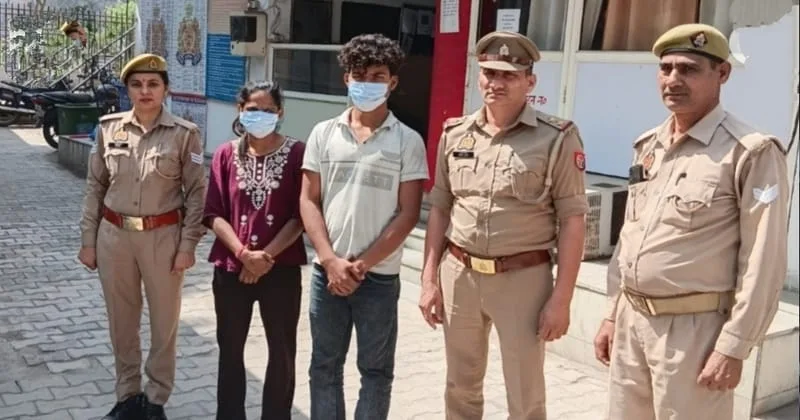
Ghaziabad: In a significant breakthrough, the Ghaziabad Police has arrested a 20-year-old man, Mohammad Naushad Ali, for his alleged role as a key recruiter in an espionage network linked to Pakistan’s Inter-Services Intelligence (ISI). In a further breakthrough in the case, police have arrested three more accused, including a woman identified as Meera, and a minor, taking the total number of arrests to 14 in what is being described as one of the largest espionage modules linked to the ISI. Investigators say Naushad is among the masterminds of the racket, playing a key role in recruiting young individuals with technical skills—such as mobile repair, computer operations, and CCTV handling—particularly from economically weaker sections, by enticing them with money.
Ghaziabad Police arrested Mohammad Naushad Ali (20), a tyre puncture repairer at a petrol pump in Faridabad's Nacholi village (Tigaon area), Haryana, as a key recruiter in a Pakistan ISI-linked espionage network.
He allegedly lured vulnerable youths to share sensitive Delhi-NCR…
— Megh Updates 🚨™ (@MeghUpdates) March 23, 2026
Modus Operandi
Police officials revealed that the accused primarily used social media and informal contacts to identify financially distressed youths. Once recruited, they were allegedly instructed to collect and share photos, videos, and GPS coordinates of key locations across the Delhi-NCR region. These tasks, though seemingly harmless, are believed to have had serious national security implications.
Authorities suspect that the information gathered could be used for reconnaissance purposes, potentially aiding hostile elements in mapping critical infrastructure and movement patterns in and around the national capital.
Wider Network Under Scanner
The arrest is part of a larger crackdown on an espionage module believed to have links across multiple states. Officials indicated that several other individuals have already been detained, and further arrests are likely as the investigation progresses.
Law enforcement agencies are now working to trace the digital footprint of the accused and identify handlers operating across borders. Intelligence inputs suggest that such networks often exploit economic vulnerability and lack of awareness among youth to carry out covert operations.
The case has once again highlighted the evolving nature of espionage activities, where low-level operatives are recruited for micro-tasks that collectively pose a significant threat. Security experts have emphasised the need for increased public awareness, particularly among young people, about the risks of sharing sensitive information for monetary gain.
Police have urged citizens to remain vigilant and report any suspicious approaches or offers that involve collecting or sharing information about strategic locations.