
“The Sangh believes that Hindu society will be able to fulfil its global responsibility effectively only on the basis of an organised and collective life, full of self-confidence founded on Dharma. Therefore, we resolve for building a model society following harmonious practices rejecting all types of discriminations, promoting value-based families founded on eco-friendly lifestyle and creating a society fully immersed in selfhood and committed to civic duties. This will enable us to construct a strong national life, materially prosperous and replete with spirituality, mitigating the challenges and solving all the problems of the society” –Resolve on the occasion of Sangh Centenary, Rashtriya Swayamsevak Sangh, ABPS 2025, Bengaluru, March 23, 2025
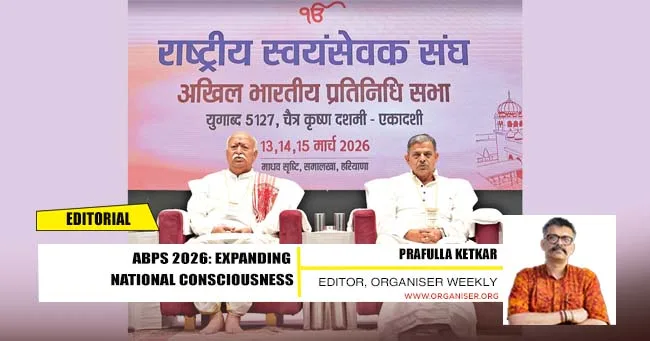
The Akhil Bharatiya Pratinidhi Sabha (ABPS) of Rashtriya Swayamsevak Sangh at Bengaluru in 2025 renewed its resolve to reach out to the unreached sections of society with the agenda of Panch Parivartan. The ABPS 2026 at Samalkha, in Panipat district of Haryana, was an occasion to review the goals set for the centenary year, and the numbers exceeded the expectations. It is interesting to see how Sangh set the process, achieved these unbelievable targets and is planning to consolidate the momentum to realise the future objectives.
The process began with the Vijayadashmi Utsav, with the mobilisation of active Swayamsevaks from October 2, 2025. More than 62,000 programmes, involving more than 32 lakh Swayamsevaks, were held in 15 days. Besides this, the Path Sanchalan (route marches) were organised at 22,000 places, with the participation of over 25 lakh Swayamsevaks. The first phase mobilised the critical mass of the awakened people who could take the campaign to the second stage.
Griha Sampark Abhiyan (door-to-door contact programme) to meet people at home and convey the Sangh’s thought process and message of Panch Parivartan, which so far has resulted in reaching out to more than 10 crore households, and this figure covers 37 out of 46 prants. The Swayamsevaks who were active at some point and the people who have a positive view of the national reconstruction work undertaken by the Sangh could be reached through this campaign. The Supta, or latent, power of the nation was galvanised by this process. The Swayamsevaks could also understand the common questions asked by the masses – admirers and critics – about the Sangh and its objectives.
Hindu Sammelans, community-level gatherings of Hindus – irrespective of caste, sect, religion or political affiliation – were attended by more than 3 crore men and women. The programmes were organised by local committees comprising eminent people and organisations, numbering 20 to 40. The idea of working together for a social cause, finding solutions to prevalent problems, and setting the process of deliberation for constructive work began with this.
In the same vein, two important programmes were held – the Sadbhav baithaks, meetings for social harmony, and the Pramukh Jan Sangoshti, a confluence of eminent people. The social and intellectual leadership of the society was brought on the common platform to inculcate the idea of working together separately for the national cause. In the process, misconceptions about the Sangh, perpetuated by deliberate narratives or ignorance, were directly addressed by the Sangh leadership through an open question-and-answer session. The idea was not to convince but to communicate with the righteous power of the society. Rarely do we find any organisational leadership taking on numerous critical questions on public platforms, the way Sangh did. The Sajjan Shakti, which Sarkaryavah Shri Dattatreya Hosabale termed the power of good while addressing the press conference, was galvanised through these two programmes, where thousands of people representing various castes, communities and professions participated, and the process will continue.
The Jagrit Shakti, the Supta Shakti and the Sajjan Shakti are the critical pillars for national reconstruction. Without getting into celebratory mode, Sangh utilised the occasion to reach out to the unreached sections through local Swayamsevak and nationwide travel of the top leadership. And still, the ABPS 2026 reviewed the process and deliberated on future challenges while channelising constructive social energy. When efforts to create a gulf in society along identity-based faultlines coincide with an unstable global scenario, the Sangh has displayed a remarkable ability to awaken and expand the national consciousness of Bharat. The remembrance of great national personalities like Lokmata Ahilyabai Holkar, Rani Abakka, Sri Guru Tegh Bahadur Ji, and this year Sant Ravidas Ji, with their critical life messages, is another dimension that plays a pivotal role in shaping this consciousness about a common motherland, common Sanskriti and common ancestors – the foundation of our nationhood. Sangh is just strengthening that foundation so that the ultimate objective of taking this ancient nation to the pinnacle of glory is reached. The ABPS 2026 has once again assured that the Sangh does not want to function as a separate organisation in society, but to organise the entire society on the principles of Dharmic harmony, so that Bharat can accomplish its mission to take the world on the path of spiritual democracy, integrated development and universal brotherhood.