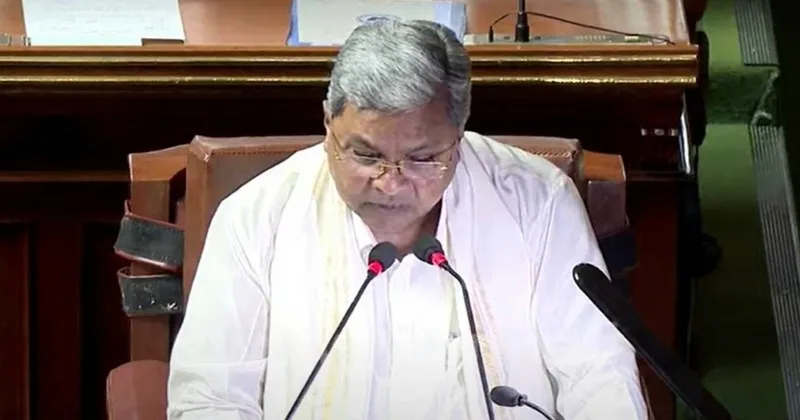
Bengaluru: A staggering ₹20 crore spent on foreign tours by Karnataka government officials has snowballed into a major controversy, with glaring lapses in accountability exposing what critics call a deep-rooted culture of negligence and misuse of public funds. The revelations, placed before the Assembly by Chief Minister Siddaramaiah, have triggered outrage as a majority of officials who travelled abroad failed to submit mandatory study reports.
According to official data, as many as 95 foreign trips were undertaken by state government officials since 2023. Of these, 58 trips were funded by the government, costing the exchequer ₹20.28 crore, while 37 trips were reportedly self-funded. On average, each government-sponsored trip cost around ₹21.35 lakh—raising serious questions about whether taxpayers’ money was spent prudently or squandered without oversight.
What has drawn sharp criticism is not just the scale of expenditure but the complete lack of accountability. Officials deputed for these trips were expected to submit detailed study reports outlining learnings, outcomes, and how such exposure would benefit governance back home. However, a significant number of officers simply failed to do so.
A circular issued by the Department of Personnel and Administrative Reforms clearly pointed out that several officials who travelled between August 2024 and July 2025 had not submitted their reports. This failure effectively renders the trips meaningless, as there is no documented evidence to show what the state gained from these expensive visits.
Critics argue that this reflects a systemic failure within the administration, where rules are either ignored or not enforced. “If officers can travel abroad at public expense and return without accountability, it raises serious concerns about governance standards”, said a senior political observer.
The controversy also puts the spotlight on the government’s role in approving and monitoring such trips. While the Chief Minister presented the data, opposition voices have questioned why stricter checks were not in place earlier. Many have alleged that the absence of timely monitoring allowed officials to treat these visits as mere foreign junkets rather than serious assignments.
Among the most expensive tours was the delegation’s visit to the World Economic Forum(WEF) in Davos in 2024, which cost a whopping ₹4.7 crore. Similarly, an 11-day visit to the United States by three senior officials in 2023 cost ₹2.2 crore. Officials also travelled to over 27 countries, including the UK, Germany, France and Italy, purportedly to study global best practices and attract investments.
However, without proper documentation or follow-up action, these objectives remain questionable. Experts point out that such trips must lead to measurable policy improvements, investment inflows or administrative reforms. In the absence of reports, there is no way to evaluate their impact.
Faced with mounting embarrassment, the government eventually imposed a ban on foreign trips in September 2025. While this move is being projected as a corrective step, critics say it came far too late, after crores of rupees had already been spent with little to show.
The episode has ignited a larger debate on bureaucratic accountability and the need for strict enforcement of rules. There are growing demands for a detailed audit of all foreign trips, fixing responsibility on erring officers and even recovering costs in cases where no reports were submitted.
The controversy has also cast a shadow on the government’s claims of transparency and efficient administration. With public money at stake, experts insist that mere bans are not enough—what is required is a robust system of monitoring, evaluation and consequences for non-compliance.
As the issue gains political traction, the spotlight is now firmly on both the bureaucracy and the government to explain how such a large-scale lapse was allowed to occur and what steps will be taken to ensure that it is never repeated.