
From Movement to Monopoly: Rise of dynastic control in DMK
July 16, 2026
  • Read Ecopy
  • Circulation
  • Advertise
  • Careers
  • About Us
  • Contact Us
Android AppiPhone AppArattai
Organiser
  • ‌
  • Bharat
    • Assam
    • Bihar
    • Chhattisgarh
    • Jharkhand
    • Maharashtra
    • View All States
  • World
    • Asia
    • Europe
    • North America
    • South America
    • Africa
    • Australia
  • Editorial
  • International
  • Opinion
  • RSS @ 100
  • More
    • Op Sindoor
    • Analysis
    • Sports
    • Defence
    • Politics
    • Business
    • Economy
    • Culture
    • Special Report
    • Sci & Tech
    • Entertainment
    • G20
    • Azadi Ka Amrit Mahotsav
    • Vocal4Local
    • Web Stories
    • Education
    • Employment
    • Books
    • Interviews
    • Travel
    • Law
    • Health
    • Obituary
  • Subscribe
    • Subscribe Print Edition
    • Subscribe Ecopy
    • Read Ecopy
  • ‌
  • Bharat
    • Assam
    • Bihar
    • Chhattisgarh
    • Jharkhand
    • Maharashtra
    • View All States
  • World
    • Asia
    • Europe
    • North America
    • South America
    • Africa
    • Australia
  • Editorial
  • International
  • Opinion
  • RSS @ 100
  • More
    • Op Sindoor
    • Analysis
    • Sports
    • Defence
    • Politics
    • Business
    • Economy
    • Culture
    • Special Report
    • Sci & Tech
    • Entertainment
    • G20
    • Azadi Ka Amrit Mahotsav
    • Vocal4Local
    • Web Stories
    • Education
    • Employment
    • Books
    • Interviews
    • Travel
    • Law
    • Health
    • Obituary
  • Subscribe
    • Subscribe Print Edition
    • Subscribe Ecopy
    • Read Ecopy
Organiser
  • Home
  • Bharat
  • World
  • Operation Sindoor
  • Editorial
  • Analysis
  • Opinion
  • Culture
  • Defence
  • International Edition
  • RSS @ 100
  • Magazine
  • Read Ecopy
Home Politics

From Movement to Monopoly: The rise of dynastic control in Tamil Nadu’s DMK

As Tamil Nadu approaches another electoral cycle, the issue is not merely about one party or one family. It is about the kind of democracy the people wish to strengthen. Should political leadership remain concentrated within a closed circle, or should it open itself to broader participation? Should the future of governance be shaped by inheritance or by merit?

Siddhartha DaveSiddhartha Dave
Mar 21, 2026, 09:30 pm IST
in Politics, Bharat, Analysis, Opinion, Tamil Nadu
Follow on Google News
FacebookTwitterWhatsAppTelegramEmail

Dynastic politics has long stood as one of the most troubling contradictions within Bharat’s democratic framework. While the nation takes pride in electoral vibrancy, several major political formations—from the Congress to the Samajwadi Party and the Trinamool Congress—have increasingly come to revolve around familial authority. In such systems, leadership is not contested; it is transferred. Authority is not earned; it is inherited. The consequences are visible in weakened internal democracy, suppression of alternative leadership and a gradual alienation of the ordinary karyakarta.

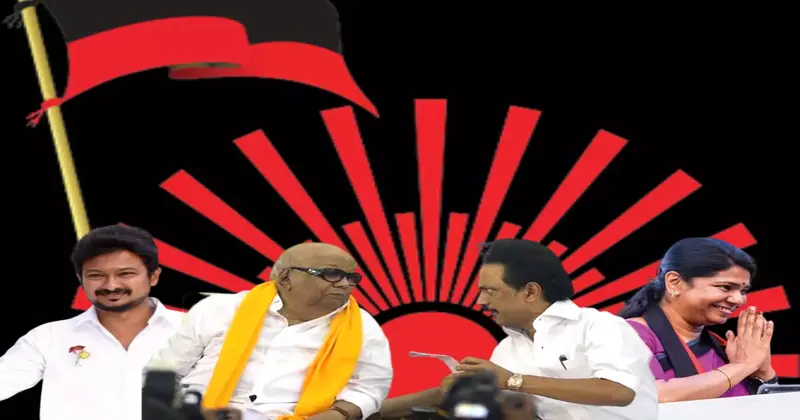
It is, however, in Tamil Nadu under the Dravida Munnetra Kazhagam(DMK) that this phenomenon finds one of its most elaborate and institutionalised expressions. The attached image is not merely a family tree—it is a political map. At its centre stands M. Karunanidhi, a towering figure whose legacy has come to define not just a party but an entire ecosystem of power. Surrounding him is an intricate web of relatives, many of whom have occupied or continue to occupy influential political, administrative and economic positions.

Karunanidhi’s immediate family itself reflects this consolidation. His sons have been central to Tamil Nadu’s political landscape. M.K. Stalin, his son, rose through the ranks to become the Chief Minister of Tamil Nadu and the current face of the DMK. Another son, M.K. Alagiri, wielded significant influence in southern Tamil Nadu and served as a Union Minister. Yet another son, M.K. Tamilarasu, has been associated with business interests linked to the family’s broader influence.

The next generation further deepens this concentration of power. Udhayanidhi Stalin, son of M.K. Stalin, has transitioned from cinema into politics and now holds a ministerial position, marking the continuation of dynastic succession. Dayanidhi Maran, Karunanidhi’s grand-nephew, has served as a Union Minister and remains a prominent political figure. His brother, Kalanithi Maran, while not directly in electoral politics, controls one of the largest media networks in the country, Sun TV, which has historically been seen as closely aligned with DMK interests—highlighting the overlap between political power and media influence.

Kanimozhi Karunanidhi, Karunanidhi’s daughter, is another key figure, serving as a Member of Parliament and playing a prominent role in shaping the party’s cultural and political narrative. The extended family includes several other individuals who, while not always in the limelight, are part of the broader network of influence—occupying roles in party structures, business enterprises, or allied institutions. Even more striking is the presence of multiple layers of relatives—sons, daughters, nephews, grand-nephews and in-laws—who are connected to positions of authority.

The image reflects names such as Durai Dayanidhi, Arulnidhi and others who are linked either to political roles or to industries like media, cinema and business, sectors that significantly shape public opinion and economic power in Tamil Nadu. The presence of spouses and extended family members in this network further underscores how influence is not confined to formal political positions but extends into a broader ecosystem of control.

This concentration of power within one family raises critical concerns about the health of democracy within the party and by extension, within the state. When leadership positions are repeatedly occupied by members of a single family, it creates a perception—if not a reality—that political power is being monopolised. For party workers who have dedicated decades of service, the message is clear: the highest offices may remain perpetually out of reach.

Such a structure also risks blurring the line between public service and private interest. When political authority, media control and economic influence intersect within a single familial network, it can create an environment where accountability becomes diffused. Decisions may be influenced not solely by public welfare but by the imperative to sustain a consolidated power structure.

Also Read: Tunis anti-terror arrests cast shadow on Gaza Flotilla, spotlight turns on Greta Thunberg and funding links

For the people of Tamil Nadu, this has deeper implications. The state, known for its high literacy, industrial growth and cultural vibrancy, has a population that is aspirational and increasingly aware. Yet, the persistence of dynastic politics risks limiting the emergence of new leadership that can bring fresh ideas and perspectives. It can create a political culture where loyalty to a family supersedes commitment to governance and public welfare.

As Tamil Nadu approaches another electoral cycle, the issue is not merely about one party or one family. It is about the kind of democracy the people wish to strengthen. Should political leadership remain concentrated within a closed circle, or should it open itself to broader participation? Should the future of governance be shaped by inheritance or by merit?

The image serves as a powerful visual reminder of the stakes involved. It is not just a depiction of relationships; it is a representation of how deeply entrenched dynastic politics can become when left unchallenged. For a state with the intellectual and cultural legacy of Tamil Nadu, the moment calls for introspection.

The coming election, therefore, is more than a political contest—it is an opportunity to reaffirm the principles of democratic openness, accountability and equal opportunity. Tamil Nadu’s electorate has the agency to decide whether its political future will continue to be shaped by a single extended family or whether it will embrace a more inclusive and merit-based path forward.

Topics: Tamil NaduDemocracydynasty politicsFamily politicsTamil Nadu elections 2026DMK
Siddhartha Dave
Siddhartha Dave
Siddhartha Dave is an alumnus of the United Nations University in Tokyo and a former Lok Sabha Research Fellow. He writes on foreign affairs and national security. [Read more]
ShareTweetSendShareSend
✮ Subscribe Organiser YouTube Channel. ✮
✮ Join Organiser's WhatsApp channel for Nationalist views beyond the news. ✮
Previous News

Karnataka: 24 sedition in 3 years; Zero conviction & dismissed for lack of evidence, raises national security concern

Next News

Karnataka: Rs 20 crore splurged on foreign tours; Missing reports expose governance failure

Related News

Tamil Nadu: Madras HC cancels registration of Rs 100 crore Palani Murugan Temple land in private individuals’ names

A Protest Held by Hindu Munnani a protest held at Thiruvattar in Kanyakumari district

Tamil Nadu: Hindu Munnani protests in Kanyakumari, seeks removal of illegal Christian prayer hall despite court orders

Tamil Nadu: Ramaswamy Naicker statue on ancient Shiva temple land without HR&CE approval; Hindu activist seeks removal

Tamil Nadu: BJP, temple activists oppose lifting of registration ban on 3,085 acres of temple land in Karur

Tamil Nadu Chief Minister S. Joseph Vijay hands over compassionate appointment orders to 31 legal heirs of Karur stampede victims on July 10, 2026

Tamil Nadu: CM Joseph offers Karur victims’ kin govt jobs, subject to judicial review, politics over tragedy continues

DMK MLA V Senthil Balaji

Tamil Nadu: Ex DMK Minister Senthil Balaji, brother get anticipatory bail in alleged Rs 35 crore TVK MLA bribery case

Load More

Latest News

UP Govt takes back Azam Khan's Jauhar University land

UP: Bulldozer action looms over Azam Khan’s Jauhar University as authority orders demolition of 38 ‘Illegal’ buildings

A representative image

IRCTC launches new website with faster ticket booking, easier checkout and improved user experience

Chenab Riverbank

J&K: Salal, Baglihar reservoirs to be de-silted in coming days, advisory issued for people living on banks

Representative Image

Tamil Nadu Police detain 73 illegal Bangladeshis in Hosur; Hindu Munnani calls for deportation

Accused Ismail

Davanagere Horror: Gym trainer Ismail booked on charges of rape, blackmail after woman alleges secret recordings

Dr. Vrushali Joshi, National Organising Secretary of Vishwa Mangalya Sabha briefing the media about the upcoming historic dialogue on contemporary motherhood by RSS Sarsanghchalak Dr Mohan Bhagwat

‘Matrutva Vimarsh’ in Delhi: RSS Sarsanghchalak Mohan Bhagwat to hold historic dialogue on contemporary motherhood

Representatives of the national trade union centers of the BRICS member and partner countries at BRICS Trade Union Forum

Declaration of 15th BRICS Trade Union Forum calls for human-centric AI, universal social security & labour cooperation

The deities' three chariots are ready for the sacred Shree Gundicha Yatra

Three Grand chariots ready at Singhadwara as Puri immerses in devotion ahead of Rath Yatra 2026

Shikshit Uttar Pradesh 2047: “Education is the basic requirement for development,” says Pilot Rakesh Tyagi

Semicon 2.0 to Urea Self-Reliance: Union Cabinet unveils Rs 2.19L crore projects to propel economic prosperity of India

Load More
  • Privacy
  • Terms
  • Cookie Policy
  • Refund and Cancellation
  • Delivery and Shipping

© Bharat Prakashan (Delhi) Limited.
Tech-enabled by Ananthapuri Technologies

  • Home
  • Search Organiser
  • Bharat
    • Assam
    • Bihar
    • Chhattisgarh
    • Jharkhand
    • Maharashtra
    • View All States
  • World
    • Asia
    • Africa
    • North America
    • South America
    • Europe
    • Australia
  • Editorial
  • Operation Sindoor
  • Opinion
  • Analysis
  • Defence
  • Culture
  • Sports
  • Business
  • RSS @ 100
  • Entertainment
  • More ..
    • Sci & Tech
    • Vocal4Local
    • Special Report
    • Education
    • Employment
    • Books
    • Interviews
    • Travel
    • Health
    • Politics
    • Law
    • Economy
    • Obituary
  • Subscribe Magazine
  • Read Ecopy
  • Advertise
  • Circulation
  • Careers
  • About Us
  • Contact Us
  • Policies & Terms
    • Privacy Policy
    • Cookie Policy
    • Refund and Cancellation
    • Terms of Use

© Bharat Prakashan (Delhi) Limited.
Tech-enabled by Ananthapuri Technologies