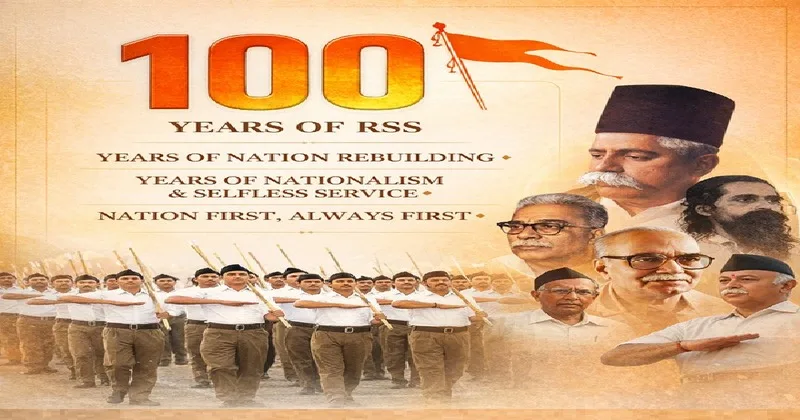
The centenary year of the Rashtriya Swayamsevak Sangh (RSS) has emerged as a powerful journey driving comprehensive transformation within societal life. In Madhya Pradesh; which, from the Sangh’s perspective, is administratively divided into three distinct provinces: Madhya Bharat, Malwa and Mahakaushal; the various dimensions of service, organizational strengthening and social awakening that have come to the fore over the past year paint a clear picture of integrated social change. When viewing the statistics and activities across these three provinces in a consolidated manner, it becomes evident that the Sangh’s work is no longer confined merely to its “Shakhas” (daily assemblies); rather, it has successfully reached every section and sphere of society.
Ashok Pandey, the “Sanghchalak” (Chief Organizer) of the Madhya Bharat prant (province), states: “Volunteers are actively engaged in issues such as de-addiction, environmental conservation, and social harmony. Today, volunteers can be seen undertaking service initiatives in every field. Dr. Hedgewar established the Sangh with the very purpose of enabling us to lead our nation to the pinnacle of ultimate glory (Param Vaibhav); consequently, every Swayamsevak (volunteer) reiterates this solemn pledge during their daily prayer”.
Pandey further asserts: “Driven by a commitment to social harmony and the resolve to mobilize the ‘virtuous forces’ (Sajjan Shakti) of society in the national interest, the Rashtriya Swayamsevak Sangh has been actively working since the very first day of its inception and it will continue to work towards this same objective in the future”.
Organizational Expansion: Sangh activities reaching every village
Indeed, the pace of the Sangh’s organizational expansion in Madhya Pradesh has been remarkable. In the Madhya Bharat prant (province), 3,842 ‘Shakhas’ are currently operational across 2,481 locations; meanwhile, in the Malwa prant, 5,049 ‘Shakhas’ are active across 3,292 locations, and in Mahakaushal, 3,078 ‘Shakhas’ are functioning across 2,141 locations. Thus, when aggregating the figures from all three provinces, the state of Madhya Pradesh currently hosts over 12,000 “Shakhas” operating across more than 7,900 distinct locations. The organization’s roots have also deepened through weekly gatherings and ‘Sangh Mandalis’ (assemblies). Currently, 736 weekly gatherings are operational in Central India, 1,961 in Malwa, and 918 in Mahakaushal.
From seva Bastis to the last person in society
The most impactful dimension of the Sangh’s service activities is evident in the state’s “Seva Bastis”. In Central India, service activities are being conducted in 970 out of 1,013 ‘Seva Bastis’; in Malwa, 672 settlements are actively engaged in service work; and extensive service activities are also underway in Mahakaushal. Taken together, thousands of service projects across the state are actively working in the fields of education, healthcare, self-reliance, and character building (Sanskar).
Notably, innovative experiments have been undertaken at the local level regarding themes such as de-addiction, environmental conservation, and cow protection. In regions like Gwalior, Shivpuri and Sehore, initiatives such as de-addiction campaigns, ‘Plastic-Free’ drives and the ‘One Home, One Roti’ campaign have successfully established a direct connection with the community. This work serves as a prime example of putting into practice the core ethos of ‘Panch-Parivartan’ (Five Transformations): Self, Society, Environment, Family, and Nation.
Building capable cadres through training and personality development
The foundation of the Sangh’s work lies in its trained volunteers (Swayamsevaks). In Central India, 8,021 volunteers underwent training across 179 ‘Introductory Camps’ (Prarambhik Vargs), while 3,485 volunteers received training in 61 ‘Primary Camps’ (Prathmik Vargs). In Malwa and Mahakaushal as well, a large number of cadres participated in various training camps. Across the state, thousands of volunteers- having been trained through the Sangh’s educational camps are now providing leadership in diverse spheres of social life. Ashok Pandey, the ‘Prant Sanghchalak’ of the Central India region, observes- “This training is not limited merely to organizational aspects; in reality, these camps serve as vehicles for character building and fostering a sense of social responsibility.”
Unprecedented public participation in centenary year
The programs organized during the Sangh’s centenary year have infused a new consciousness into society. In the Madhya Bharat region, Vijaya Dashami celebrations were held at 2,124 locations and route marches (Path Sanchalan) at 1,818 locations; meanwhile, in the Malwa region, over 400,000 volunteers participated in uniform across 1,489 celebrations. In the Mahakoshal region as well, approximately 178,000 volunteers participated in programs held at 3,138 locations. Viewed collectively across all three provinces, the participation of hundreds of thousands of volunteers has made it evident that the Sangh has now evolved into a broad-based mass movement.
A message of social unity through “Hindu Sammelans”
The most impactful events of the centenary year were the “Hindu Sammelans” (Hindu Conferences). In Madhya Bharat, over 5.2 million people connected with 1,569 such conferences; in Malwa, participation exceeded 7 million; and in Mahakoshal, it surpassed 2.3 million. Thus, the participation of over 14.5 million citizens across the entire state has set a new record. Notably, various elements within these conferences including early-morning processions (Prabhat Pheris), Kalash Yatras (sacred pot processions), community meals, cultural programs, and guidance from spiritual leaders- all served to strengthen social harmony. A particularly significant highlight was the active participation witnessed among women and the youth demographic.
Reaching every household through the home-contact campaign
The Home-Contact Campaign (Grih Sampark Abhiyan) stood as the most extensive initiative of the Sangh’s centenary year. In Madhya Bharat, contact was established with 2.7 million families; in Malwa, with 3.2 million families and in Mahakoshal, with over 4.3 million families. Consequently, an introduction to the Sangh’s work reached over 10 million families across the entire state of Madhya Pradesh. More than 80,000 volunteers went door-to-door to engage in direct dialogue with residents. Ashok Pandey observes, “Even during the construction of the Shri Ram Temple, volunteers undertook an extensive door-to-door outreach campaign. Undoubtedly- both in the past and on this occasion- these outreach campaigns have served as unprecedented examples of social dialogue, trust-building, and ideological clarity.”
The new generation’s engagement with social leadership
Programs in the Malwa region involving the participation of 188,000 youths, the engagement of over 50,000 youths in Mahakoshal, and ongoing initiatives in Central India; such as ‘Bal Gokulam’, study centers, and youth dialogues- all indicate that the new generation is rapidly connecting with the work of the Sangh. Initiatives such as ‘Yuva Sangam’ (Youth Conclaves), lectures, ‘Yuva Samvada’ and entrepreneurship forums have fostered a sense of national consciousness and leadership capabilities among the youth.
Similarly, efforts to engage the enlightened sections of society through social harmony meetings and conclaves for prominent citizens have also proven effective. In Malwa, over 10,000 community leaders participated in 181 meetings, while in Central India, more than 17,000 prominent figures joined 193 such conclaves. Indeed, by bringing together diverse segments of society; including spiritual leaders, intellectuals, women leaders, and professionals- on a single platform, these programs have taken significant strides toward realizing a harmonious society.
From service to organizational expansion; From organization to social transformation
The consolidated statistics from all three regions of Madhya Pradesh- Central India, Malwa and Mahakoshal; clearly demonstrate that the Sangh’s work has now become multifaceted and all-encompassing across society. The expansion of ‘Shakhas’, the extensive scope of service activities, programs reaching millions of people and the growing participation of the youth all serve as indicators that the Sangh’s centenary year has truly evolved into a movement for social transformation.
The objectives of the ‘Panch-Parivartan’- namely, Self-Awakening, Family Enlightenment, Social Harmony, Environmental Conservation and Civic Duty- no longer appear confined merely to the realm of ideas; rather, they are visibly being translated into concrete action. In this context, one can only hope that in the times to come, this organized and awakened society will further strengthen the trajectory of nation-building.