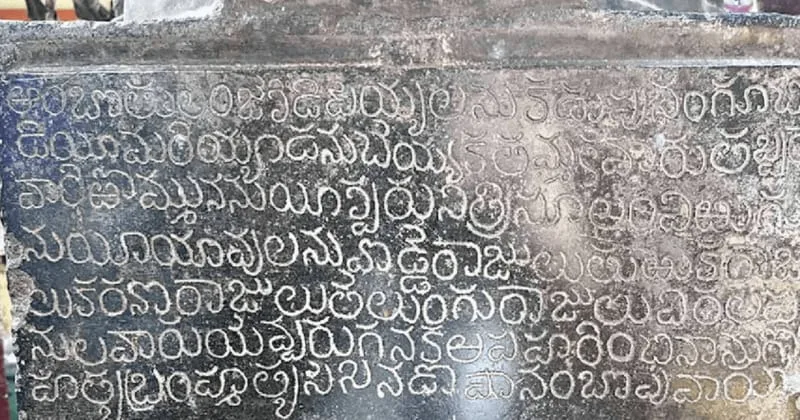
A medieval Telugu inscription connected to the Gajapathi rulers of Odisha has been discovered on a stone pillar at the historic Lakshmi Narasimha Swamy Mandir in Ramachandrapura Agraharam, Guntur. The inscription sheds light on the political and cultural ties between coastal Andhra and Odisha during the late medieval period, highlighting the administrative reach and religious patronage of the Gajapathi dynasty in present-day Andhra Pradesh.
Link to Gajapathi King Purushottama Deva
Epigraphist Bishnu Mohan Adhikari notes that the inscription is engraved on both sides of a Mandir mandapa pillar. It mentions Kumaraguru Mahapatra, a steward under Gajapathi ruler Purushottama Deva, who reigned in the 15th century CE. The record offers evidence of the Gajapathi kingdom’s administrative network extending into Andhra during that era.
Mandir Artefacts from Kondaveedu Fort
Local tradition holds that the murti of Bhagwan Narasimha at Guntur was brought from Kondaveedu Fort following medieval invasions. Mandir pujari Nadyala Yoganand adds that the stone pillars of the mandapa were also relocated from Kondaveedu after a divine dream instruction. Interestingly, Kondaveedu’s own Narasimha temple contains an Odia inscription recording Gajapathi donations for ritual worship.
Details on Mandir Service and Cattle Management
Originally dedicated to Bhagwan Mulasthana Mallikarjuna of Kondaveedu, the Guntur inscription directs that milk be offered during evening worship and specifies that cows used for rituals should be cared for by communities such as Tammula and Ambicvaru, likely pastoral groups like the Koyas. Kumaraguru Mahapatra is also mentioned in inscriptions from the Kalinga region, including modern Ganjam and Visakhapatnam districts.
Key Historical Insights
* The Gajapathi dynasty ruled large parts of Odisha and coastal Andhra during the medieval period.
* Purushottama Deva was a prominent 15th-century Gajapathi ruler.
* Kondaveedu Fort was a major medieval political centre in Andhra Pradesh.
* Hari-Hara worship combines reverence for both Shiva and Vishnu.
* Inscriptions at Kondaveedu and Guntur reflect the Gajapathi promotion of Shaiva-Vaishnava traditions.
Historians note that such discoveries illuminate the shared cultural heritage and administrative connections between Odisha and Andhra Pradesh during the medieval period.