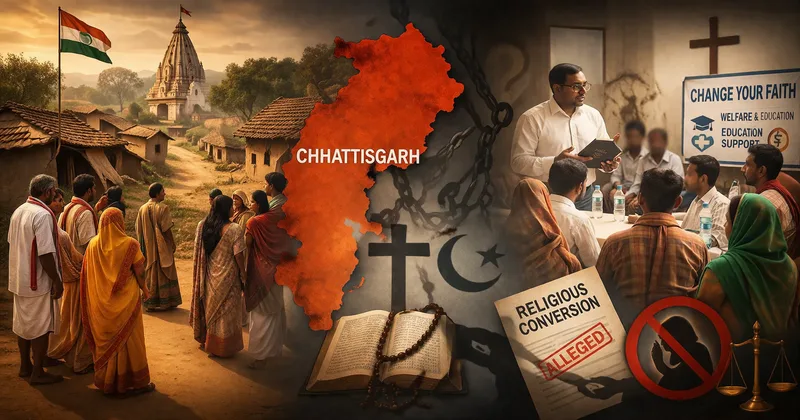
The current situation of religious conversions in Chhattisgarh cannot be viewed merely as a matter of individual faith. Across various parts of the state, it is emerging as a broader and more consistent phenomenon, with an impact that extends beyond individuals to entire villages and communities.
Incidents related to conversions have repeatedly surfaced in regions such as Narayanpur, Amabeda (Kanker), Bastar, and Surguja. These cases have not remained confined to religious change alone; in several instances, they have escalated into social tensions and even violent clashes. This indicates that the issue is not limited to isolated events but reflects a broader and recurring trend.
Official data suggests that the Christian population in the state is limited. However, the increasing number of informal churches and prayer centres, and their growing presence across different regions, point to a parallel expansion. This trend is particularly evident in tribal areas, where conversion-related incidents appear more concentrated.
A common pattern can be observed in this process—initial social engagement and influence, followed by conversion, and, eventually, social divisions at the local level. When such a sequence appears consistently across regions, it suggests that the phenomenon may not be merely a series of individual choices but part of a more organised process.
Therefore, the issue of religious conversion in Chhattisgarh extends beyond faith and becomes closely linked to social balance, law and order, and community structure.
Regional Distribution and Expansion Patterns
To understand the situation, it is important to look beyond overall population percentages and examine regional concentration and patterns of spread.
Regions such as Jashpur, Surguja, and Bastar have long reported conversion-related activities. In Jashpur district, the proportion of Christians is higher compared to other districts in the state. Meanwhile, several villages in Bastar and Narayanpur have witnessed noticeable demographic changes in recent years.
Villages such as Bhumiyabeda, Teradul, Ghumiyabeda, Chiprel, Kohda, Orchha, and Gudari have reportedly seen Christian populations grow to a majority. A key feature of these villages is that they are predominantly inhabited by tribal communities.
This pattern is no longer limited to tribal regions. In the plains, similar trends have been observed among backward and Scheduled Caste communities, including Satnami, Sahu, and Devangan groups. This suggests that an initial base established in tribal areas may now be expanding into other social sections.
Although no unified official data exists on the number of churches and prayer centres, various sources indicate rapid growth of both organised and unorganised religious institutions. The presence of groups such as Protestant, Roman Catholic, Syro-Malabar, and Mennonite communities reflects an institutional dimension to this expansion. The establishment of one of Asia’s largest churches in Kunkuri (Jashpur) is often cited as an example of this growing infrastructure.
Taken together, these observations suggest that the process of conversion in Chhattisgarh is not random or scattered but appears regionally concentrated and gradually expanding.
Understanding the Process of Conversion
To fully understand this phenomenon, it is essential to examine not only “where” and “how much,” but also “how” it operates.
Evidence from various regions suggests a structured and phased process:
1. Social Entry Phase
Initial engagement occurs through education, healthcare, employment, and financial assistance. These activities appear as service or welfare initiatives but gradually establish social connections and dependency.
2. Ideological Influence
The next phase involves influencing beliefs within communities. Efforts are made to present local traditions as separate from broader cultural frameworks, gradually distancing communities from their roots and creating an ideological vacuum.
3. Transformation Phase
This leads to what is often described as a “two-step process”—first disconnecting communities from their cultural base, and then filling that vacuum with a new religious identity. This transition is gradual, making it appear voluntary rather than externally influenced.
Various methods reportedly used include free services, economic aid, employment opportunities, interfaith marriages, and “healing gatherings.” These create an environment where conversion appears natural and acceptable.
In some areas, once the converted population reaches a certain level, social tensions and conflicts begin to emerge between converted and non-converted groups, as seen in places like Narayanpur and Amabeda.
The Hidden Dimension: Demographic Change
A less visible but critical aspect of this process is demographic transformation.
The concept of “crypto Christians” is relevant here—individuals who adopt Christianity in practice while retaining their original identity in official records. This makes it difficult to accurately assess demographic changes and adds complexity to the issue.
Comparison with Northeast India
To understand the long-term implications, the situation in Chhattisgarh is often compared with developments in Northeast India.
States such as Mizoram, Nagaland, and Meghalaya have witnessed significant changes in population composition over the past century. These shifts have influenced not only religious identity but also social structures, political representation, and regional dynamics.
Such transformations did not occur suddenly but evolved gradually—starting with small pockets of change and expanding over time.
Observers suggest that similar early-stage patterns—localised concentration, community-level shifts, and emerging tensions—can now be seen in parts of Chhattisgarh.
The question, therefore, is not whether Chhattisgarh will replicate the Northeast model, but whether similar early indicators are present.
The Bru-Reang Tribe Case
The Bru (Reang) tribe, residing in Northeast India and originally from Mizoram, is often cited in discussions of demographic and social change.
In the late 1990s, large-scale displacement occurred, with around 40,000 members of the tribe moving to Tripura. The migration followed ethnic tensions and violence.
According to accounts, members of the Bru community who resisted conversion faced targeted attacks. As a result, many were forced to leave their homes and live as refugees for decades.
Efforts by central and state governments to resettle them in Mizoram faced resistance from certain organisations. Groups such as the Central Young Mizo Association opposed their return and even raised demands to deny them voting rights, reportedly viewing them as outsiders.
The fear created by these circumstances was such that many members of the Bru community were reluctant to return to their native land despite the hardships.
The situation in Chhattisgarh is increasingly viewed through a long-term lens, in which religious conversion is linked not only to faith but also to broader social, demographic, and structural changes.
Analysts argue that when early indicators of such processes are visible—and when historical examples exist—the issue requires careful examination. Ignoring such patterns, they suggest, may lead to policy challenges in the future.
As demographic composition, social balance, and local dynamics evolve together, the issue moves beyond individual choice and enters the domain of structural transformation, making it a subject of wider societal and policy concern.