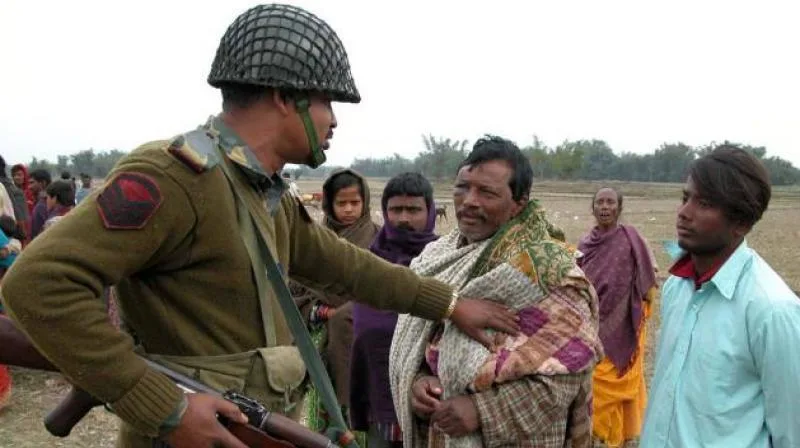
The newly elected West Bengal BJP government under Suvendu Adhikari approved the transfer of 600 acres of land to the Border Security Force (BSF) for completing the fencing of the India-Bangladesh border in the state.
Chairing the first Cabinet meeting at Nabanna, the Chief Minister announced that the BSF would receive full control over the land required for fencing operations and said the transfer process would be completed within 45 days. According to him, the completion of fencing would significantly help curb illegal infiltration occurring through porous stretches of the international border.
The decision comes at a time when illegal infiltration from Bangladesh has become one of the most fiercely debated national security and political issues in eastern India. For years, concerns have been raised regarding porous borders, human trafficking, cattle smuggling, fake currency rackets, illegal settlements, forged identity documents, and cross-border extremist networks operating through vulnerable areas along the border.
The development is big shift from the previous political standoff between the state government and the Centre over land acquisition and BSF jurisdiction.
India’s longest international border remains vulnerable
The India-Bangladesh border stretches approximately 4,096 kilometres across five Indian states, West Bengal, Assam, Meghalaya, Tripura and Mizoram. It is the longest international border India shares with any neighbouring country.
Among these states, West Bengal alone accounts for nearly 2,216 kilometres of the border. The geography of the region makes surveillance extraordinarily difficult. The border cuts across densely populated habitations, agricultural land, riverine stretches, forests, marshes and villages that often lie extremely close to the international boundary.
Unlike mountainous borders where natural barriers exist, large parts of the India-Bangladesh frontier remain flat and heavily populated, making infiltration easier. Security experts have repeatedly warned that porous stretches are exploited not just by illegal migrants but also by organised smuggling syndicates and anti-national elements.
According to figures cited in the report, around 1,647.696 kilometres of the border have already been fenced. However, approximately 569 kilometres remain unfinished. Of this, 112 kilometres have been categorised as “non-feasible” for fencing because of rivers, marshlands, forests and hilly terrain, while 456 kilometres are considered feasible but remain incomplete due to administrative and land acquisition hurdles.
The situation in West Bengal is especially alarming. Of the 456.224 kilometres of feasible fencing work pending in the state, land for only 77.935 kilometres has been formally handed over to the executing agencies. Land acquisition for 148.971 kilometres has not even begun, while another 229.318 kilometres remain stuck in various stages of acquisition.
For decades, these delays have created loopholes that illegal infiltrators and criminal networks have allegedly exploited with impunity.
Illegal infiltration is not merely a political slogan
The debate over illegal infiltration is often reduced to partisan rhetoric during elections, but the scale of the issue has repeatedly surfaced in official records and security discussions.
According to a 2025 release from the Ministry of Home Affairs, there were reportedly 745,000 incidents related to illegal infiltration and cross-border crimes till July 2025, while 3,245,700 such incidents were reported in 2024.
These incidents include not only illegal crossings but also smuggling, trafficking, document fraud, narcotics movement, cattle smuggling and other organised criminal activities operating across the border belt.
Security agencies have long warned that illegal infiltration creates cascading consequences. Once infiltrators enter the country, many allegedly obtain forged Aadhaar cards, ration cards, voter IDs and other identity documents through local syndicates. This eventually creates deeper governance and security challenges because identification and deportation become far more difficult after illegal settlers merge into local populations.
The concern is not merely about numbers. It is about the institutional networks that sustain infiltration and allow illegal entrants to remain undetected for years.
Border politics and the clash between state and centre
The fencing issue became deeply politicised in West Bengal over the last several years.
The Centre maintained that fencing delays were caused largely due to difficulties in acquiring land and obtaining administrative clearances from the state government. The then state administration, led by Mamata Banerjee, countered that border security was constitutionally the responsibility of the Union government.
Tensions escalated further in 2021 when the Union government expanded the jurisdiction of the BSF from 15 kilometres to 50 kilometres inside border states including West Bengal. The move was strongly opposed by the Trinamool Congress government, which accused the Centre of encroaching upon the powers of the state police.
This political resistance to stronger border enforcement weakened national security preparedness at a time when infiltration concerns were rising rapidly.
The new government’s decision to expedite land transfer for fencing is therefore being viewed not merely as an administrative step, but as a major political and strategic shift in the state’s approach towards border security.
Murshidabad and the demographic debate
In recent years, districts such as Murshidabad have frequently emerged at the centre of infiltration-related debates.
During the election campaign, allegations intensified regarding the movement of Bangladeshi nationals through border districts and their alleged impact on demographic patterns and voter rolls.
The BJP repeatedly accused the previous administration of ignoring illegal migration for political reasons, while the TMC rejected the allegations as communal and politically motivated.
However, the broader concern regarding demographic change in border districts is not new. Security observers and political analysts have repeatedly pointed to unusual population growth patterns in some border regions over the years, prompting demands for stricter verification of citizenship records and stronger border surveillance.
The issue remains highly sensitive because it intersects with electoral politics, citizenship debates and communal tensions.
Radical networks and security concerns
Another major factor intensifying concerns is the growing influence of Islamist organisations in parts of Bangladesh bordering India.
There are major concerns surrounding the growing influence of Jamaat-e-Islami in Bangladeshi districts adjoining West Bengal. The organisation’s political resurgence in Bangladesh has reportedly triggered fears regarding radicalisation, extremist spillover and the strengthening of cross-border networks.
Security agencies in India have, over the years, busted multiple modules linked to extremist organisations operating through border corridors. Several investigations have also exposed networks involving fake currency circulation, illegal arms movement and trafficking routes using unfenced stretches of the border.
The porous borders in geopolitically sensitive regions cannot be treated merely as a humanitarian or electoral issue. They directly impact national security architecture.
BSF personnel continue fighting a difficult battle
The burden of managing one of the world’s most difficult borders largely falls on the shoulders of the Border Security Force.
BSF personnel patrol riverine stretches at night, monitor densely populated border villages, intercept smugglers, prevent illegal crossings and respond to infiltration attempts under extremely challenging conditions.
Yet, security officials have repeatedly pointed out that fencing delays and incomplete infrastructure weaken operational effectiveness. In many unfenced regions, personnel rely on manual patrols and temporary barriers, which are inadequate against organised infiltration networks that continuously adapt their methods.
Riverine stretches remain particularly vulnerable because seasonal changes in river courses often make fixed barriers impossible.
Why Bharat cannot afford complacency
The issue of illegal infiltration is no longer confined to border villages in Bengal or Assam. Its effects are felt across the country through forged documentation networks, illegal labour chains, trafficking rackets and security concerns linked to radical elements.
Every sovereign nation has the right and responsibility to protect its borders. Strong border fencing, technological surveillance, stricter verification systems and coordinated intelligence operations are essential components of national security, not optional political choices.
The reality is that an unfenced and weakly monitored border benefits traffickers, smugglers, document forgers and extremist networks far more than ordinary civilians.
A defining test for India’s border security policy
The latest decision by the West Bengal government may prove to be a crucial moment in India’s long-delayed effort to secure its eastern frontier.
If land transfer and fencing work proceed without political obstruction, it could significantly strengthen border management in one of the most infiltration-prone regions of the country. However, fencing alone cannot solve the crisis. It must be accompanied by sustained surveillance, intelligence coordination, strict documentation systems and political willingness to confront illegal infiltration without hesitation.
For years, Bharat’s eastern border has remained vulnerable due to administrative paralysis, political confrontation and difficult terrain. The consequences of that vulnerability are now visible in recurring security concerns, demographic anxieties and organised cross-border criminal activity.
The challenge before the Indian state is clear: whether it finally treats illegal infiltration as a serious national security issue demanding long-term structural action or allows the problem to deepen further under political compulsions and bureaucratic delays.