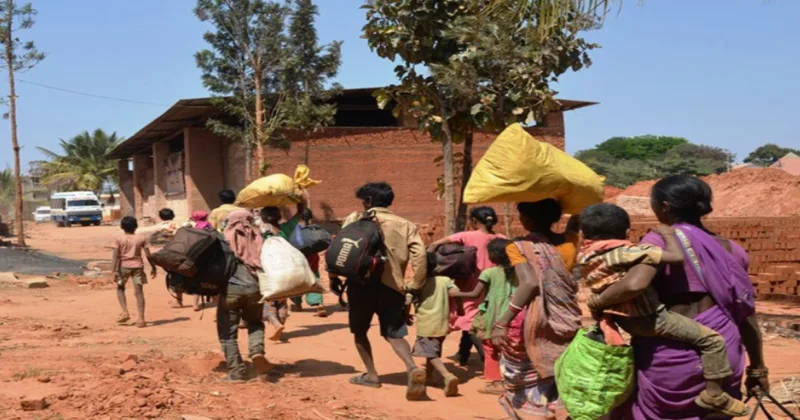
Janaki is a Khadima, a domestic worker from South India employed in the Persian Gulf. She is ensnared in the Kafala System, under which a kafeel, or sponsor, exercises near-total control over a worker’s freedom. For three long years, Janaki endured physical and psychological abuse at the hands of her sponsor. Before attempting to escape, a compassionate social activist helped her make one final video call to her young son, physically disabled and waiting for her in their distant village home. The image of that call becomes an emotional axis of the narrative: a mother suspended between fear and hope, between captivity and reunion. Her ordeal was powerfully portrayed in a short film titled Khadima. It has been directed by young debut filmmaker Govind K Saji. The film, which has received multiple awards and recognition, exposes the enduring pain of the Kafala System, an entrenched labour practice that persists in several Gulf countries despite recent reform efforts.
Modus Operandi
The Kafala System, historically used in parts of West Asia, requires foreign workers to be sponsored by an employer in the host country. The sponsor assumes legal responsibility for the worker’s job visa, residence permit (iqama) and immigration status. In effect, the worker’s legal existence is tied entirely to the employer. Although defended as an administrative framework, the system is widely described as a form of “modern-day slavery.” The kafeel’s control frequently extends beyond employment into the worker’s mobility, legal standing, and personal autonomy.
Common allegations include labour rights violations, confiscation of passports, restrictions on movement, prohibition on changing employers without permission, withholding or delaying wages, forcing workers into menial or unwanted tasks, working in extreme heat even during midday hours, online trading or “sale” of workers between kafeels and false charges of “absconding” against those who attempt to leave. Workers who flee abusive conditions may face arrest, fines, detention, or deportation. For helpless foreign workers trapped in unfamiliar places, access to legal remedies is often limited, and trade unions in many of these countries remain weak or non-existent.
The International Labour Organisation (ILO) took cognisance of the high levels of exploitation faced by domestic workers under Kuwait’s Kafala System. In 2009, the issue was formally presented in the Standards Committee of ILO Conference in Geneva by the representative of Bharatiya Mazdoor Sangh (BMS). Following sustained international scrutiny, the Government of Kuwait agreed to introduce legislative reforms. The ILO has advocated country-specific legal changes, ratification of relevant conventions, labour rights protections, and pre-departure orientation and training for migrant workers.
Workers Expire: Run-Up to FIFA WC
When stadium construction began in 2010 for the 2022 FIFA World Cup, reports indicated that thousands of workers employed under the Kafala System died in the course of large-scale construction activities. Many workers described their living and working conditions as prison-like. In response to mounting criticism, Qatar initiated reforms in 2016, becoming the first Gulf nation to formally modify elements of the Kafala structure. Other countries, including the United Arab Emirates, Saudi Arabia, Kuwait, and Lebanon have also announced reforms.
Reforms: Limited Impact & Concerns
In 2025, Saudi Arabia formally declared the abolition of the decades-old Kafala framework governing nearly 13 million migrant workers, many from Bharat. However, human rights groups argue that these reforms are uneven, discriminatory in their implementation based on social status, origin, and nationality, and fall short of international labour standards. Critics contend that implementation gaps remain wide. While terminology has changed, the core dependency on employer sponsorship remains intact.
Kuwait, Oman, Jordan, and Lebanon continue to retain variants of the Kafala System. The United Arab Emirates and Oman have introduced only partial reforms and continue to retain the core sponsorship model. In Lebanon, reform proposals have faced resistance from recruitment agencies, and legislative efforts have stalled in Parliament. Concerns about gaps in the implementation of labour reforms were raised by human rights activists on the eve of the 2023 UN Climate Change Conference in Dubai, following reports of serious worker rights violations at the conference sites. HRW’s World Report, 2026 indicates that the UAE continues to face widespread issues of wage theft, illegal recruitment fees, and passport confiscation, inadequate workplace safety, and a variety of complaints from migrant workers. In several countries, workers who leave employers without permission still risk imprisonment under “absconding” laws, even in cases involving severe abuse. Domestic workers, personal drivers, guards, agricultural labourers, shepherds, and undocumented migrants are frequently excluded from labour protections.
Employers Can Cancel Residency Permits
Passport confiscation continues in many Gulf states despite the reforms. Human rights organisations further allege that employers often retain the power to cancel residency permits, block job transfers, or manipulate immigration status, conditions that sustain environments conducive to exploitation. Reports from large warehouses and industrial sites, including multinational facilities, describe wage theft, unsafe working conditions, and retaliatory legal complaints against workers asserting their rights.
Data from 2026 indicates persistent problems in the UAE, including wage violations and safety lapses. Migrant workers who seek legal redress may face fabricated accusations of theft or misconduct.
A System Rooted in Social Custom
The Kafala System is deeply embedded in social structures that regularise exploitative practices and abuses, normalise hierarchy and preserve employer dominance. Migrant domestic workers are often viewed not as workers, but as servants. Shifting this cultural mindset may prove more difficult than amending legislation. Reform efforts have begun, but the transformation remains incomplete.
Meanwhile, Janaki’s story in the film Khadima is not only personal; it is emblematic. Behind each contract lies a human life, suspended between survival and dignity. Until enforcement matches reform, and culture evolves alongside law, the age-old system will continue to cast its long shadow.