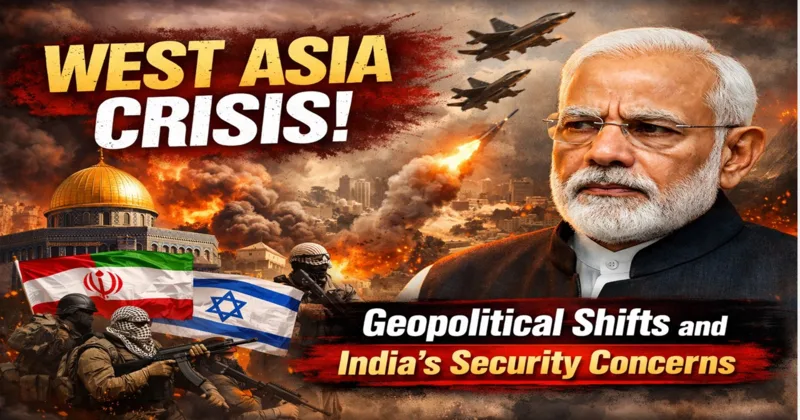
The current ongoing conflict in West Asia during the US-Israel-Iran war is going to have far-reaching strategic implications for the emerging world order. The decapitation of Iranian Supreme Leader Ayatollah Ali Khamenei on 28 February has led to widespread protests by the Shia community in India, particularly in the Kashmir valley. In India, Shia Muslims constitute approximately 15 per cent of the 25 crore overall Muslim population, and the sudden protests in India over the death of a Shia religious leader have major internal security implications for India.
In recent times, India and Iran have shared a somewhat uneasy relationship, with India attempting a balancing act between the US, Israel and the regional security dynamics. The key aspect of the India-Iran relationship centres around the pact on Chabahar Port, which provides India a direct route to Afghanistan and Central Asia, bypassing Pakistan. This notwithstanding, Ayatollah Ali Khamenei has repeatedly commented on India’s internal security matters, particularly on the Kashmir issue and the security of Muslims in India. So, for the Muslims of India, particularly the Shia Muslims, Ayatollah Ali Khamenei remained their religious leader, above India’s national interests.
A large number of external forces have interfered, directly and indirectly, in the internal security affairs of India. The unknown face of terrorism has added an extra dimension to the faceless and nameless supporters, both from outside and within the country. The inimical forces carefully watch the support for religious leaders like Khamanei in India. The radical elements of Islam would like to foment trouble in India, while the issue of Khamanei’s killing is alive. Pakistan’s ISI in particular would already have already activated its sleeper cells in India. Pakistan is facing the heat on the Durand Line from the Taliban government of Afghanistan. So, Pakistan, in retaliation, would certainly be more than keen to foment more homegrown trouble in India.
The biggest threat to India’s internal security may happen in Jammu & Kashmir. With the onset of summer, there is always a spike in terror activities in the Kashmir region. In the backdrop of Sthe hiite sympathy factor, there would be an attempt to rouse people’s sentiments against the government. The intelligence agencies have to be extra vigilant at this point of time. The network of professionals, like the doctors from Jammu & Kashmir, behind the Delhi blasts of 10 November last year, may be activated once again. One of the aims would be to discourage the forthcoming tourist season and project the Kashmir region as unsafe for tourists.
The forthcoming assembly elections in states like West Bengal, Keralam, Assam and Uttar Pradesh present another opportunity for such inimical forces to create a religious divide in the country. All these states have a considerable Muslim population, and it is not difficult to sway the opinion of people. Social media adds fire to the fuel in such instances, and our security agencies have to safeguard against such venomous diatribes. The issue of illegal immigration would be given religious fervour at the cost of national security. Special Intensive Revision of electoral rolls in states like West Bengal is likely to be used to polarise the voters on religious lines. In addition, an attempt will be made to disturb the peace by instigating communal riots.
There would also be an attempt to revive terrorism in India’s North East. During the interim government period of Mohamad Yunus in Bangladesh, Pakistan’s ISI would certainly have made major inroads to bring arms and ammunition for the separatist groups. India has made a positive beginning in reviving relations with the newly elected BNP government of Prime Minister Tarique Rahman of Bangladesh. It is hoped that the new government in Bangladesh will review the relations with Pakistan, which are primarily aimed at forming a China-Pakistan-Bangladesh axis against India.
Maoism or the Naxal threat is in the final stages of elimination from India. This achievement has come after a coordinated offensive against the red terrorism under the leadership of PM Modi in the last decade. China, in particular, would be uncomfortable with the elimination from India, having provided both moral and material support to the Naxals in the past. There would be an attempt by the Urban Naxals to present a negative image of the government by citing human rights violations. Home Minister Mr Amit Shah has personally monitored anti-LWE operations, and the MHA should be extremely careful of any attempts to provide a lifeline to well-organised terror outfits.
In the festive season ahead, the threat to internal security in India may witness a surge. Neither Pakistan nor China are not going to sit idly and let India remain peaceful. There are other inimical agencies with similar aims. The rest of the Budget Session of the Parliament commencing on 9 March may also be a stormy one. We Indians are indeed fortunate to live and prosper in an increasingly violent and uncertain world. Such a peaceful environment in the country can only be maintained when every citizen remains vigilant. Wishing you all a colourful and safe Holi.