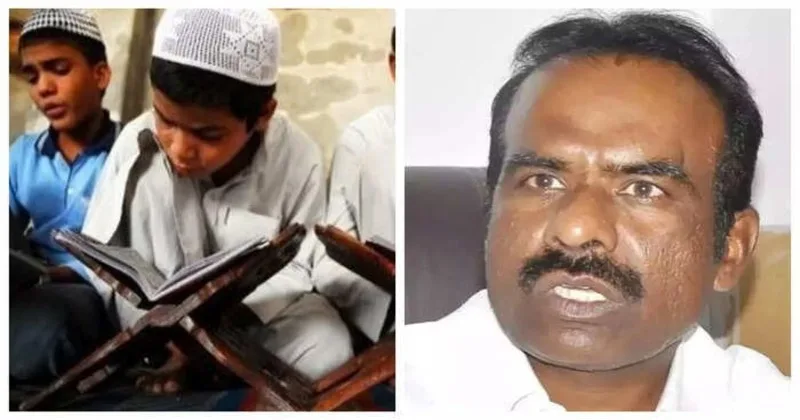
Bengaluru: BJP member of the Karnataka Legislative Council, N. Ravikumar, has alleged that the state government provided evasive replies to a series of questions he raised regarding certain verses in the Quran and the nature of education being imparted in madrassas across the state.
Ravikumar had submitted four unstarred questions seeking the government’s clarification on whether some Quranic verses being taught in madrassas could be interpreted as conflicting with the spirit of the Constitution of India, which is based on secular principles.
In his first question, the BJP leader referred to specific verses, including Surah Ayat 3:85, 9:5, 3:118, 3:28, 9:23, and 66:9. He asked the government to clarify its stance on whether these verses were consistent with constitutional values and requested an explanation of their meanings.
He also sought information on whether these verses were being taught in madrassas and whether the government had examined the implications of such teachings in a secular democratic society.
इस मुल्ले का बयान सुनकर पत्रकार खूद हैरान रह गया
बयान: कुरान तो खुद कहता है तुम खुद आतंकवादी बनो, कुरान का हुक्म है ये
ये मुल्ला कहाँ का है कौन है, लेकिन इसका किसी भी मुसलमान ने विरोध नही किया😾 pic.twitter.com/fWq86iMuxK
— Shubhangi Pandit (@Babymishra_) August 5, 2025
In response to the question, the state’s Department of Minority Welfare, Haj and Waqf stated that madrassas provide religious education and that the Constitution of India upholds secular principles. The department added that the interpretation of religious scriptures is not within the department’s jurisdiction.
Ravikumar later alleged that the reply failed to address the central issue raised in his question. According to him, the government did not provide a clear position on the verses he referred to and instead gave a general statement.
In his second question, Ravikumar asked whether the government had observed that children aged between three and ten studying in madrassas were being exposed to teachings that could potentially create hostility towards people of other religions.
He asked whether such teachings could disturb peace and communal harmony in society and sought the government’s view on the matter.
The Minority Welfare Department responded that madrassas in the state provide value-based religious education and that the government had not received any information indicating that such education had disturbed peace or law and order.
However, Ravikumar alleged that the reply again failed to provide a direct response to the concerns raised.
In his third query, the BJP MLC asked whether the government had come across instances in which children who had received such religious education at a young age later became involved in antisocial activities or in the destruction of public property.
He also asked what action had been taken against such madrassas or teachers if such incidents had been reported.
In its response, the department did not provide a detailed explanation, stating that such a situation “does not arise.” Ravikumar claimed that the government once again failed to provide a clear and detailed answer.
Speaking to reporters after the questions were tabled, Ravikumar said he had raised the issue to seek transparency about the type of education imparted in madrassas, especially in cases where institutions receive government benefits or support.
According to him, institutions that avail themselves of government facilities should ensure that the education provided to children promotes constitutional values and a sense of national integration.
He also demanded that the government conduct a detailed inquiry into the curriculum followed in madrassas and examine whether the content aligns with constitutional principles.
Ravikumar further suggested that a committee of the legislature be formed to study the nature of education provided in such institutions and submit recommendations.
Meanwhile, Congress MLA Rizwan Arshad criticised Ravikumar’s remarks, stating that raising such issues could affect unity among communities.
He said India’s strength lies in harmony and brotherhood among different communities and warned that questioning religious teachings in this manner could damage social cohesion.
In another question, Ravikumar sought information about the number of mosques in the state. The Minority Welfare Department replied that there are 10,859 mosques registered with the Karnataka State Waqf Board.
The department clarified that there are no separate rules under the Waqf Board specifically governing mosque construction. Instead, mosques are built after obtaining the necessary permissions from local authorities in accordance with existing civic regulations.
The government also informed that no applications seeking permission for mosque construction had been submitted to the Waqf Board during the past three years.
Ravikumar reiterated that his questions were aimed at seeking clarity and transparency on issues related to religious education. He maintained that the government should provide direct, detailed answers to such questions rather than giving what he described as evasive replies.