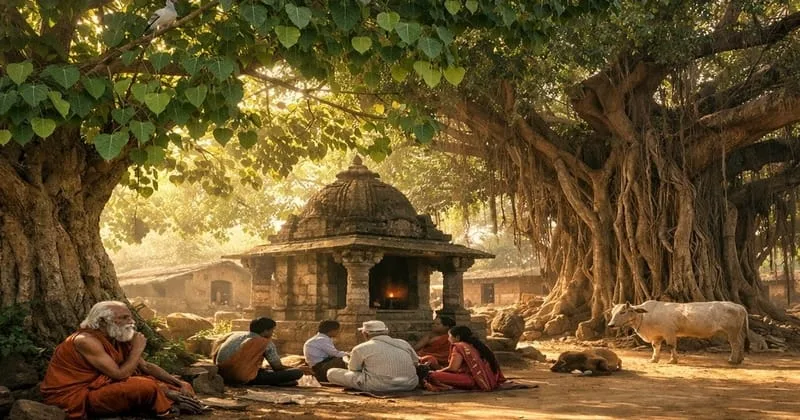
Long before modern science formally identified oxygen or explained the chemistry of photosynthesis, Indian villages had already developed an intuitive system to protect the environment. At the centre of this system stood two trees that became deeply embedded in the social and cultural life of the subcontinent, the Peepal (Ficus religiosa) and the Banyan (Ficus benghalensis). These trees were not merely part of the landscape; they were revered, protected and integrated into everyday life.
2000 years before we named oxygen, villagers already knew which trees kept them alive.
Banyan and Peepal. Every settlement. Every temple compound.
Protected as divine.
But here's what colonial scholars missed — the sacred wasn't spiritual theater. It was encoded survival.… pic.twitter.com/Lt9nuNXbZq
— GemsOfINDOLOGY (@GemsOfINDOLOGY) March 9, 2026
Across India, it was common to find a Peepal or Banyan tree at the centre of a village, near a temple or at a community gathering space. People prayed near them, tied sacred threads around their trunks and held social meetings beneath their shade. Colonial scholars and early modern observers often interpreted these traditions as religious superstition or ritualistic symbolism. However, what they overlooked was the practical ecological logic embedded within these customs.
Ancient communities did not possess the scientific vocabulary that modern ecology uses today. They did not know about oxygen molecules or carbon dioxide cycles. Yet they understood something equally powerful, the value of careful observation.
Generations of villagers noticed that sitting under certain trees brought relief, especially during the intense summer heat. The air beneath these trees felt cooler and lighter. Breathing seemed easier, and the shade created a calm and comfortable space even when the surrounding land was hot and dry. People returned again and again, experiencing the same effect over days, seasons and generations. These repeated experiences slowly transformed into collective knowledge.
Over time, this knowledge evolved into cultural norms. Instead of writing scientific papers or conducting laboratory experiments, communities encoded their observations into traditions that would be remembered and followed by future generations.
Observation Before Explanation
The Peepal and Banyan trees are among the largest and most ecologically significant trees in the Indian subcontinent. Both species have enormous leaf areas and expansive canopies that allow them to exchange large volumes of gases with the atmosphere. Their thick shade reduces ground temperature, while the moisture retained around them helps create cooler microclimates.
Modern science now explains what ancient communities simply experienced. Large trees help regulate air quality, provide shade, support biodiversity and create natural cooling systems in hot climates. In rural settlements, where temperatures could become extreme, the presence of such trees could significantly improve the comfort and health of the local population.
Villagers may not have known the chemical formula for oxygen, but they understood the physical experience of cleaner and cooler air. When people repeatedly observed that certain trees improved their surroundings, those trees naturally gained importance within the community. Observation, repeated across generations, gradually became knowledge. And that knowledge needed a system of protection.
Culture as an Environmental Protection System
The solution that emerged was remarkably effective: make the trees sacred. By associating Peepal and Banyan trees with religious reverence, communities created a powerful social rule that prevented them from being cut down. When a tree became sacred, it was no longer just a plant, it became part of the moral and spiritual order of the village. Cutting it would not only damage the environment but also violate cultural norms.
As a result, nearly every settlement preserved at least one large tree. Temple compounds, village squares and roadside shrines often grew around them. These trees became natural gathering points where people rested, discussed village matters or conducted rituals.
In effect, ancient society created a decentralised environmental management system. There were no government ministries, environmental laws or climate conferences. Instead, cultural traditions ensured that key ecological assets were preserved.
This system worked for centuries because it was simple and deeply rooted in daily life. By embedding environmental protection within culture and belief, communities ensured that the next generation would automatically continue the practice.
In many ways, this approach represents a different form of science, one based on observation first and explanation later. Modern chemistry eventually explained the biological processes behind what people had already experienced for centuries.