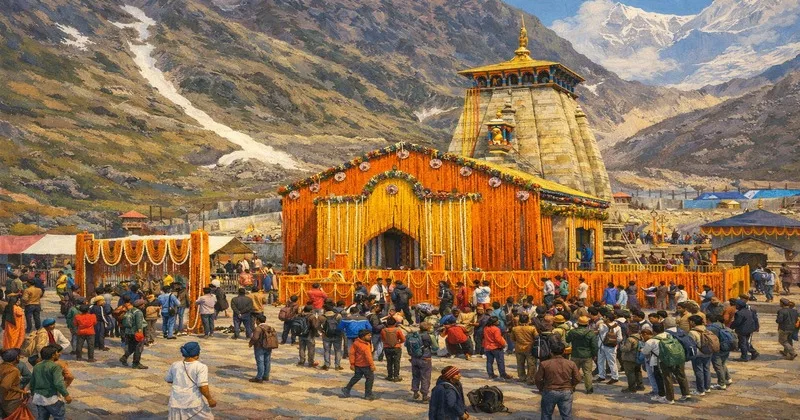
You might call it a pledge to preserve the Hindu faith that the Badrinath-Kedarnath Temple Committee (BKTC), while passing the budget for the upcoming pilgrimage season 2026-27, also approved a significant proposal prohibiting the entry of non-Sanatanists into the Badrinath and Kedarnath shrines. This decision clearly states that the temples should be open only to those who have faith in the deity or are willing to surrender their all to the open spiritual doors of Indian culture.
Indeed, the Badrinath and Kedarnath shrines, considered the most prominent of the Char Dhams in Uttarakhand, attract millions of devotees every year. In such a situation, the committee clearly states that temples are places of faith, not tourist destinations. Therefore, those who do not have faith in Hindu deities have no justification for visiting the temple; they are not allowed entry.
This decision, taken amid preparations for the Chardham Yatra, is being seen as an attempt to strengthen religious decorum. In the upcoming pilgrimage season, the doors of Gangotri and Yamunotri will open on April 19th on the occasion of Akshaya Tritiya, the doors of Kedarnath on April 22nd, and the doors of Badrinath on April 23rd. The government and the temple committee are also talking about making better arrangements for devotees.
It is noteworthy that many temples in India have different entry rules. For example, the famous Jagannath Temple in Odisha has been closed to non-Hindus for centuries. The temple administration believes that this tradition is necessary to maintain the sanctity of the temple. From this perspective, the Badrinath-Kedarnath decision is not a completely new experiment, but rather follows an old model of Indian temple tradition.
At the same time, there are temples in India where non-Hindus can gain entry, but they must also express their faith in the temple and the deity enshrined within. The world-famous Tirupati Balaji Temple in Andhra Pradesh is an example of this. People of any religion can gain entry here, but they are expected to declare their devotion to Lord Venkateshwara.
Regarding the Badrinath-Kedarnath case, Umed Rawat, a resident of Uttarakhand, says, “These Himalayan shrines are considered extremely sacred, and anyone visiting here should be a devotee, not just a visitor.” He argues that “there has often been a tendency to view temples as tourist destinations, which impacts the religious atmosphere. Therefore, this decision is a necessary step to protect faith.” Meanwhile, Hemant Dwivedi, President of the Badrinath Kedarnath Temple Committee (BKTC), stated that their primary objective is to ensure the convenience and safety of pilgrims. He explained that a budget of over ₹121 crore 7 lakh was approved for the upcoming pilgrimage season 2026-27. Several important proposals, including a ban on the entry of non-Sanatanists into Badrinath and Kedarnath, were unanimously passed.
He also stated that, in accordance with the Prime Minister’s vision, following the reconstruction of Kedarnath, large-scale development work is underway at Badrinath Dham. The government and administration claim that the Chardham Yatra will be more streamlined and safe in the coming years. Committee members clearly stated that the temple is a sacred site for devotees and is an open spiritual gateway to Indian culture. Therefore, entry is only permitted to those who have faith and devotion to the temple and the deity enshrined within. The yatra will begin in April for which the government is making extensive preparations.