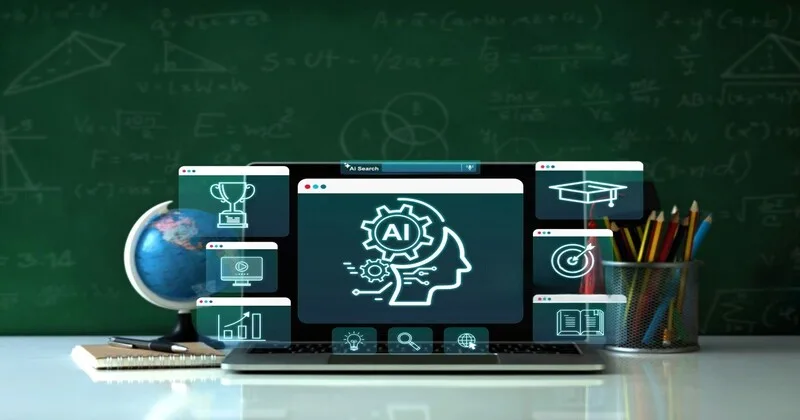
Artificial Intelligence is reshaping global economies and India is positioning itself as a major player in this technological transformation. The adoption in the country already signals a shift by 89 per cent of new startups in 2024 were AI-powered, 87 per cent of the institutions are actively employing AI technologies. The momentum will intensify in the coming years. According to industry projections, the Indian AI market is expected to grow at a rate of 25–35 per cent through 2027, indicating a rapidly expanding ecosystem of innovation, research, and industry applications.
This growth requires a strong human capital base. India has an AI talent pool of about 600,000-650,000 professionals, and it is estimated that India will need more than 1.25 million AI professionals by 2027, with a CAGR of about 15 per cent. To fulfill this requirement, India has started creating an ecosystem in which education policy, research, and skill development are closely related.
The vision is Viksit Bharat 2047, in which technological capability and inclusive development go hand in hand. It is not about adopting AI in India, it is about making sure that technology reaches every village, every tribal, and every underserved area.
National Education Policy 2020 and the AI Transition
The transformation of India’s education system through the National Education Policy (NEP) 2020 has provided a structural foundation for AI integration. The policy recognises the emerging technologies such as artificial intelligence, big data and machine learning which will transform labour markets and drive future innovation.
To prepare the next generation for this shift, the policy demands multidisciplinary learning and the introduction of subjects like AI, computer science and data science across educational levels. The goal is to equip students with the skills that are needed to participate in a rapidly evolving digital economy.
Education being on the Concurrent List of the Constitution, NEP recommendations influence both central and state governments. This allows the reforms across school and higher education systems while encouraging states and Union Territories to adapt the policy to regional needs.
AI in School Education
The integration of AI in school education is already in place. The Ministry of Education has integrated AI in school education through CBSE and NCERT by aligning itself with the objectives of NEP 2020 and National Curriculum Framework (NCF) 2023.
The most appreciated aspect is the integration of AI learning modules from middle school itself. CBSE has introduced a 15-hour AI skill module from Class VI onwards. In addition to this, AI has been introduced as an optional subject from Classes IX to XII.
NCERT has integrated AI content in Class XI Computer Science and Informatics Practices textbooks to ensure that senior secondary students are familiar with AI basics. AI-based translation tools are being used to translate Grade 1 and Grade 2 textbooks into 22 Indian languages. These efforts reflect a broader attempt to make digital technologies inclusive, thus enabling students from diverse backgrounds to benefit from educational tool.
AI Learning Platforms for Students and Teachers
DIKSHA Platform
The DIKSHA Digital Infrastructure for Knowledge Sharing platform has become a major national repository of digital learning resources. It is developed by the Ministry of Education, where the platform uses AI-driven features such as keyword search in educational videos and reading tools designed for visually impaired learners. Available through a mobile application, DIKSHA serves teachers, students and parents with the learning materials and interactive resources.
SOAR Initiative
Another initiative is SOAR Skilling for AI Readiness, launched by the Ministry of Skill Development and Entrepreneurship. The programme aims to introduce students from Classes VI to XII to AI awareness and practical skills.
The programme also includes three 15-hour AI modules for students and a 45-hour AI for Educators module designed to help teachers understand AI pedagogy, use AI tools in classrooms, design educational AI projects and promote ethical AI practices.
SWAYAM Platform
At a higher level, the government SWAYAM Study Webs of Active Learning for Young Aspiring Minds platform offers more than 110 AI-related courses from premier institutions such as IIT and IISc. The platform has recorded over 41.2 lakh student enrolments, thus demonstrating the growing interest in AI learning among Indian youth.
AI in Higher Education and Research
India’s higher education institutions are also increasing their engagement with AI technology. The University Grants Commission (UGC) initiated the introduction of the revised undergraduate curriculum in 2022. This has been done by incorporating subjects such as artificial intelligence, big data analytics, machine learning, drone technology, deep learning, and 3D machining. There is an increase in the association of these subjects with health, environment and sustainable development.
The All India Council for Technical Education (AICTE) has incorporated AI into various IT-related courses. AICTE has also initiated various activities related to innovation, including hackathons and scholarships such as PRAGATI and Saraswati for women engineering students. AICTE has also collaborated with the AI-powered search engine Perplexity. This collaboration aims to reach 40 million students across 14,000 institutions in India through digital channels. The collaboration aims to train the faculty and establish Centres of Excellence. The collaboration aims to help students learn how to leverage AI technology for research and innovation.
IndiaAI Mission: The National Framework
However, a major milestone in India’s AI development was achieved with the launch of the IndiaAI Mission in March 2024, which focuses on making India a leader in artificial intelligence. The IndiaAI Mission has been allocated Rs 10,371.92 crores over five years to develop computing infrastructure, datasets for training artificial intelligence models and sectoral artificial intelligence applications.
The IndiaAI Mission also focuses on research and innovation by collaborating with various institutions and technology companies. One such initiative is the establishment of the Centre for Generative AI, Srijan at IIT Jodhpur by IndiaAI and Meta.
Along with this initiative, the YuvAi Initiative has been launched by MeitY and AICTE to advance the development of open-source artificial intelligence.
The initiative focuses on reaching 100,000 students and developers aged 18-30 over three years by developing artificial intelligence solutions across sectors such as healthcare, education, agriculture, smart cities, and financial inclusion.
AI Research Projects and Responsible Innovation
Research institutions in India are developing various AI applications that benefit society. One such application is DeepFlood, a prototype developed by a research team from IIT Delhi. The application is developed using Synthetic Aperture Radar data and deep learning algorithms. The application generates rapid flood inundation maps using advanced techniques like Vision Transformers and satellite data for real-time flood detection.
Alongside such applications, the government has also focused on developing responsible AI. Several research institutions are actively working on developing a framework that addresses various concerns like ethical concerns, bias mitigation, and data privacy.
Some of the projects developed by research institutions are:
- Machine Unlearning in Generative Models at IIT Jodhpur
- Synthetic Data Generation frameworks at IIT Roorkee
- Bias mitigation strategies for healthcare AI systems at NIT Raipur
- Explainable and privacy-preserving AI models developed by DIAT Pune and Mindgraph Technology Pvt. L
- AI algorithm auditing tools like ParakhAI developed by Civic Data Labs.
AI for Inclusive Education
Artificial intelligence is also being applied to assist children with learning disabilities. Existing solutions include Readabled, a web-based dyslexia training platform and ScreenPlay, a digital screening tool designed to identify children aged 3–6 who may be at risk of autism or related developmental conditions.
Other AI-based solutions under development include Voice Fusion AI, which supports individuals with specific learning disabilities in multiple Indian languages and Adaptive Learning Detection systems designed to detect disorders such as dyslexia, dysgraphia and dyscalculia.
Skilling India’s Workforce for the AI Economy
Recognising that the AI revolution will affect multiple sectors, the government has also launched large-scale skilling initiatives.
Under Pradhan Mantri Kaushal Vikas Yojana (PMKVY) 4.0, 36,584 individuals had been trained in AI as of June 30, 2025, with 45 per cent of participants being women.
The SkillSaksham Programme, implemented through a partnership between the Ministry of Skill Development and Microsoft, targets 200 Industrial Training Institutes (ITIs) and aims to train over 10,000 candidates, with 8,500 already trained. The programme includes 1,200 hours of AI training and 400 hours of advanced AI instruction.
Other initiatives include:
- FutureSkills PRIME, which has recorded over 16.29 lakh enrolments, offering 500+ courses and 2,000 digital fluency pathways in emerging technologies.
- YUVA AI for All, a self-paced foundational course designed to reach 1 crore citizens through a 4-4.5 hours AI literacy programme.
These initiatives are aimed at building an AI-ready workforce among students, professionals, and government officials.
Towards an Inclusive AI Future
The Indian AI education initiative appears to be a well-thought-out national strategy that encompasses school education, higher education, research and workforce development. By including AI education in the classroom, developing digital infrastructure, supporting innovation and promoting ethics in AI development and use, India appears to be building a foundation for a sustainable technology future.
Another aspect of the Indian initiative in AI education appears to be a focus on inclusiveness. From translating textbooks in 22 languages to developing AI solutions for children with learning disabilities, the initiative appears to be ensuring that the technological future does not remain exclusive.
As India looks towards building a Viksit Bharat 2047 vision, the intersection of education, innovation and inclusive development may well prove to be a determinant of India’s role in the future of AI globally.