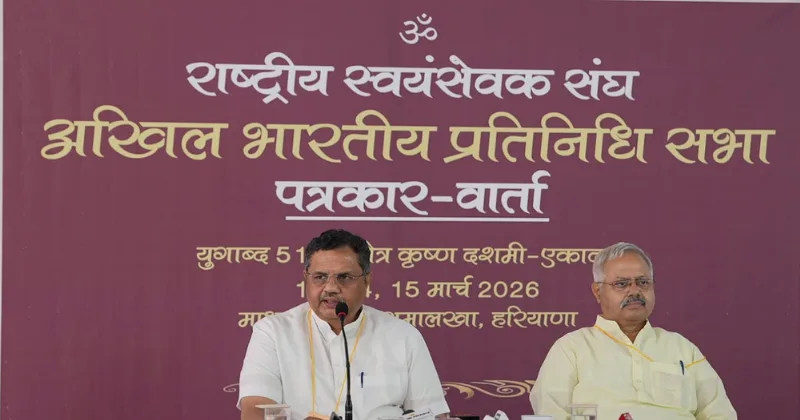
Rashtriya Swayamsevak Sangh’s (RSS) annual decision-making body, the Akhil Bharatiya Pratinidhi Sabha (ABPS) 2026, commenced on Friday, March 13, in Samalkha, Haryana. The three-day meeting will continue until March 15, 2026.
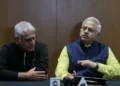
A press conference was held on the opening day, attended by RSS Akhil Bharatiya Prachar Pramukh Sunil Ambekar ji and Sah sarkaryavah Mukunda ji, who briefed the media on the proceedings of the first day of the meeting.
Speaking to the media, Mukunda ji stated that the RSS ABPS, conducted in accordance with the Sangh’s organisational traditions, was inaugurated by RSS Sarsanghchalak Mohan Bhagwat and Sarkaryavah Dattatreya Hosabale.
He noted that the gathering holds special significance as the Sangh is marking its centenary year. Around 1,400 Sangh functionaries from across the country, engaged in organisational expansion, social contact, and awareness activities, are present.
Mukunda ji added that representatives from every part of the country have assembled at the Samalkha meeting. More representatives were expected, and all those present are united in purpose.
Shradhanjali
The RSS ABPS 2026 paid shradhanjali to eminent personalities of the country who have passed away.
Among those remembered were P. Sadgurudas Maharaj (Bhau Vajyarao Deshmukh) of Wardha; Pujya Durganand Giri Maharaj (Swamiji) from Maharashtra; and Dr Madhav Gadgil of Karnataka, an environmental scientist; Shivraj Patil Chakurkar, former Home Minister of the Government of India and former Governor of Punjab; Ves Paes of West Bengal, an Indian hockey player; and Saalumarada Thimmakka of Karnataka, Padma Shri award winner and environmental icon; K. N. Dixit, Padma Bhushan awardee and well-known archaeologist who initiated the Saraswati River Atlas, and Balnath Labbh, Chancellor of Nav Nalanda Mahavihar & Sanshi; Kabindra Purkayastha of Uttar Assam, a senior Swayamsevak, former former Minister and Member of Parliament; Dr Ashok Modak of Maharashtra, a senior thinker, practitioner and speaker on Russian politics; and Anand Kumar of Meerut, who served as Co-Provincial Publicist, State Publicist.
The ABPS also paid homage to Ajit Pawar, Deputy Chief Minister of Maharashtra; Dharmendra (Dharamsingh) Deol, actor and former MP; Sulakshana Pandit of Konkan, famous actress; A. V. M. Saravanan of Tamilnadu, legendary producer of Tamil cinema; A. Vellayan of Tamilnadu, Chairman of the Murugappa Group; and Swaraj Kaushal of Delhi, former Governor of Mizoram.
राष्ट्रीय स्वयंसेवक संघ की अखिल भारतीय प्रतिनिधि सभा की बैठक आज माधव सृष्टि, समालखा, हरियाणा में प्रारम्भ हुई। बैठक का शुभारम्भ पू. सरसंघचालक मोहन भागवत जी और मा. सरकार्यवाह दत्तात्रेय होसबाले जी ने भारत माता के चित्र पर पुष्पार्चन कर किया। बैठक में देशभर से 1487 प्रतिनिधि भाग ले… pic.twitter.com/8MbUo5THe3
— RSS (@RSSorg) March 13, 2026
Shakha Expansion
Mukunda ji said that during the centenary year, the Sangh has intensified its organisational expansion. Over the past two to three years, Swayamsevaks have worked with increased dedication across regions. More than 4,000 new locations have been added, and the number of shakhas has increased by over 5,000, with new locations continuing to be incorporated. This expansion drive will continue in more villages and localities throughout the country.
He recalled that the centenary year formally began on October 2 in Nagpur, where the inaugural programme was attended by former President Ram Nath Kovind. A day earlier in New Delhi, the Government of India released a commemorative stamp related to the RSS centenary year in the presence of Prime Minister Narendra Modi.
Mukunda ji stated that during the centenary year, the Sangh has placed particular emphasis on expanding shakhas and strengthening social outreach. Efforts are under way to enhance social contact, foster unity in society, bring together positive social forces, organise society, and promote social awareness.
He explained that the organisation has identified Panch Parivartan — five key themes for public discussion. These include environmental responsibility, protection of families and households, promoting social harmony, reminding citizens of their civic duties and behavioural responsibilities, and encouraging the spirit of Swadeshi in thought and conduct.
Mukunda ji added that discussions are being held on a large scale among respected members of society, journalists, and intellectuals who influence public thinking. Through such interactions, efforts are being made to build a constructive mindset within society. Prominent citizen meetings and intellectual discussions have become important instruments for this purpose. Their impact is visible, as more people are being attracted and stronger relationships are being built through these engagements.
He emphasised that the effort to conduct meetings with prominent citizens is continuing. Similarly, at the local basti and block levels, discussions are taking place with main organisers and associates to promote contributions and properly establish social harmony. In these discussions, while recalling duties regarding the environment and efforts to foster harmony in society, behaviour should remain firm as a matter of responsibility.
Awakening the spirit of Swadeshi, reflecting on the hundred years of the Sangh, and considering conduct and thoughts are key to providing direction. As all are working with Panch Parivartan in mind, these five subjects have entered the lives of lakhs of people. Discussions among respected members of society, intellectuals, journalists, and thinkers are being conducted to create a positive mindset in society.
Hindu Sammelans
Hindu Sammelans were held, where prominent citizen meetings serve as an effective instrument, and their impact is clearly evident. For social outreach, efforts have been made in various ways. The primary focus has been to reach every house and every village. So far, more than 10 crore families have been contacted, and this work continues. Swayamsevaks are strengthening their discipline through this effort, and the experience has been very positive.
In Kerala, houses were visited across all sections, including those with communist leanings. From the perspective of worship practices, around 55,000 Muslim families and 54,000 Christian families were contacted. Everywhere, a warm welcome was received.
Discussions focused on the nation, transformations in the country, and the subjects of Panch Parivartan. Ideologically and in outlook, discussions took place in all types of households.
Even in Vanvasi regions and among tribal communities, house-to-house and village-to-village contact was established effectively.
Across the country, around 36,000 Hindu Sammelan meetings have taken place so far, with more planned in urban areas, rural areas, tribal communities, and remote regions.
In Arunachal Pradesh, Sah-Sarkaryavah Arun Kumar noted that many felt this was unprecedented — so many people from all sections of society coming together in such numbers to think about the nation and society. Conferences are receiving support from everyone, and efforts are being made to advance together with all sections while fostering good understanding.
These discussions will continue for the next four months. Regarding the prosperity of the country and other subjects, ancient wisdom has also been referenced on government platforms. Many who suffered earlier are now seeing improvement due to government efforts, and the situation is normalising.
On Manipur, Mukunda ji said conditions are improving. Political stability is returning, and importantly, all tribal communities are making efforts to think together. The Sangh has played a role in this, and the visible results should be welcomed.
Regarding Bangladesh, Mukunda ji said the situation for Hindus remains very difficult, and the Sangh insists that all necessary efforts should be made for their protection and rights.
In the four major metropolitan cities of the country, Delhi, Kolkata, Bangaluru, Mumbai intellectual promotion programmes (Vyakyanamala) have been organised and addressed by RSS Sarsanghchalak Dr Mohan Bhagwat.
Apart from Delhi and Mumbai, such dialogues are being held in the capital cities of many states. Interactions and guidance with society are yielding very good results. Nearly 10,000 questions from society — covering the country, Hindu society, and the Sangh — have been received and discussed.
For the centenary celebrations, every step has received positive responses. This is not merely a four-month programme, and such dialogues should continue thereafter. With strong participants and thinkers, society is building consensus and presenting a civilisational vision.
This centenary programme, with sustained dialogue and capability, represents a major effort. This phase will continue until October, after which, drawing on experiences gathered from society, the work will expand with greater speed.
Questions and Answers
Answering a question on Manipur, Mukunda ji said the understanding has always been that the situation should not worsen and coordination must be maintained. The Sangh has worked in Manipur for nearly fifty years, and contacts remain active. In the last two years of difficulty, senior Sangh Swayamsevaks from tribal communities and others continued meeting everyone and emphasising unity.
On West Asia, particularly developments involving Iran and others, and their adverse impact on India, Mukunda ji noted that the Government of India should maintain truth and balance in dialogues with the leaders of those countries. Protection of local society and Bharatiya society there remains a concern.
Contacts with various organisations there continue, though not completely, and efforts are being made to maintain relations with Indian society in the region.
On UGC-related changes and protests by Hindutva organisations and Dalit groups, with Supreme Court cognisance and restrictions, Mukunda ji said this has arisen from certain imbalances within Hindu society, which must be addressed collectively. The court has taken note of it, and the government will endeavour to resolve it. The Sangh’s effort is to unite all sections of society.
He added that true maturity emerges when society becomes organised. Unity must develop quickly, and differences and discrimination should be eliminated, leading to social harmony. Government efforts in this regard should be welcomed.