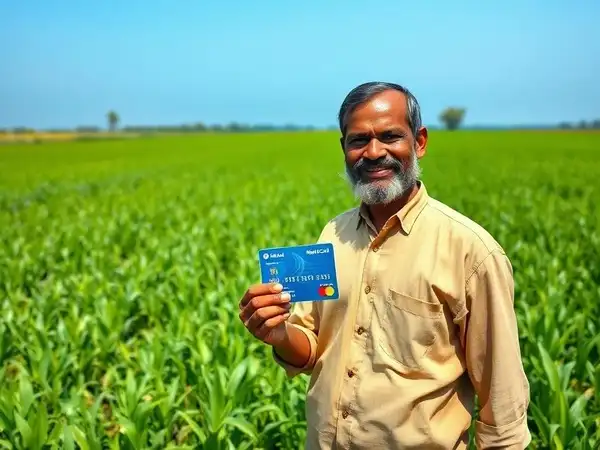
Access to affordable and timely credit has long been considered essential for sustaining agricultural livelihoods in Bharat. Recognising this need, the Government of India steadily expanded the reach of the Kisan Credit Card (KCC) system to ensure that farmers can obtain working capital for cultivation, allied activities, and post-harvest operations without depending on informal lenders.
According to official data released by the Press Information Bureau, the scheme currently has over 7.72 crore operational Kisan Credit Cards nationwide, with total outstanding credit touching Rs 10.2 lakh crore. The scale of lending reflects the growing importance of the programme as a cornerstone of agricultural financing in India.
The KCC initiative is designed to provide timely, affordable and collateral-free credit to a broad category of beneficiaries including small and marginal farmers, tenant cultivators, sharecroppers, and farmer collectives such as Self Help Groups (SHGs) and Joint Liability Groups (JLGs).
Through continuous reforms and digital integration, the scheme has evolved into a comprehensive credit delivery mechanism aimed at improving farm productivity, stabilising rural incomes, and reducing dependence on informal credit sources.
Agriculture’s central role in India’s economy
Agriculture and allied activities remain a crucial pillar of India’s economy. Nearly 46.1 percent of the population depends on agriculture and related sectors for livelihood, making access to institutional finance vital for sustaining rural economies.
For decades, lack of formal credit access forced farmers to rely on private moneylenders who often charged exorbitant interest rates. In response, the government introduced targeted financial interventions, with the Kisan Credit Card Scheme launched in 1998 as a major step toward expanding formal credit access.
Over time, the scheme has undergone several reforms to accommodate changing agricultural needs and to ensure that farmers can secure credit for both production and post-production requirements.
The Kisan Credit Card (KCC) Scheme, introduced in 1998, was originally designed to simplify and accelerate farmers’ access to short-term credit for crop cultivation. Instead of requiring repeated loan applications for each agricultural season, the scheme provided farmers with a revolving credit facility that could be used as needed.
The programme has gradually expanded beyond crop loans to include investment credit for allied activities such as dairy, poultry, fisheries, and other farm-based enterprises.
A major reform came with the launch of the Modified Interest Subvention Scheme (MISS) in 2006–07. The scheme was designed to reduce the cost of borrowing for farmers by providing interest subsidies on short-term agricultural loans. Through this initiative, farmers could access credit at concessional interest rates while also receiving incentives for timely repayment.
In 2020, the government introduced the Revised Kisan Credit Card Scheme, which integrated various credit needs under a single-window system. The updated framework allows farmers to access credit not only for cultivation but also for post-harvest activities, marketing expenses, household consumption, farm maintenance, and small-scale investment.
The revised KCC also introduced RuPay-enabled debit cards, enabling farmers to withdraw funds easily, make digital payments, and access credit through ATMs and point-of-sale machines.
Inclusive coverage for diverse farming communities
One of the defining features of the Kisan Credit Card programme is its emphasis on inclusive financial access.
The scheme covers a wide range of beneficiaries, including: Individual farmers who cultivate their own land
Joint borrowers engaged in agriculture and tenant farmers, oral lessees, and sharecroppers alongwith farmer collectives such as Self Help Groups (SHGs) and Joint Liability Groups (JLGs).
By including tenant cultivators and sharecroppers who often lack formal land ownership documents, the scheme aims to ensure that institutional credit reaches even the most vulnerable sections of the farming community.
To expand the reach of the programme, the government has introduced several measures to simplify the application process for Kisan Credit Cards.
A one-page simplified application form has been introduced, with basic applicant details pre-filled from records under the Pradhan Mantri Kisan Samman Nidhi (PM-KISAN) database. Farmers are only required to provide land records and information about the crops they cultivate.
The form has been widely disseminated through newspaper advertisements and is available for download on websites of scheduled commercial banks, the agriculture department, and the PM-KISAN portal.
In addition, Common Service Centres (CSCs) have been authorised to help farmers complete applications and submit them digitally to banks, making the process accessible even in remote rural areas.
Kisan Rin Portal: Digital transformation of agricultural credit
A significant technological step in strengthening the implementation of the KCC scheme was the launch of the Kisan Rin Portal in September 2023.
The portal functions as a unified digital platform that integrates several critical components of agricultural credit administration. These include farmer profiles, loan disbursement records, interest subvention claims, and scheme performance monitoring.
For farmers, the portal simplifies the process of obtaining institutional credit by enabling faster loan processing and digital integration with banks and cooperative institutions.
For financial institutions, the system allows automated submission and processing of interest subvention claims and prompt repayment incentives, reducing delays and enhancing transparency.
The platform has significantly improved the efficiency, monitoring, and accountability of agricultural credit delivery across the country.
In the financial year 2025–26, the Government of India introduced several reforms to expand farmers’ access to credit under the KCC system.
Key changes include:
1. Increase in crop loan limit under MISS from Rs 3 lakh to Rs 5 lakh
2. Increase in credit limit for fisheries and allied activities from Rs 2 lakh to Rs 5 lakh
3. Increase in collateral-free credit limit from Rs 1.6 lakh to Rs 2 lakh per borrower
4. Short-term agricultural loans of up to Rs 3 lakh are currently available at 7 percent interest, with an additional 3 percent interest subvention for timely repayment, reducing the effective interest rate to 4 percent.
These reforms aim to ensure that farmers can meet rising input costs and invest in modern agricultural practices without facing financial constraints.
The KCC system provides different credit structures depending on the financial capacity and landholding size of farmers.
For non-marginal farmers, banks provide asset-linked term loans designed to support long-term investments such as irrigation systems, farm machinery, and allied enterprises.
For marginal farmers, flexible composite credit limits are provided, covering short-term production expenses, household needs, and small investments.
Typically, marginal farmers receive credit limits ranging from Rs 10,000 to Rs 50,000, which remain valid for five years and can be revised depending on changes in cropping patterns or investment requirements.
These loans are intended to cover post-harvest expenses, warehouse-related credit needs, routine farming costs, and minor investments such as purchasing farm equipment or establishing small allied enterprises.
Massive institutional participation in the KCC platform
The scale of the KCC programme is reflected in the wide participation of banking institutions.
Currently, 457 banks are part of the KCC platform, including: 37 commercial banks, 46 regional rural banks, 374 cooperative banks, These institutions collectively ensure the nationwide delivery of agricultural credit.
A total of 1,998.7 lakh KCC applications have been processed across these institutions. Of these: 631.5 lakh applications were processed by commercial banks, 337.2 lakh applications by regional rural banks and 1,030 lakh applications by cooperative banks.
The strong participation of cooperative banks highlights their critical role in delivering agricultural credit at the grassroots level.
Recognising the growing importance of allied activities in rural incomes, the government expanded the KCC scheme in 2018-19 to include fishers and fish farmers.
This step ensured that workers engaged in fisheries and aquaculture could also access institutional credit for working capital requirements.
The response from allied sectors has been significant. In animal husbandry, for instance, 55.9 lakh applications were received, of which 55.08 lakh were accepted, reflecting high eligibility levels and strong policy support.
Similarly, in the fisheries sector, 6.83 lakh applications were received, with 6.77 lakh accepted and 4.82 lakh sanctioned, demonstrating increasing integration of allied sectors into formal financial systems.
Boosting productivity through affordable credit
By enabling farmers to access timely working capital, the KCC scheme plays a critical role in improving agricultural productivity.
Farmers can invest in high-quality seeds, fertilisers, irrigation systems, and farm equipment, leading to higher yields and improved income levels.
The availability of credit at concessional interest rates also ensures that farmers are not forced to sell their produce prematurely due to financial pressures.
Furthermore, the scheme provides risk mitigation support during natural disasters by allowing interest-free periods of up to one year, extendable in severe cases.
The government has undertaken multiple initiatives to increase awareness and accessibility of the Kisan Credit Card scheme.
These include extensive awareness campaigns conducted by the Union and state governments in collaboration with institutions such as the Reserve Bank of India and National Bank for Agriculture and Rural Development.
Under the Atmanirbhar Bharat Abhiyan, a nationwide KCC Saturation Drive has been launched to ensure that all eligible farmers receive credit cards.
District-level camps are organised to cover farmers engaged in dairy, fisheries, and other allied activities.
The introduction of RuPay-enabled KCC cards has further promoted digital transactions and reduced reliance on cash and informal lending channels.
A pillar of rural financial inclusion
The Kisan Credit Card Scheme represents one of India’s most significant policy tools for strengthening rural financial inclusion.
By integrating credit access with modern digital platforms and expanding coverage to allied sectors, the programme has evolved into a comprehensive support system for farmers.
With millions of beneficiaries and substantial institutional participation, the scheme continues to play a critical role in improving agricultural productivity, enhancing rural incomes, and supporting sustainable agricultural development.
As India’s agricultural sector faces new challenges such as climate variability and market fluctuations, the continued strengthening of the KCC system will remain essential for ensuring financial resilience and long-term stability in rural economies.