India secures oil supply through diversified imports
June 15, 2026
  • Read Ecopy
  • Circulation
  • Advertise
  • Careers
  • About Us
  • Contact Us
Android AppiPhone AppArattai
Organiser
  • ‌
  • Bharat
    • Assam
    • Bihar
    • Chhattisgarh
    • Jharkhand
    • Maharashtra
    • View All States
  • World
    • Asia
    • Europe
    • North America
    • South America
    • Africa
    • Australia
  • Editorial
  • International
  • Opinion
  • RSS @ 100
  • More
    • Op Sindoor
    • Analysis
    • Sports
    • Defence
    • Politics
    • Business
    • Economy
    • Culture
    • Special Report
    • Sci & Tech
    • Entertainment
    • G20
    • Azadi Ka Amrit Mahotsav
    • Vocal4Local
    • Web Stories
    • Education
    • Employment
    • Books
    • Interviews
    • Travel
    • Law
    • Health
    • Obituary
  • Subscribe
    • Subscribe Print Edition
    • Subscribe Ecopy
    • Read Ecopy
  • ‌
  • Bharat
    • Assam
    • Bihar
    • Chhattisgarh
    • Jharkhand
    • Maharashtra
    • View All States
  • World
    • Asia
    • Europe
    • North America
    • South America
    • Africa
    • Australia
  • Editorial
  • International
  • Opinion
  • RSS @ 100
  • More
    • Op Sindoor
    • Analysis
    • Sports
    • Defence
    • Politics
    • Business
    • Economy
    • Culture
    • Special Report
    • Sci & Tech
    • Entertainment
    • G20
    • Azadi Ka Amrit Mahotsav
    • Vocal4Local
    • Web Stories
    • Education
    • Employment
    • Books
    • Interviews
    • Travel
    • Law
    • Health
    • Obituary
  • Subscribe
    • Subscribe Print Edition
    • Subscribe Ecopy
    • Read Ecopy
Organiser
  • Home
  • Bharat
  • World
  • Operation Sindoor
  • Editorial
  • Analysis
  • Opinion
  • Culture
  • Defence
  • International Edition
  • RSS @ 100
  • Magazine
  • Read Ecopy
Home Politics

India cuts reliance on Strait of Hormuz; 70% crude imports now routed through alternative channels

Amid rising tensions in West Asia and disruptions around the Strait of Hormuz, the Government of India said its diversified energy sourcing strategy has secured crude supplies, boosted domestic LPG production, and ensured priority fuel availability for households and essential sectors.

WEBDESKWEBDESK
Mar 11, 2026, 10:30 pm IST
in Politics, Bharat, West Asia
Follow on Google News
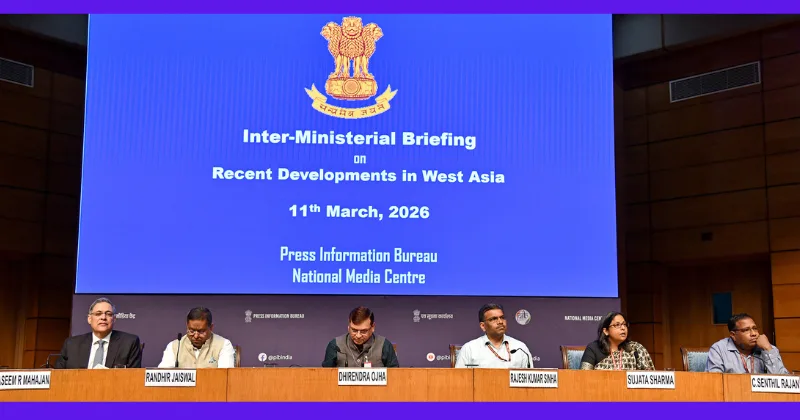
The Joint Secretary, Ministry of Petroleum & Natural Gas (MoP&NG), Ms. Sujata Sharma, addressing at the Inter- Ministerial Briefing on Recent Developments in West Asia at National Media Centre, in New Delhi on March 11, 2026.

The Joint Secretary, Ministry of Petroleum & Natural Gas (MoP&NG), Ms. Sujata Sharma, addressing at the Inter- Ministerial Briefing on Recent Developments in West Asia at National Media Centre, in New Delhi on March 11, 2026.

FacebookTwitterWhatsAppTelegramEmail

India’s diversified energy sourcing strategy is helping cushion the country from disruptions arising from the evolving situation in West Asia and concerns over shipments through the Strait of Hormuz. Officials said India now imports crude oil from around 40 countries, and about 70 per cent of its crude imports come through routes outside the Strait of Hormuz, compared with around 55 per cent earlier. India’s daily crude oil consumption stands at about 55 lakh barrels, and the volumes currently secured exceed what would normally have arrived through the Strait of Hormuz during this period.

The details were shared during an inter-ministerial briefing organised at the National Media Centre on Wednesday (March 11). Senior officers from the Ministry of Petroleum and Natural Gas, Ministry of External Affairs, Ministry of Ports, Shipping and Waterways, and Ministry of Information and Broadcasting briefed the media on preparedness measures related to energy supply, maritime safety, the welfare of Indian nationals abroad, and the communication steps being taken by the Government of India.

Crude oil supply remains secure

Officials said India’s crude oil supply position remains stable despite global uncertainties. Two additional crude cargoes are already on their way to the country and are expected to arrive in the coming days, further strengthening the supply position.

Refineries across India are currently operating at very high capacity utilisation levels, with some units functioning above 100 per cent capacity utilisation, ensuring uninterrupted production of petroleum products.

Natural gas supplies adjusted

India’s total natural gas consumption is about 189 million metric standard cubic metres per day (MMSCMD), of which 97.5 MMSCMD is produced domestically. However, 47.4 MMSCMD of supply has been affected due to force majeure conditions linked to the regional situation.

Officials said procurement through alternative suppliers and routes is underway to offset the disruption. Gas companies have also secured LNG cargoes from new sources, and two LNG cargoes are currently on their way to India.

To manage supplies and protect priority sectors, the government issued a Natural Gas Control Order on 9 March 2026 under the Essential Commodities Act.

Under the new allocation framework, domestic piped natural gas (PNG) supply and CNG for vehicles will continue to receive 100 per cent supply with no cuts. Industrial consumers such as tea industries and manufacturing units connected to the gas grid will receive around 80 per cent of their previous six-month average supply, while fertiliser plants will receive about 70 per cent supply. Refineries and petrochemical units will take a 35 per cent reduction so that higher priority sectors remain protected.

LPG imports vulnerable due to Strait of Hormuz

Officials highlighted that the Strait of Hormuz remains critical for LPG imports. India imports about 60 per cent of its LPG consumption, and nearly 90 per cent of these imports normally pass through the Strait of Hormuz, making the route crucial for domestic cooking fuel supplies.

To address the situation, the government issued an order on 8 March 2026 directing refineries and petrochemical complexes to maximise LPG production by diverting propane, butane, propylene and butenes streams to the LPG pool. As a result, domestic LPG production has increased by about 25 per cent, with the entire domestic output now being directed towards household consumers.

For non-domestic LPG supply, priority is being given to essential sectors such as hospitals and educational institutions. A three-member committee of Executive Directors from IOCL, HPCL and BPCL has been constituted to review allocations to restaurants, hotels and other commercial users and ensure fair and transparent distribution of available LPG supplies.

Pricing and consumer supply measures

Officials said the current price of a domestic LPG cylinder in Delhi stands at ₹913 following a recent ₹60 increase. However, beneficiaries under the Pradhan Mantri Ujjwala Yojana continue to receive cylinders at ₹613 per cylinder.

For PMUY households, the recent increase translates to less than 80 paise per day, officials said. Despite the Saudi Contract Price rising by about 41 per cent since July 2023, the PMUY cylinder price has fallen by around 32 per cent during the same period due to government support.

The government has also approved ₹30,000 crore as compensation for oil marketing companies to offset LPG under-recoveries.

Measures against panic booking

Officials noted that field-level feedback indicates some panic booking and hoarding behaviour, but clarified that the normal delivery cycle for domestic LPG remains about 2.5 days, and consumers have been advised not to rush-book cylinders.

The Delivery Authentication Code (DAC) system is being expanded to cover about 90 per cent of consumers to prevent diversion at the distributor level. As a temporary demand-management measure, the minimum gap between LPG bookings has been increased from 21 days to 25 days.

Oil marketing companies and enforcement teams are coordinating at the field level to clear distributor backlogs and ensure smooth deliveries. Officials reiterated that the government is continuously monitoring the global situation and taking necessary steps to ensure uninterrupted fuel supplies while protecting households and priority sectors


Topics: LPG supply Indiacrude oil imports IndiaNatural Gas Control Order 2026Indian oil supply diversificationindia energy securityStrait of HormuzWest Asia Tensions
ShareTweetSendShareSend
✮ Subscribe Organiser YouTube Channel. ✮
✮ Join Organiser's WhatsApp channel for Nationalist views beyond the news. ✮
Previous News

West Asia Conflict: Indian students begin leaving Iran; First batch to head towards Armenia border

Next News

Monalisa–Mohammed Farman wedding in Kerala sparks row as CPI(M) leaders back ‘safe haven for love’ amid age doubts

Related News

West Asia Conflict: 3 Days, 3 Tankers & 3 Deaths; How US muscle flexing is fueling humanitarian crisis in Hormuz?

West Asia Conflict: 3 Indian seafarers died in Gulf of Oman who were missing after US military strike hit the vessel

West Asia Conflict: Collective response to energy crisis

India-flagged vessel attacked near Strait of Hormuz; Seafarers send distress signal; All crew members rescued safely

How India keeps cooking gas cheaper than most nations

The LPG Reality Check: Why India still has the world’s cheapest cooking gas

Strait of Hormuz Crisis: Why India cannot afford to be a spectator

Load More

Latest News

India-Slovakia heralds new era of partnership: Seal MoUs in defence, digital tech, counter-terrorism & labour mobility

Telangana: LRPF Seeks NHRC Probe into Agape Over HIV Orphans’ Privacy, Child Safety and Regulatory Concerns

US protests against India’s FCRA amendments; Transparency norms rattle foreign funded missionary networks

PoJK Protests: 2 JAAC activists killed, 8 injured in Rawalakot; Pakistani security forces crackdown on civilians

Singapen Special Task Force (SSTF) unit in Tamil Nadu

Singapen, all-women police unit, force launched by TVK, but crimes against women remain a growing concern in Tamil Nadu

The National Democratic Alliance (NDA) on June 10 passed a resolution marking 12 years of the Narendra Modi-led Government, describing it as a defining phase of "people-centric development, participative democracy and performance-oriented governance"

12 years of Modi government:  Restoration of self-belief

More than a cultural gathering, the event reflected a collective resolve to protect indigenous traditions, strengthen community bonds and celebrate Bharat's enduring unity in diversity.

Janajati Samagam 2026: The indigenous quest to protect culture, tradition and the soul of Bharat

12 years of Modi government: The scale of endurance

Representative Imaeg

The Fifty-Year Sabotage: How politicians are making delimitation meaningless

Video of CM Bhagwant Mann sprinkling alcohol on Sikh Guru portraits is authentic: Akal Takht Jathedar Gargaj to Sangat

Load More
  • Privacy
  • Terms
  • Cookie Policy
  • Refund and Cancellation
  • Delivery and Shipping

© Bharat Prakashan (Delhi) Limited.
Tech-enabled by Ananthapuri Technologies

  • Home
  • Search Organiser
  • Bharat
    • Assam
    • Bihar
    • Chhattisgarh
    • Jharkhand
    • Maharashtra
    • View All States
  • World
    • Asia
    • Africa
    • North America
    • South America
    • Europe
    • Australia
  • Editorial
  • Operation Sindoor
  • Opinion
  • Analysis
  • Defence
  • Culture
  • Sports
  • Business
  • RSS @ 100
  • Entertainment
  • More ..
    • Sci & Tech
    • Vocal4Local
    • Special Report
    • Education
    • Employment
    • Books
    • Interviews
    • Travel
    • Health
    • Politics
    • Law
    • Economy
    • Obituary
  • Subscribe Magazine
  • Read Ecopy
  • Advertise
  • Circulation
  • Careers
  • About Us
  • Contact Us
  • Policies & Terms
    • Privacy Policy
    • Cookie Policy
    • Refund and Cancellation
    • Terms of Use

© Bharat Prakashan (Delhi) Limited.
Tech-enabled by Ananthapuri Technologies