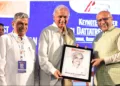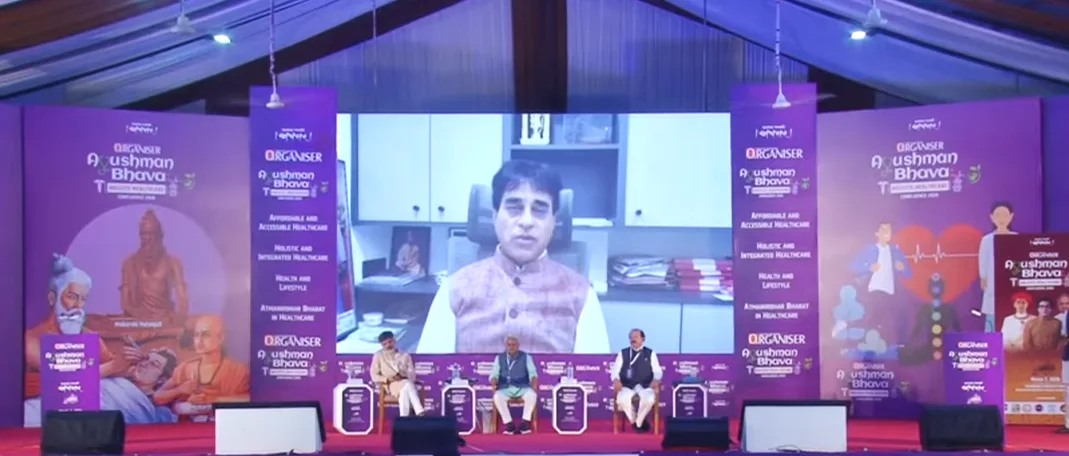
India today needs role models in the healthcare sector who can inspire the next generation of doctors to dedicate their lives to service and build a healthy nation. He said that healthcare must not be viewed merely as a profession but as a form of national service, said Dr Jayantibhai Bhadeshiya, Paschim Kshetra Sanghchalak of the Rashtriya Swayamsevak Sangh, during the valedictory session of “Ayushman Bhava: Holistic Healthcare Confluence 2026” organised by Organiser Weekly, concluded on March 7 at Jatelpur in Ahmedabad, Gujarat.
The ‘Ayushman Bhava’ event was held with theme of holistic approach was attended by Purnesh Modi, Deputy Speaker of the Gujarat Legislative Assembly, as the Chief Guest, while delivered the distinguished address.
He pointed out that institutions across the country are already demonstrating such models of service. Referring to one such initiative, he said, “In Bengaluru there is Jayadeva Hospital, established by the Rashtriya Utthan Parishad associated with the Sangh. There every OPD and indoor patient is given lifestyle modification instructions, not only to the patient but also to the relatives.”
Emphasising the ethical foundations of healthcare, Dr Bhadeshiya said the sector must be guided by strong principles beyond affordability alone.
“In the health sector it is not only about affordable price. There are some principles we must follow — we should be honest to science, we should be honest to the profession, we should be honest to society, and we should be honest to ourselves and to the organisation where we work,” he said.
He noted that organisations such as the National Medical Organisation (NMO) and Arogya Bharati are working to bring together doctors, medical students and healthcare professionals to contribute to public health initiatives. According to him, swayamsevaks associated with such initiatives have helped establish more than forty hospitals and blood banks across the country.
Inspiring Examples of Doctors Who Chose Service
Dr Bhadeshiya said the most effective way to inspire young medical professionals is by presenting real-life examples of doctors who have dedicated their lives to serving society, often in remote and underserved regions.
He cited the example of Padma Vibhushan Dr Ashok Rao Kukde, who chose service over a comfortable career. “Dr Ashok Rao Kukde’s father had a hospital in Pune. But while studying, he decided to go to a place where healthcare services were scarce,” Dr Bhadeshiya said.
Dr Kukde moved to the Marathwada region of Maharashtra, where medical facilities were extremely limited.
“He went there with his wife and two friends and started a small ten-room hospital. Over time it developed into a charitable institution and today functions as the Vivekananda Medical Mission, providing advanced services including cancer and cardiac treatment,” he said.
Dr Bhadeshiya also referred to the work of Dr Mehul Shah, who along with his wife chose to serve in the tribal belt. “Dr Mehul Shah and his wife studied in South India and later moved to Dahod, a tribal region on the Gujarat–Madhya Pradesh border,” he said.
Initially, the couple started a private hospital but soon realised that many tribal patients could not afford treatment. “They reduced the charges and began offering free services two days a week. Eventually the hospital became a charitable institution, and today patients come there from distant places,” he said.
The hospital now performs super-speciality eye surgeries and also serves as a training centre for postgraduate fellows, demonstrating that advanced healthcare institutions can develop even in small towns.
“This shows that such healthcare institutions can emerge even in small towns,” Dr Bhadeshiya observed.
Models of Compassionate Healthcare
Dr Bhadeshiya further cited the example of Dr Vasant bhai, whose trust hospital displayed a board stating that payment of hospital bills was not compulsory.
“Patients could pay whatever they could afford,” he said.
Another example he mentioned was the Sadbhavana Charitable Hospital in Mahuva, run by Dr Kanu bhai Kalsariya.
“Many people have donated for the hospital, but the rule is that no donor’s name will be displayed anywhere,” he noted, highlighting the spirit of service behind such institutions.
According to Dr Bhadeshiya, such examples represent the values that should guide healthcare in India.
“These are the role models that the next generation must follow. Only then can we build a healthy nation,” he said.
Minister Praful Panseriya’s Address
Praful Chhaganbhai Panseriya, Minister for Health, Family Welfare and Medical Education in the Government of Gujarat, speaking virtually said, “The Ayushman Bhava programme is very necessary in this time. What to eat, what not to eat, what to drink, what not to drink all these things are described in Ayurveda, which we often neglect thinking them to be ancient. But actually it is a lifestyle.
Across the world, in Europe and other developed countries, medicines are processed carefully, whereas in food production chemicals and fertilisers are used extensively. Because of this people are facing many serious diseases from cancer to many others.
In Charaka Samhita and the texts of Sushruta Muni there are nearly one lakh shlokas related to Ayurveda. Many present-day diseases are already described there. Therefore awareness is necessary. Earlier elders would place their hand on the head and bless saying ‘Ayushman Bhava’. This is our tradition, our ancient lifestyle which is superior.
Today certain people with destructive thinking are filling food materials with harmful substances and endangering human life. Therefore awareness is required. Government is working carefully, medicines are being given, free schemes are being created. But we should not reach a situation where we depend on schemes — lifestyle itself must be healthy.
In the body, Vata, Pitta and Kapha are responsible for diseases, and Ayurveda cures them. Thought processes also influence health — Sattva, Rajas and Tamas. Food influences thoughts, and distorted thoughts create imbalance in society.
Change in Life Style:
Lifestyle must change. First we must give up addictions like paan, mawa, gutka, tobacco and cigarettes which cause cancer. People waste money on such habits and damage their bodies.
To remove diseases and remain healthy one must remain healthy in mind, speech and body. If the mind is healthy the body will become healthy. Programmes like Ayushman Bhava are very necessary today and such programmes should continue. I salute the organisers. Due to my scheduled programmes in Kamrej I could not attend. Please forgive me. Best wishes to everyone. Jai Dhanvantari.”
Address by Deputy Speaker Purnesh Modi
Purnesh bhai Modi, Deputy Speaker of the Gujarat Legislative Assembly, said, “The Ayushman Bhava programme is an opportunity to understand health — through which we can understand how our entire life can remain disease-free.
Today we are making many mistakes. This day should not remain merely information for us, but the solution to these problems has been said in our culture for years.
Rajiv Dixit used to say that our ancestors the Rishis and Munis had already examined and explained the diagnosis of diseases thousands of years ago. But in the last hundred or two hundred years our life at every level has gone against nature. Our behaviour and actions have gone against nature, and as a result many problems have arisen.
Therefore today in the Ayushman Bhava programme discussions are taking place again on how health can improve, how strength and wellness can remain.
The Gujarat Government is fully aware of this matter and is taking firm steps continuously. On the first day one important subject is natural farming. Today the things we eat in our daily life vegetables, grains, fruits all contain chemicals and poison which enter our stomachs, and because of that many diseases arise.
Our lifestyle must change. It is said that our digestion is connected with the sun. Our stomach is connected with the sunrise and sunset cycle. One should eat within a couple of hours of sunset, because digestion is connected with the sun. One should eat before sunset, but we are doing the opposite.
As a result many diseases which we had never imagined are now seen. Through Yoga and Ayurveda, India has guided the world on many subjects. Because of that strength we still have the ability to defeat diseases and health problems.
But we must take a pledge — this body is ours. How we live, how we eat, how we keep our body healthy depends on us. If we take this pledge ourselves, then I feel that this one-day seminar will prove useful and meaningful for you.
Whenever necessary, the Gujarat Government has brought policies.
Earlier civil hospitals had limited capacity, but today you can see that the OPD in civil hospitals receives huge numbers of patients. In Surat alone around 5,000 OPD patients visit civil hospitals.
Beyond civil hospitals, the government has encouraged PPP model multi-super-speciality hospitals — not only in metropolitan cities but also in districts and rural areas.
The Minister said the Gujarat Government has strengthened healthcare by increasing MBBS and postgraduate seats and expanding modern medical infrastructure, including AIIMS and UN Mehta Hospital in Ahmedabad.
He said schemes such as Amrutam Yojana provide cashless treatment of up to ₹2 lakh for poor patients, while Ayushman Bharat covers treatment up to ₹5 lakh. The Gujarat Government has added another ₹5 lakh, raising total medical assistance to ₹10 lakh for Ayushman Bharat cardholders.
The Vote of Thanks was presented by Prafulla Ketkar, Editor of Organiser Weekly.