
India no longer sees any single system of medicine as the only answer to patients’ needs. While modern medicine focuses on diagnosing and treating disease, systems such as Ayurveda and Homeopathy place greater emphasis on prevention and maintaining overall health.
Many in India’s medical community are now calling for a more integrated approach to healthcare that brings together modern medicine and traditional systems like Ayurveda and Homeopathy. With lifestyle diseases on the rise and healthcare challenges becoming more complex, experts believe collaboration rather than competition among medical disciplines can lead to more holistic and effective treatment for patients.
Synergy between Medical Systems
The idea of “synergy” between medical systems is now gaining attention among practitioners, researchers and policymakers seeking a more comprehensive healthcare model for the future. Dr Parul Vadgama, an advocate for the integration of Allopathy and Ayurveda, emphasises that “Health is everybody’s subject.” True wellness is not merely the absence of disease but a state of physical, mental, and spiritual balance. She is the HoD of Tuberculosis and Chest Diseases Government Medical College, Surat.
According to Dr Vadgama, the ground-level “fight” between different systems of medicine must end. The solution? Standard Operating Procedures (SOPs) that incorporate all three paths—Allopathy, Ayurveda, and Homeopathy—tailored to the specific needs of the patient.
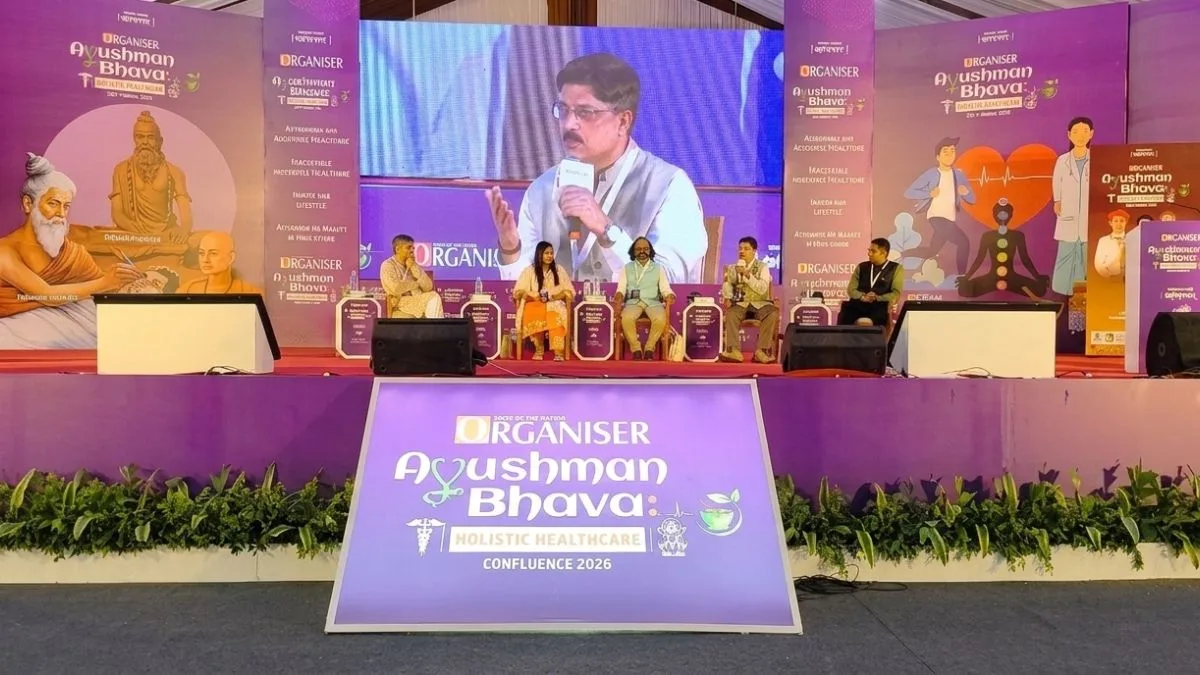
Along with Dr Parul Vadgama, strategic healthcare leader Lt Col Dr Praveen Kumar Reddy, Amrita Hospital Medical Director Dr Sanjeev Singh, and Ganatra Ayurved & Panchkarma Clinic founder Vaidya Dr Bhavdeep Ganatra also participated in Organiser’s Ayushman Bhava Holistic Healthcare Confluence 2026. Organiser Weekly Editor Prafulla Ketkar moderated the Holistic & Integrated Healthcare session.
“Validation is the bridge. We need modern scientific research to recognize and validate these combinations. When India provides evidence-based validation, it will give our traditional systems a global push.”
SGVP Holistic Hospital follows an integrated approach to healthcare, where patients are referred for various Ayurvedic diagnostic assessments, along with the routine health check-ups in allopathy. The patient’s condition is then evaluated through both allopathic and Ayurvedic perspectives to determine the most suitable course of treatment.
“The enemy is not any pathy, but the disease. The more experts we have working together as a team, the better we can cure it,” said Chief Ayurveda Operations (CAO) and consultant Vaidya Dr. Bhavdeep Ganatra, who is also the founder of Ganatra Ayurved & Panchkarma Clinic.
Amrita Hospital Medical Director Dr Sanjeev Singh underlined the growing need for greater dialogue and collaboration among the systems of allopathy, Ayurveda, and homoeopathy, noting that integrated medical practices already exist but require wider acceptance and stronger institutional support.
Speaking on the issue, Singh observed that modern medicine often tends to view itself as superior, which can limit openness to other medical traditions. They pointed out that this mindset is also reflected in the current medical curriculum, which offers little exposure to alternative treatment systems.
According to them, regular dialogue and professional interactions between practitioners of different medical streams are essential to overcome institutional barriers and professional ego.
“Doctors often have strong professional egos, but we must recognise that every system of medicine has its own limitations,” said Dr Sanjeev Singh, Medical Director of Amrita Hospital, stressing that cooperation rather than competition between disciplines would ultimately benefit patients. According to him, such “clinical egos” can only be overcome through experience and knowledge.
Responding to a question on why Chinese traditional medicines have gained acceptance in the US market while Indian systems still struggle for similar global recognition, experts said the issue is partly a matter of mindset and partly a systemic challenge.
They argued that India needs a clearer vision and a more inclusive approach from the government and regulatory bodies to strengthen the global standing of its traditional medical systems. Medical associations, they said, should also be open to discussing integration and research in public forums.
Experts emphasised that institutions such as the National Medical Commission and the National Commission for Indian System of Medicine have an important role to play in encouraging collaborative research and regulatory support.
They also suggested that ethics committees in medical colleges should be strengthened and expanded to include experts from multiple systems of medicine so that clinical trials involving Ayurveda, homeopathy and modern medicine can be conducted more effectively.
Ethics Committees and Scientific Research
Experts noted that professional associations such as the Indian Medical Association have not opposed cooperation between medical systems but maintain that practitioners must operate within the limits of their qualifications while treating patients.
They also emphasised the importance of strengthening ethics committees in medical colleges to evaluate clinical trials involving multiple systems of medicine more effectively. Such committees, they said, should include experts from different disciplines, including allopathy, Ayurveda and homeopathy.
Calling for a broader research ecosystem, experts said studies should not be limited to large institutions. District-level research initiatives, they argued, could also contribute valuable data on the effectiveness of integrated medical practices. Strong scientific evidence will be crucial for gaining global recognition.
According to them, a lingering colonial mindset continues to shape how traditional knowledge systems are perceived in India. “We often become good followers of global trends but hesitate to take our own initiatives.” Sanjeev Singh remarked.
They added that greater engagement with rural communities could also offer important lessons in preventive healthcare, as many villages continue to follow modest and balanced lifestyles that naturally support better health outcomes.
Ayurveda is at the core of India’s integrated healthcare framework
Medical experts have emphasised the need to place Ayurveda at the core of India’s integrated healthcare framework while encouraging cooperation between different systems of medicine to improve patient outcomes.
Speaking on the role of traditional systems in modern healthcare, experts said Ayurveda focuses on making an individual healthy rather than merely treating disease, a principle they described as its central philosophy.
“Ayurveda’s fundamental objective is to keep a person healthy. Treatment is only one part of the process,” an expert said, highlighting the system’s emphasis on preventive care and lifestyle management.
They noted that Ayurveda offers robust lifestyle-based interventions to help manage conditions such as diabetes and other lifestyle diseases. According to them, many such illnesses can be addressed effectively through dietary regulation, daily routines and preventive health practices. At the same time, experts acknowledged the role of modern medicine in treating acute conditions and, when necessary, curing patients. They stressed that collaboration between allopathy, Ayurveda and Homeopathy medicine could create a more comprehensive healthcare model.
“Practitioners from different systems should sit together, discuss and even debate their approaches. Eventually, such engagement can lead to mutual understanding and acceptance,” Former Army Medical Corps Officer and Strategic healthcare leader Lt Col Dr Praveen Kumar Reddy said. According to him, making a person healthy is the ‘Mool Mantra’ of Ayurveda.
Netra Kumbh at Kumbh Mela 2025
The success of Netra Kumbh during Kumbh Mela 2025 stands as a powerful example of what collaborative healthcare can achieve. It was not merely a camp, but a mission carried out on a massive scale. Lakhs of people did not just receive eye check-ups; they received comprehensive care. The Swami Vivekanand Health Mission Society ensured that spectacles and surgical care were delivered directly to beneficiaries at their homes.
It is notable that China and Japan have successfully integrated their traditional medical systems into mainstream healthcare with strong social acceptance. India should adopt a similar approach to strengthen Ayurveda.
Experts further called for an end to professional rivalries across medical systems, noting that such conflicts often hinder the development of integrated healthcare practices.
They added that initiatives under the AYUSH framework have already highlighted the potential of traditional systems and that stronger collaboration among medical disciplines could help build a more inclusive healthcare model for the future.