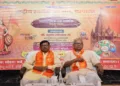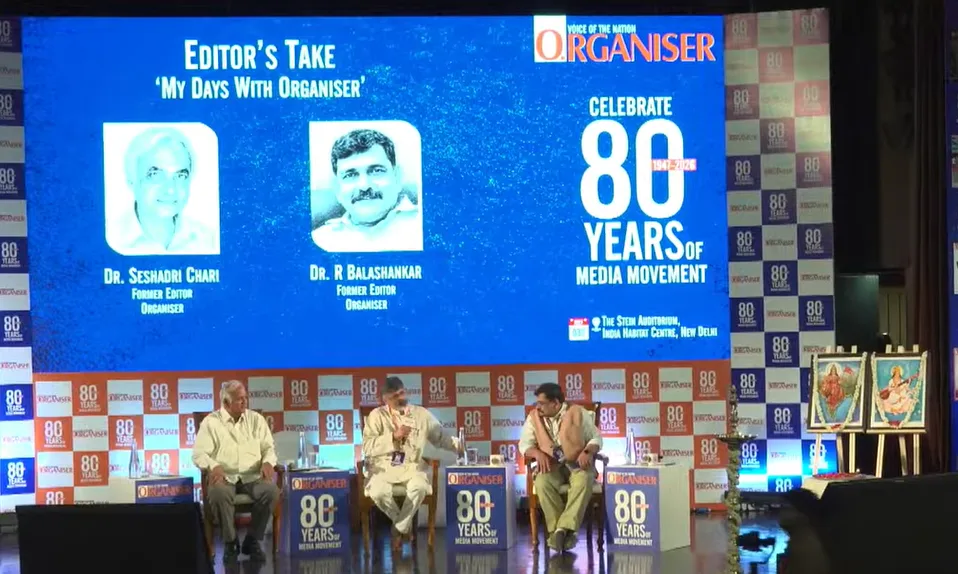
New Delhi: The second session of Organiser Weekly’s 80th Foundation Day celebrations, titled “Editor’s Take – My Days With Organiser”, featured former editors Seshadri Chari and R. Balashankar reflecting on their editorial journeys, the publication’s evolution and its enduring ideological commitment over the past eight decades.
While interacting with current editor Prafulla Ketkar during the session, former Organiser editor Seshadri Chari ji (1992–2004) described himself as an “accidental editor”, recounting how he unexpectedly took charge of the publication in 1992 despite having no formal editorial background.
Chari ji said his association with Organiser began while serving as an RSS Pracharak in Mumbai, where he edited an English edition of the Marathi journal Vivek. His work drew the attention of senior RSS leaders, eventually leading to his transfer to Delhi after the Ram Janmabhoomi movement.
He recalled being informed by senior RSS leaders, including Rajju Bhaiya ji and Sudarshan ji, that he would succeed the ailing editor V. P. Bhatia. Describing the decision as a complete surprise, Chari ji said he had expected to work on improving the weekly’s circulation rather than becoming its editor.
Reflecting on his early days, Chari ji shared that former editor K. R. Malkani became his mentor and imparted a lasting editorial lesson: an editor should always keep a dictionary on the desk—not to use difficult words, but to avoid using words that require one.
Chari ji also narrated how he began his editorial tenure with just Rs 200 for local travel and a bicycle, underscoring the simplicity with which Organiser functioned in those days. He concluded by recalling that when he stepped down in 2004, officials discovered he had never been issued an appointment letter or drawn a salary, joking that, officially, he had “neither been appointed nor resigned” as editor.
Former Organiser editor R. Balashankar ji, who served as the weekly’s editor from 2004 to 2013, described the event as one of the most memorable in the publication’s history and congratulated current editor Prafulla Ketkar ji for transforming Organiser into a magazine format and expanding its digital presence.
Balashankar ji said Organiser had traditionally functioned with limited resources and noted that the publication now faces a different editorial environment compared to the years when it was in the Opposition. He observed that today’s circumstances demand greater editorial restraint and careful deliberation.
Recalling his tenure during the Manmohan Singh government, he said political controversies and ideological debates provided extensive material for editorials and cover stories. He described Organiser as more than a publication, calling it a source of ideological understanding and inspiration for generations of swayamsevaks.
He paid tribute to former editor K. R. Malkani, describing him as a fearless journalist whose editorials commanded wide attention. Balashankar ji said he was advised him to introduce changes gradually, leading Organiser to publish thematic special issues that both enriched the publication and strengthened its finances.
Balashankar ji also recalled receiving guidance from senior RSS leaders, who regularly visited the office to discuss editorial ideas. He said he enjoyed complete editorial freedom during his tenure, with financial limitations being a challenge rather than editorial constraints.
Concluding his remarks, Balashankar ji said Organiser’s influence extended well beyond its circulation, recalling that senior journalists and even the Prime Minister’s Office closely followed its columns during the UPA years, reflecting the publication’s growing impact on national political discourse.