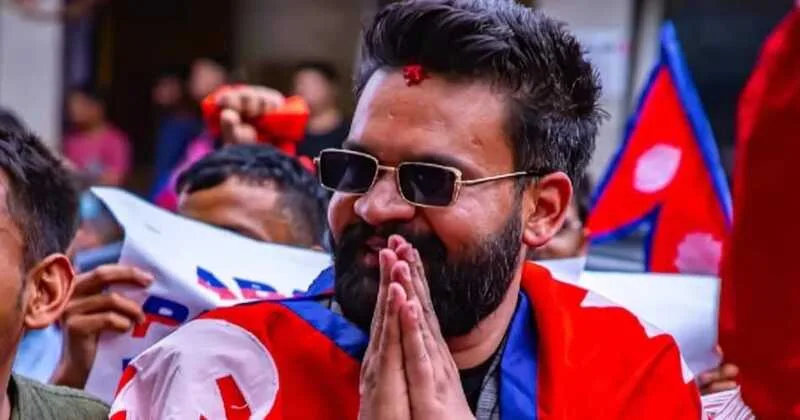
Kathmandu/New Delhi: Rapper-turned-politician Balendra Shah’s Rastriya Swatantra Party (RSP) was on Friday heading towards a sweeping victory in Nepal’s general elections, the first national vote held after last year’s youth-led protests that shook the country’s political establishment. The results indicate a major political shift in the Himalayan nation, with Shah emerging as the leading contender for the post of prime minister while veteran leader and former prime minister KP Sharma Oli trails significantly in his own stronghold.
According to data released by Nepal’s Election Commission from 161 of the 165 constituencies, the RSP has already secured multiple seats and is leading in a large number of others, signalling a dramatic erosion of support for the country’s traditional political parties.
Youth wave propels Balen Shah
Early trends show Shah’s RSP winning several seats while leading in over a hundred constituencies, according to local media reports. The outcome suggests a decisive electoral wave in favour of the relatively new political force that rose to prominence following the youth-driven protests that toppled the previous government.
Balendra Shah, widely known as “Balen”, has drawn particular attention for his strong performance in Jhapa-5 constituency, long considered a bastion of the Communist Party of Nepal–Unified Marxist Leninist (CPN-UML). In this constituency, Shah has secured more than 15,000 votes, leaving behind CPN-UML chairman and four-time prime minister K.P. Sharma Oli, who has so far managed only about 3,300 votes.
Shah, a 35-year-old engineer who until recently served as the Mayor of Kathmandu, is now widely expected to become Nepal’s next prime minister if the trends translate into a final mandate. The scale of the electoral shift reflects growing public frustration with traditional political leadership. Nepal has witnessed 14 governments in the last 18 years, highlighting the chronic instability that has characterised the country’s political system.
The election marks a turning point for the RSP, which only recently emerged as a major political force. According to Election Commission figures cited by The Kathmandu Post, the party has already won 20 seats and is leading in another 95 constituencies based on results from 161 seats counted so far.
From Rapper to Political Challenger
Balendra Shah’s political rise has been unconventional. Known for his career as a rapper before entering public life, Shah first gained national recognition after winning the Kathmandu mayoral election, where he positioned himself as an anti-establishment candidate challenging Nepal’s entrenched political elites.
His growing popularity was particularly evident during the recent campaign, where large crowds, many of them young voters, attended his rallies. Shah’s appeal among the youth reflects his role in the political movement that emerged in September 2025, when thousands of young Nepalis took to the streets to protest corruption and entrenched political patronage. Those demonstrations eventually led to the collapse of the government led by Prime Minister KP Sharma Oli. Many observers described the protests as a “Gen Z movement” or even a “revolution,” reflecting the scale of youth participation and the intensity of public anger toward traditional parties.
Shah was widely seen as one of the key figures associated with this movement. After the protests forced the government’s fall, an interim administration led by former Chief Justice Sushila Karki was formed to oversee the country’s political transition and conduct fresh elections.
The Rastriya Swatantra Party itself is led by Rabi Lamichhane, a former television host who turned politician. Shah joined the party in December last year and soon emerged as one of its most prominent leaders. His campaign narrative has consistently focused on challenging the dominance of Nepal’s long-standing political elite and presenting himself as a symbol of generational change.
Shah’s campaign style also drew attention for its cultural and linguistic outreach. When launching his prime ministerial campaign, he opened his speech with the words: “Sarvapratham, Mata Janaki ke pranaam.” Notably, the speech was delivered in Maithili, a language widely spoken in India’s Bihar and Jharkhand regions as well as Nepal’s Madhesh province. Significantly, Shah chose to begin his campaign not in Kathmandu or the hill regions traditionally associated with Nepal’s political leadership, but in Janakpur, the capital of Madhesh province and the birthplace of the Hindu goddess Sita, also known as Janaki. The move was widely interpreted as an attempt to broaden his political appeal across Nepal’s diverse linguistic and regional communities.
Gen Z protests reshape Nepal’s politics
Thursday’s election was the first nationwide vote held since the youth-led uprising of September 2025 that forced the resignation of Prime Minister KP Sharma Oli. The protests were sparked by widespread dissatisfaction over corruption, governance failures and the continued dominance of established political parties. Many analysts have described the election as a direct political test of the energy unleashed by the Gen Z-led protests. The strong performance of Shah’s RSP suggests that voters, particularly younger citizens, are seeking a decisive break from Nepal’s traditional political structures.
According to Nepal’s acting Chief Election Commissioner Ram Prasad Bhandari, voter turnout stood at around 60 percent, with only sporadic incidents reported in a few districts during polling.
The scale of RSP’s performance, combined with Shah’s commanding lead in Oli’s own constituency, underscores the depth of the political shift underway. If the current trends hold, Nepal may witness one of the most dramatic generational changes in leadership since the country’s transition to a republic.
India welcomes Nepal’s democratic exercise
India has welcomed the successful conduct of the elections in Nepal, congratulating the interim government and the people of the country for participating in the democratic process despite the political upheaval of the past year. In a statement issued on March 5, Ministry of External Affairs spokesperson Randhir Jaiswal said New Delhi welcomed the “successful conduct of elections and the exercise of their democratic mandate by the citizens of Nepal,” noting the enthusiastic participation of voters.
India also congratulated interim Prime Minister Sushila Karki, the Nepali government and other stakeholders for ensuring that the elections were held despite what the statement described as the “exceptional circumstances” experienced in the previous year.
The statement further noted that India had provided logistical support for the polls at the request of the Kathmandu government. New Delhi reaffirmed its commitment to supporting peace, progress and stability in Nepal, while expressing its intention to work with the new government in Kathmandu to strengthen the robust and multifaceted ties between the two neighbouring countries.