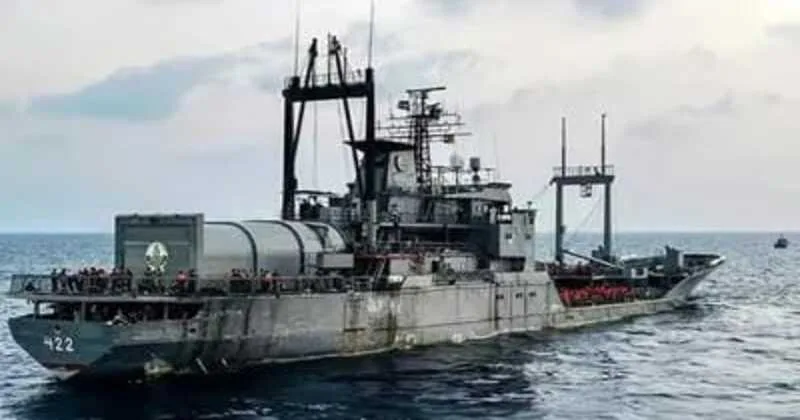
Kochi/ Colombo: Iran had requested India on February 28, days before IRIS Dena was sunk by the U.S. Navy, to urgently dock another vessel, IRIS Lavan (514), at Kochi due to technical issues. India granted permission on March 1, and the vessel docked at Kochi on March 4. Its crew of 183 sailors are currently being accommodated at naval facilities in Kochi.
An official announcement from Indian authorities is awaited as the government carefully assesses the rapidly evolving security situation in the region. Officials indicated that information regarding IRIS Lavan was handled with strategic caution due to the uncertain status of the other two Iranian vessels in nearby waters, IRIS Dena and IRIS Bushehr. The measured approach reflects India’s priority to ensure maritime security and maintain stability in the Indian Ocean while responsibly managing humanitarian and diplomatic considerations.
Iranian ships seek refuge in regional ports
In a statement on March 5, the President of Sri Lanka revealed that three Iranian ships had requested permission on February 26 to enter the port of Colombo between March 9 and March 13. However, events quickly unfolded at sea before that request could be fulfilled.
On March 4, IRIS Dena was sunk south of Galle, off Sri Lanka’s southern coast. According to the reports, the attack was carried out by the U.S. Navy submarine USS Charlotte, operating under the U.S. Indo-Pacific Command (INDOPACOM). The submarine fired two Mark 48 torpedoes at the Iranian frigate. The first torpedo reportedly missed its target, but the second struck the vessel, causing it to sink.
Following the incident, Sri Lanka granted refuge to another Iranian naval vessel, the replenishment ship IRIS Bushehr. The ship is expected to berth at Trincomalee, while 208 members of its crew have been temporarily accommodated in Colombo under the supervision of Sri Lankan authorities. Australia’s Prime Minister Anthony Albanese also revealed that three Australian sailors were aboard the U.S. submarine during the operation that sank IRIS Dena. However, he clarified that the Australian personnel did not participate in the attack itself.
With IRIS Dena destroyed and both IRIS Bushehr and IRIS Lavan effectively interned by neutral nations, Iran currently has no known large surface warship operating in open seas. Analysts say that under the ongoing U.S. campaign known as Operation Epic Fury, Washington has severely degraded Iran’s naval capability. Reports indicate that more than 20 Iranian vessels have been sunk or disabled, while several naval facilities have also been targeted.
Rescue operations and diplomatic pressure
Meanwhile, the Indian Navy’s sail training vessel INS Tarangini arrived in Colombo after completing a visit to Trincomalee from February 27 to March 2. Tarangini was the closest Indian naval vessel to the location where IRIS Dena sank.
During its stay in Sri Lanka, the ship will conduct ocean-sailing training programmes for Sri Lankan trainee naval officers, strengthening maritime cooperation between the two countries.
At the same time, new developments have emerged regarding the fate of the Iranian sailors involved in the incident. Days after the sinking of IRIS Dena, Washington is reportedly urging the Sri Lankan government not to repatriate survivors of the destroyed vessel.
According to the reports, the request was conveyed through an internal U.S. State Department cable. The cable reportedly advised Sri Lankan authorities not to return the rescued sailors to Iran and also asked that the 208 crew members of IRIS Bushehr currently in Sri Lankan custody should not be repatriated. The Iranian frigate IRIS Dena had been torpedoed and sunk approximately 19 nautical miles off Sri Lanka’s southern port city of Galle. After receiving a distress signal, Sri Lankan authorities launched a rescue operation in the surrounding waters. The operation recovered at least 87 bodies from the sea, while 32 sailors were rescued alive.
Strategic implications of the attack
According to the diplomatic cable dated March 6, Jayne Howell, the charge d’affaires at the US Embassy in Colombo, urged Sri Lankan officials to limit Iran’s ability to use the captured sailors for propaganda purposes. “Sri Lankan authorities should minimise Iranian attempts to use the detainees for propaganda,” the cable reportedly stated.
On Thursday, Sri Lankan authorities began offloading the crew of IRIS Bushehr and relocating them to temporary facilities near Colombo. President Anura Kumara Dissanayake said the island nation had a “humanitarian responsibility” to assist stranded sailors and ensure their safety.
The destroyed frigate IRIS Dena was one of Iran’s newer Moudge-class warships and carried around 180 personnel on board. The vessel was equipped with missiles, naval guns and torpedoes, making it one of the more capable ships in Iran’s fleet.
Reports say that the attack submarine USS Charlotte fired two MK-48 torpedoes during the operation. While the first torpedo missed the target, the second struck the frigate and caused catastrophic damage, leading to its sinking. U.S. Defence Secretary Pete Hegseth later confirmed the strike and described the attack as a “quiet death” delivered by a torpedo against a warship that believed it was safe in international waters. Another Iranian vessel involved in the developments is IRIS Lavan, a Hengam-class landing ship commissioned in the 1980s. In 2022, Iran had released footage showing the vessel launching multiple one-way attack drones during a naval exercise, highlighting its potential use as a drone-launch platform. The rapid loss of IRIS Dena, combined with the detention of IRIS Bushehr and the docking of IRIS Lavan in Kochi, has significantly reduced Iran’s visible naval presence in the region. The developments have also drawn attention to the increasingly complex maritime tensions unfolding across the Indian Ocean as the confrontation between Washington and Tehran continues to escalate.