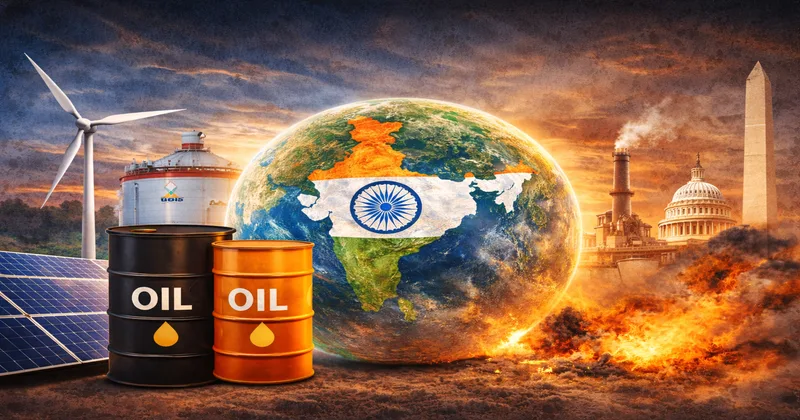
The landscape of global energy politics has always been a theatre for the exercise of power, but rarely has it witnessed a more coordinated campaign of disinformation than what we are seeing today. On March 6, 2026, the United States Treasury issued General License 133, a document that provides a thirty-day window for refineries to process certain Russian oil cargoes currently in transit. Almost instantaneously, the usual suspects within the Lutyens’ media ecosystem and the political opposition began a chorus of derision. They have attempted to frame this technical, administrative adjustment as a moment of subservience, claiming that the United States has finally “allowed” Bharat to purchase energy. This narrative is not only factually bankrupt but is a calculated insult to the sovereignty of a civilizational power. It deliberately conflates a narrow, technical waiver designed for corporate entities with the sovereign command of a nation-state. To suggest that a global power like Bharat operates on a thirty-day “permission slip” from Washington is a fantasy peddled by those whose minds remain colonised, unable to fathom a Bharat that speaks to the world as an equal.
The Critical Distinction Between State Sovereignty and Commercial Entities
The most egregious error in the opposition’s rhetoric is the failure to distinguish between the Republic of Bharat and the refining entities that operate within its borders. Bharat, as a sovereign republic, has never asked for, nor does it require, permission from any foreign power to conduct its trade. Our foreign policy is guided strictly by the Atmanirbhar spirit and the pragmatism of national interest. We never signed the G7 price cap, we never joined the Western sanctions regime, and we have never recognised the legal validity of unilateral embargoes imposed by a few nations outside the framework of the United Nations. However, the world of international trade is a complex web of services. Refining entities, whether they are state-owned giants like Indian Oil Corporation and Bharat Petroleum or private behemoths like Reliance Industries and Nayara Energy, must interact with this global web. They rely on international banks, maritime insurance providers, and global shipping lanes that have historically been dominated by Western infrastructure.
When the US Treasury issues a waiver like the one seen today, it is not an act of granting permission to the government in New Delhi. Rather, it is an administrative directive aimed at Western financial and maritime service providers. It tells American and European banks and insurers that they will not face legal repercussions for a limited period while they facilitate the clearing of specific cargoes that were already at sea. The “authority” being exercised here is over the internal regulatory compliance of Western corporations, not over the sovereign decisions of the Bharatiya state. By ignoring this distinction, the opposition seeks to manufacture a crisis of sovereignty where none exists, hoping the common man will mistake a technical banking workaround for a diplomatic surrender.
The Architecture of Sanctions and the Weaponisation of Finance
To understand why this waiver was issued today, one must first understand the architecture of the sanctions that have been in place for years. These were never a direct ban on Bharat’s right to buy oil; instead, they were a sophisticated attempt to tax and control the logistics of the trade. The G7 nations attempted to weaponise the “plumbing” of the global oil market, insurance, financing, and shipping. Because nearly ninety per cent of global maritime insurance is managed by the London-based P&I Clubs, the West believed they could effectively halt the flow of Russian hydrocarbons by simply denying insurance to any vessel carrying oil priced above their arbitrary sixty-dollar cap.
This was a technical trap designed to force every buyer into a subordinate position. If a refinery bought oil at sixty-one dollars, it would theoretically lose access to the ships and the banking clearinghouses that allow modern trade to function. These sanctions were already a reality long before the current trade dynamics between Bharat and Russia reached their peak. They were an extension of a decades-long Western strategy of using the US Dollar as a geopolitical weapon. However, what the architects of these sanctions failed to account for was the technical resilience and the strategic foresight of Bharat’s refining sector.
The Mechanics of the Parallel Banking System
While the opposition claims that Bharat waited for a waiver, the reality is that our public sector undertakings and private refiners spent the last three years building a parallel global economy. They did not bypass the sanctions through trickery; they rendered them irrelevant through systemic engineering. The most sophisticated part of this strategy involved the bank-to-bank transfer mechanisms that moved the trade away from the New York-centred clearing system. When the West cut off major Russian banks from the SWIFT network, Bharat’s financial strategists did not retreat. Instead, they deepened the use of the Vostro account system.
In this mechanism, Russian banks opened special Rupee Vostro accounts in Indian banks like UCO Bank and State Bank of India. When a Bharatiya PSU purchased oil, the payment was deposited in Rupees into these accounts. This meant that not a single cent had to pass through a Western intermediary or be converted into US Dollars. While there were initial challenges regarding the imbalance of trade and the accumulation of Rupees in Russia, Bharat’s refiners quickly mastered a multi-currency pivot. A significant portion of the trade began to be settled in UAE Dirhams. By using non-sanctioned banks in the Middle East as clearinghouses, Bharat ensured that the financial “off-ramps” for its oil trade were located in neutral jurisdictions. This bank-to-bank coordination allowed Bharat to maintain a steady flow of millions of barrels of oil per day, even at the height of Western pressure, proving that the Dollar’s hegemony is no longer absolute.
The Shadow Fleet and Sovereign Insurance
The second pillar of Bharat’s technical defiance was the creation of an independent logistics chain. The West thought they could stop us by controlling the tankers, so Bharat’s refiners and their partners mobilised what analysts call the “Grey Fleet.” This is a decentralised network of over six hundred tankers that operate outside the traditional Western ownership structures. These vessels do not rely on London for their insurance. Instead, Bharat empowered the General Insurance Corporation of India and other domestic providers to issue sovereign guarantees.
When a tanker carrying Russian crude docks at a Bharatiya port today, it does so under the protection of Bharatiya insurance and often under the guidance of non-Western maritime services. This was a massive undertaking that essentially broke the century-long monopoly held by European maritime clubs. By the time the US Treasury issued its waiver today, nearly eighty per cent of the Russian cargoes destined for our shores were already operating entirely outside the reach of Western sanctions. The waiver, therefore, was not a “gift” to a struggling nation; it was a desperate attempt by the US to bring some of this “off-the-books” trade back into a framework where they could at least observe it.
The Hormuz Emergency and the US Tactical Retreat
The timing of today’s waiver is perhaps the most telling evidence of Bharat’s leverage. It did not come out of a vacuum. As of March 2026, the global energy market is in a state of absolute emergency. The escalating conflict in West Asia and the subsequent disruptions in the Strait of Hormuz have put nearly one-fifth of the world’s petroleum supply at risk. In such a volatile environment, the global economy simply cannot survive the removal of Russian crude from the market. There are currently nearly fifteen million barrels of oil “stranded” at sea on vessels that were facing technical banking hurdles due to the latest round of US regulatory updates.
If those barrels were not allowed to be processed by Bharat’s refineries, global oil prices would have skyrocketed past one hundred and ten dollars per barrel within hours. The US administration, facing its own internal economic pressures and the looming threat of hyperinflation, had no choice but to issue a waiver. They needed Bharat’s refineries to act as the global “safety valve.” The waiver was an act of American self-preservation, a tactical retreat by a superpower that realised its sanctions were about to crash its own economy. The opposition’s claim that Bharat is “bowing” is a pathetic inversion of reality; in truth, it is Washington that has had to adjust its rules to accommodate the reality of Bharat’s indispensable power.
Bharat as the Global Refinery and the Laundromat Irony
There is a profound irony in this saga that the Lutyens’ media goes to great lengths to hide from the public. While the West pretends to maintain a moral high ground through sanctions, they have become the primary customer of the very oil they claim to block. This is what experts call the “Laundromat Effect.” Russian crude enters the world-class refining complexes in Jamnagar, Vadinar, and Paradip. It is processed with Bharatiya expertise into high-grade diesel and jet fuel that meets the stringent environmental standards of the European Union.
This refined fuel is then shipped to ports in Germany, France, and the Netherlands. The very molecules that the US Treasury “authorises” today through a thirty-day waiver will likely keep the lights on in European cities tomorrow. Bharat has transformed itself into a global energy hub that the West cannot afford to sanction. If they were to truly block our refineries, the European transport sector would grind to a halt. We are not a “vassal state” following orders; we are the essential provider of energy security to the very nations that try to lecture us on geopolitics.
Exposing the Opposition’s Inferiority Complex
The opposition leaders’ reaction to this development reveals a deep-seated psychological malaise. For decades, the political establishment that preceded the current government operated under a mindset of dependency. They cannot conceive of a Bharat that acts as a pole of power in its own right. When they see a US Treasury waiver, their first instinct is to assume that their own country must have made a secret concession. They are more comfortable in the salons of London and the lecture halls of Washington than they are in the industrial heartlands of their own nation.
They have attempted to link this waiver to recent trade negotiations, suggesting a “quid pro quo” that compromises our autonomy. However, the data tells a different story. Even as Bharat diversifies its energy basket by increasing imports from the United States and West Asia, it has never abandoned its strategic relationship with Russia. Our leadership has demonstrated that in a multipolar world, one does not have to choose sides. We can be a “Major Defence Partner” of the United States while being the largest customer for Russian hydrocarbons. This is the definition of strategic maturity, a concept that is entirely alien to an opposition that still thinks in the binary terms of the Cold War.
The Economic Dividends of Autonomy
Beyond the lofty talk of sovereignty, there is a very real economic dividend that this government has secured for the common citizen. By refusing to buckle under pressure and masterfully navigating the sanctions minefield, Bharat has saved an estimated twelve to fifteen billion dollars in energy costs over the last four years. These are not just abstract numbers on a balance sheet. These savings have directly funded the massive expansion of the PM Gati Shakti infrastructure projects, the stabilisation of domestic fuel prices during a global crisis, and the provision of subsidised fertilisers to our farmers.
While the rest of the world was reeling from ten per cent inflation and energy poverty, the Bharatiya consumer was protected by the government’s refusal to seek “permission” for its energy purchases. The opposition, by attacking this policy, is essentially arguing that Bharat should have paid higher prices and sacrificed its economic growth to satisfy the geopolitical whims of the West. Their position is not only anti-government; it is anti-people.
The End of the Permission Culture
The events of March 6, 2026, will be remembered as a milestone in Bharat’s journey toward becoming a Viksit Bharat. General License 133 is not a permission slip given to a subordinate; it is a recognition of reality given to a peer. The US Treasury issued this waiver because it had no other choice. They realised that the “Dollar Weapon” had met its match in the technical and diplomatic resolve of New Bharat. We have moved past the era where our national security or our economic stability depended on the benevolent gaze of a foreign capital.
Bharat’s energy policy is guided by a singular, unwavering principle: Bharat First. We bought Russian oil because it was in our national interest. We built a shadow fleet and independent insurance mechanisms because it was necessary for our survival. And today, our refineries will process that oil because the world needs the energy that only Bharat can provide with such efficiency. The era of seeking permission ended in 2014. We are no longer a nation that asks “Can we?”; we are a nation that says “We will.” To the media houses and the opposition leaders who continue to mourn Bharat’s “loss of sovereignty,” the answer is simple: The world has changed, and it is time you changed with it. Bharat is not just a participant in the global order; Bharat is now one of its primary architects.