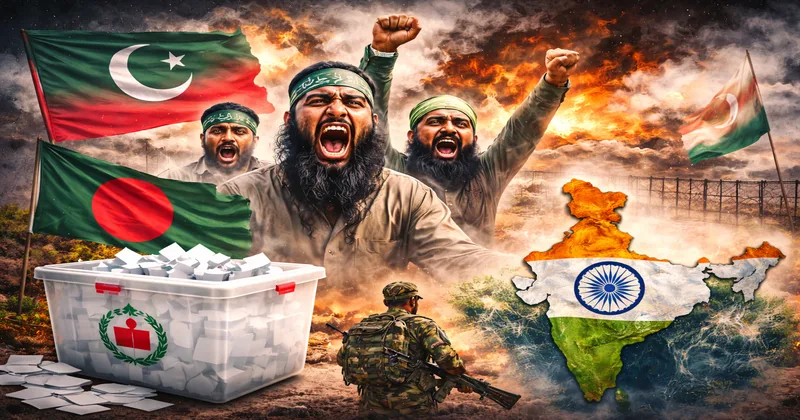
Bangladesh election result 2026 has taken off the camouflage of Jamaat-e-Islami Bangladesh, the pro-Pakistan radical outfit preaching political Islam. While Awami League’s political dominance over a very large majority of seats camouflaged the growing presence of Jamaat in Bangladesh, recent prohibition on Awami League & participation of Jamaat in the latest election exposed the radical outfit’s prominent presence along Bangladesh-West Bengal border, indicating the rising acceptance of radical Islamism in TMC-ruled West Bengal being probably attributable to Jamaat itself.
Such a hypothesis corroborates well with the Government of West Bengal’s open-border policy under TMC. In spite of Calcutta High Court’s order to transfer the requisite land to the Government of India for fencing around 450 kms unfenced length of West Bengal–Bangladesh border, West Bengal CM posed recalcitrant that land won’t be a problem if the MHA Government of India (GOI) reverted back to BSF’s 15 kilometres jurisdiction rolling back their present jurisdiction of 50 kilometres. It could not be said more clearly that the West Bengal Government will not allow the GOI to prevent the entry of infiltrators into Indian territory through West Bengal. Though such anti-GOI obstinacy of an Indian Chief Minister is supposed to be beyond one’s wildest dreams, West Bengal CM’s attitude indicates a strong presence of foreign forces behind her.
The table given below lists the on-border Assembly constituencies of West Bengal (left hand side columns) vis-à-vis the corresponding Assemblies of Bangladesh (right hand side columns). Constituency numbers & names written in red colour are all won by Jamaat-e-Islami in this election forming a thick longitudinal band of Jamaat’s political domain along the West Bengal-Bangladesh border almost throughout South Bengal & at quite some points of North Bengal.
Modus Operandi to Inflintrate Bharat
Jamaat-e-Islami’s presence was almost entirely along the border, indicating that its supporters moved like a wave from inside Bangladesh towards the border, coalesced at the border, and overflew into West Bengal, denting Indian border security. The radical outfit apparently displayed its prime objective to infiltrate into the Indian territory which is similar to the objective of the Pakistanis. While Bangladeshi infiltrators regularly leaked through the porous border in small numbers till today, the huge build up of Jamaatis on Bangladesh border constituencies might bring in a sudden tsunami in West Bengal breaking the border resulting in a sudden fall of Bangladesh population. Such a sudden fall in Bangladesh population had happened earlier, not only in the 1970s but also between 2005 & 2010 during the UPA era in Bharat.
It is relevant to mention that from North to South in descending order, the West Bengal districts bordering Bangladesh are 1) Coochbehar, 2) parts of Darjeeling, 3) Jalpaiguri, 4) Uttar Dinajpur, 5) Dakshin Dinajpur, 6) Maldaha, 7) Murshidabad, 8) Nadia, 9) Uttar 24 Parganas and 10) Dakshin 24 Parganas.
Local political discourse of various such on-border Assemblies may be correlated with Jamaat’s pattern of politics on the other side of the border. For example, the tendency of regular violence in Dinhata under TMC MLA Udayan Guha, may be correlated to Jamaat’s dominance in Kurigram 1 & Kurigram 2 of Bangladesh adjacent to Dinhata. The same applies to Sitai, which witnessed significant post-poll violence in 2021, having Jamaat dominance in Kurigram 2, while no one forgot the incident of Sitalkuchi during the West Bengal assembly election 2021, when the central forces were compelled to open fire at certain miscreants allegedly belonging to Bangladesh.
Located beside Jamaat-dominated Nilphamari 1 of Bangladesh, Mekliganj too is feeling the heat of Islamic politics as some Sheimutun Miyan (63), on January 25, 2026, terrorised an 11-year-old girl of Mekliganj with the help of a sharp weapon and raped her, followed by eruption of local outrage tackling which the police under Md. Shabaz, OC of Mekliganj PS, had to face some physical injuries.
As per some local sources of Coochbehar, the presence of Muslim minorities as OCs & ICs in various police stations of West Bengal appears to be an indicator where Islamic politics is being encouraged in the concerned area by the Government of West Bengal.
Areas of Dakshin Dinajpur too such as Tapan, Balurghat, Gangarampur, bordered by Jamaat-dominated Naogaon 2 & Joypurhat 1 are facing the heat of Islamic politics typical of Bangladesh. BSF being attacked, cow-smugglers turning desperate to infiltrate through Balurghat, tribal women being asked to perform ‘dandavat parikrama’ as ‘praayashchitt’ against joining the BJP leaving TMC are all showcase examples of aggressive Islamic politics entering West Bengal across the border. The threat of Jamaat feels real on the ground.
Of the 43 West Bengal Assemblies on the border, 12 have Muslim MLAs, such as Chopra, Islampur, Goalpokhar, Kumarganj, Samserganj, Suti, Raghunathganj, Lalgola, Bhagabangola, Raninagar, Jalangi, and Chapra.
While Chopra of Uttar Dinajpur was established in 1977 as an assembly of Muslim infiltrators from East Pakistan having Bachcha Munshi as the first MLA of the CPIM who infiltrated from Nilphamari to Chopra, Kumarganj of Dakshin Dinajpur too was represented by a Muslim MLA for the first time in 2001 fielded by the CPIM. Before 2001, Kumarganj was represented by non-Muslim leaders. While Islampur, Goalpokhar, Lalgola, Bhagabangola & Suti were represented by Muslim MLAs from the very 1951 election, Samserganj, Raghunathganj & Raninagar assemblies were established in 2011 presumably to accommodate the rising population pressure due to steady cross-border infiltration throughout the tenure of the Left Front. While Left Front facilitated infiltration, TMC garnered the electoral benefit of the newly born assemblies post 2011. While Jalangi assembly was represented by Muslim MLAs all through, Jan Sangha MLA Prafulla Kumar Sarkar won the assembly in 1971 & 1972 elections in the West Bengal Assembly. Chapra assembly, being established in 1962, was represented by Muslim MLAs of the CPIM ever since 1971 before which it was represented by non-Muslim MLAs of Bangla Congress.
All such facts indicate that the cross-border infiltration machinery worked all through the Left Front and the TMC regime, offering strong ground to the radical outfits like Jamaat to spread themselves in West Bengal & practice politics of violence against non-Muslims. Observing Jamaat’s strong presence along the Bangladesh-West Bengal border, it is rational to suspect their involvement behind the recent incidents of violence in Dhuliyan, Samserganj, Beldanga, Mothabari and last but not least, statewide post-poll violence in 2021. The Awami League’s presence in Bangladesh allowed Jamaat to operate behind the veil of an apparent political prohibition. However, the prohibition on the Awami League this time ultimately exposed them. Good for Bharat to identify the enemy forces & ensure the Indo-Bangla border is thoroughly sealed in no time.